
Species
White-footed mouse
Peromyscus leucopus
A big-eyed, white-bellied woodland mouse, an agile climber and a key part of the forest food web.
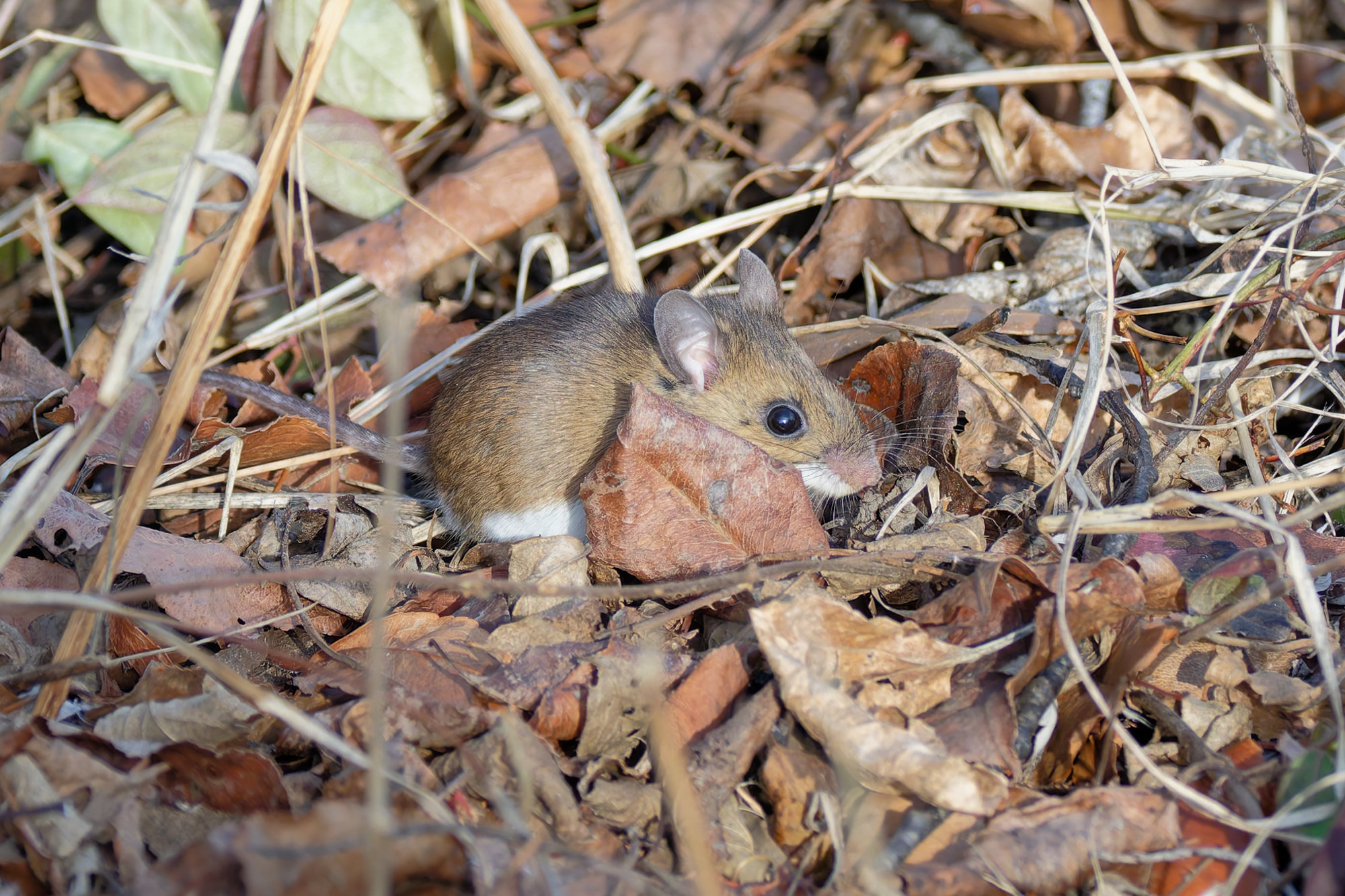
Photo Corey Farwell (opens in a new tab) / iNaturalist, CC BY 4.0 (opens in a new tab)
At a glance
- Size
- Body about 9 to 10 cm; tail about 7 to 9 cm
- Weight
- About 15 to 25 g
- Habitat
- Forests, woodland edges, brushy fields, stone walls and outbuildings
- Diet
- Seeds, nuts, fruit, fungi, insects, caterpillars and snails
- Active
- Night
- Shelter
- Nests in tree cavities, logs, stone walls, old bird nests and buildings
- Lifespan
- Usually less than a year in the wild
- Rabies vector
- No
Identification
- Key marks
- Brown back and sides; white belly and white feet; large, dark eyes and large ears; tail shorter than the body, dark above and pale below
- Told apart from
- House mouse, which is plain grey-brown with a scaly, uniformly coloured tail
- Told apart from
- Eastern deer mouse, which is very similar but usually has a longer, more sharply two-coloured tail
- Told apart from
- Cotton mouse, which is larger
- Where to look
- Woodpiles, sheds and forest floors at night; caches of seeds and nutshells in hidden places
Behaviour
White-footed mice are agile climbers that forage both on the ground and in trees at night. They store seeds and nuts in hidden caches, and often use old bird nests as feeding platforms or roof them over as nests of their own.
In cold weather they may enter a daily torpor, lowering their body temperature to save energy, and several may share a nest.
Why they matter
White-footed mice are one of the most important small animals in eastern forests. They eat and bury tree seeds, eat large numbers of moth pupae — including those of the spongy moth, a serious forest pest — and feed owls, foxes, weasels and snakes.
They are also a main host for the ticks that spread Lyme disease, which has made them central to research on how forests, mice, ticks and people are linked.
Reproduction and lifecycle
Breeding — spring to autumn, and in winter in the South
Gestation — about 22 to 25 days
Litter — usually two to six young
Eyes open — at about two weeks old
Weaning — at about three weeks old
Maturity — at about six to eight weeks old
Lifespan — usually less than a year in the wild
Living around people
- White-footed mice sometimes enter cabins and sheds in autumn; sealing gaps keeps them out.
- Like other wild rodents, they can carry diseases, including hantaviruses; clean up droppings wet, with gloves and ventilation, rather than sweeping.
- Glue traps and poisons cause slow deaths and poison the owls and foxes that eat mice.
- A nest of young mice found in a shed can often be left until they leave in a few weeks.
Misconceptions
- All mice in a shed are house mice. In the country many are native white-footed mice.
- Mice only cause problems. In forests they plant trees and eat pest insects.
- Poison is the tidy solution. Poisoned mice are eaten by owls, hawks, cats and foxes, which are poisoned in turn.
Related species
Seasonal activity
When this species is breeding, and when there are nests on the ground. Mowing during the shaded months is how most nests are found.
| Jan | Feb | Mar | Apr | May | Jun | Jul | Aug | Sep | Oct | Nov | Dec | |
|---|---|---|---|---|---|---|---|---|---|---|---|---|
| Breeding | Jan: no | Feb: no | Mar: no | Apr: no | May: no | Jun: no | Jul: no | Aug: no | Sep: no | Oct: no | Nov: no | Dec: no |
| Active nests | Jan: no | Feb: no | Mar: no | Apr: no | May: no | Jun: no | Jul: no | Aug: no | Sep: no | Oct: no | Nov: no | Dec: no |
| Notes | Active; several may share a nest in cold weather | Active on stored food | Breeding begins | First litters | Young leave the nest at about three weeks old | Breeding continues | Breeding slows in summer heat in the South | Breeding resumes | Autumn litters; caching seeds | Caching nuts and seeds | Some move into outbuildings | Active on stored food |
Where it lives
Recorded in 64 states and provinces. Each one links to the other animals there, and to the rehabilitators licensed for them.
United States
- Alabama
- Arizona
- Arkansas
- Colorado
- Connecticut
- Delaware
- District of Columbia
- Florida
- Georgia
- Illinois
- Indiana
- Iowa
- Kansas
- Kentucky
- Louisiana
- Maine
- Maryland
- Massachusetts
- Michigan
- Minnesota
- Mississippi
- Missouri
- Montana
- Nebraska
- New Hampshire
- New Jersey
- New Mexico
- New York
- North Carolina
- North Dakota
- Ohio
- Oklahoma
- Pennsylvania
- Rhode Island
- South Carolina
- South Dakota
- Tennessee
- Texas
- Vermont
- Virginia
- West Virginia
- Wisconsin
- Wyoming
If you found one
Answer a few questions and you will get a specific answer for what you are looking at.
I found an animal