
Species
Northern long-eared bat
Myotis septentrionalis
A small, long-eared forest bat that picks insects off leaves, and is now endangered.
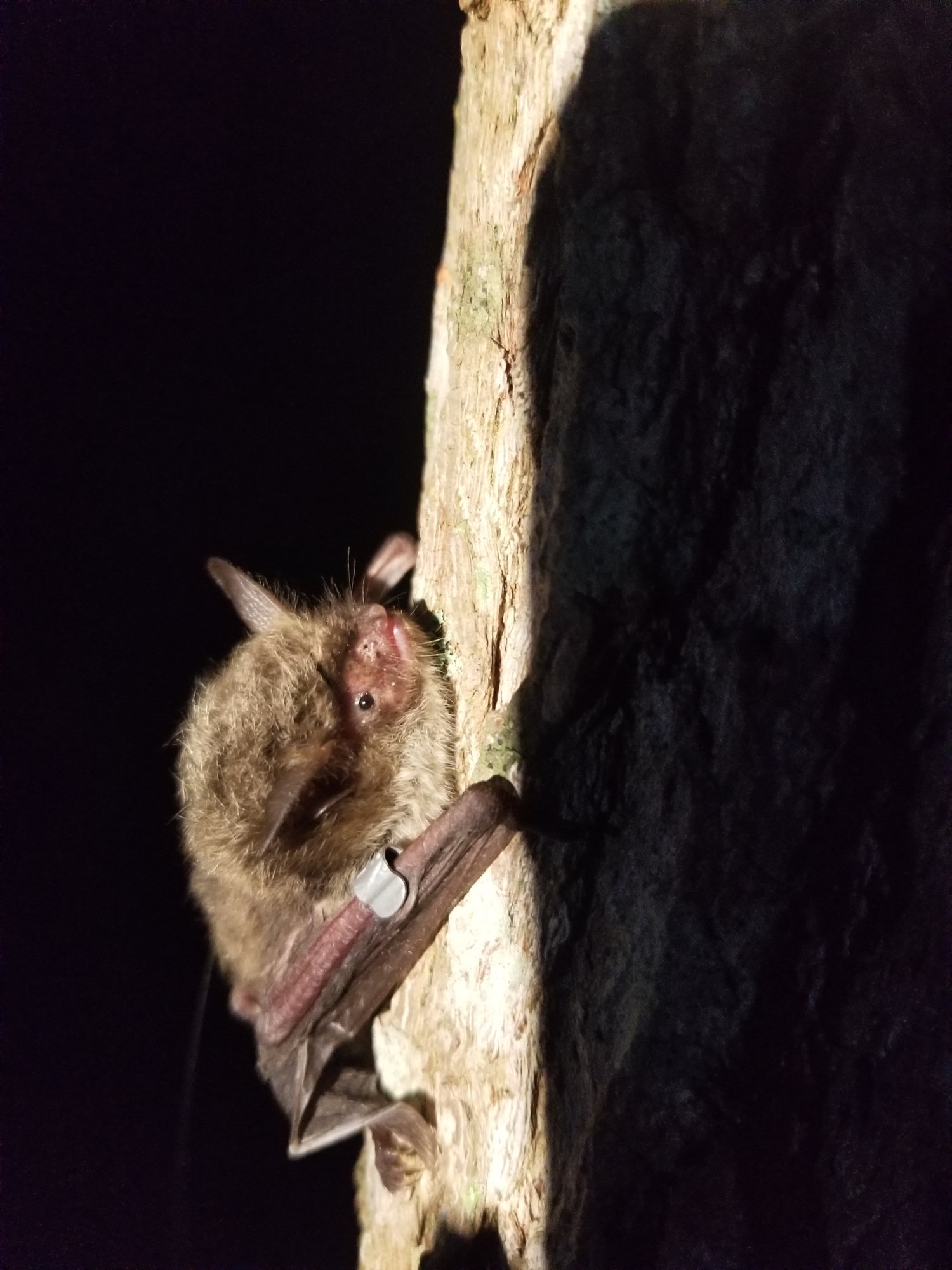
Photo otiegoat (opens in a new tab) / iNaturalist, CC BY 4.0 (opens in a new tab)
At a glance
- Size
- Body about 8 to 10 cm; ears about 1.7 cm
- Weight
- About 5 to 9 g
- Habitat
- Mature forests; caves and mines in winter
- Diet
- Moths, beetles, flies and spiders, often picked from leaves
- Active
- Night
- Roost
- Under loose bark and in cavities of live and dead trees; caves and mines in winter
- Status
- Listed as endangered in the United States since 2023
- Rabies vector
- Yes
Identification
- Key marks
- Dull brown fur; long ears that reach past the tip of the nose when laid forward; long, pointed tragus
- Told apart from
- Little brown bat, which has shorter ears and glossier fur
- Told apart from
- Rafinesque's big-eared bat, whose ears are far larger
- Where to look
- Under loose bark in forest by day; hibernating singly in crevices in caves and mines
Behaviour
Northern long-eared bats are forest specialists. They hunt beneath the canopy, often by "gleaning" — hovering to pick insects and spiders off leaves and bark — which their long ears help them do by hearing the faint sounds of prey.
In summer they roost under loose bark and in the cracks and cavities of trees, moving between several roost trees. In winter they hibernate in caves and mines, usually alone and tucked into crevices.
In Georgia they occur mainly in the north, with some records farther south.
Why they matter
By gleaning, northern long-eared bats take insects that other bats miss — caterpillars and moths resting on leaves — and they depend on the kind of mature, varied forest that supports many other species.
White-nose syndrome has devastated this bat. It was listed as threatened in 2015 and, as declines continued, reclassified as endangered, one of the fastest collapses of a once-widespread North American mammal.
Reproduction and lifecycle
Mating — autumn at hibernation sites; fertilisation delayed until spring
Birth — June and July, a single pup
Flight — at about three weeks old
Independence — by late summer
Lifespan — up to about 18 years has been recorded
Living around people
- Standing dead trees with loose bark are roosts; leave them where it is safe to do so.
- Tree cutting in summer can kill mothers and pups roosting under bark.
- Stay out of caves and mines where bats hibernate, and clean gear to slow white-nose syndrome.
- Never handle a bat with bare hands; bats are rabies vector species.
Misconceptions
- Dead trees are worthless and unsafe. Many are nurseries for this endangered bat.
- A bat hunting close to leaves is lost. Gleaning is how this species hunts.
- Bats will always be common. This one went from widespread to endangered in little more than a decade.
Related species
Seasonal activity
When this species is breeding, and when there are nests on the ground. Mowing during the shaded months is how most nests are found.
| Jan | Feb | Mar | Apr | May | Jun | Jul | Aug | Sep | Oct | Nov | Dec | |
|---|---|---|---|---|---|---|---|---|---|---|---|---|
| Breeding | Jan: no | Feb: no | Mar: no | Apr: no | May: no | Jun: no | Jul: no | Aug: no | Sep: no | Oct: no | Nov: no | Dec: no |
| Active nests | Jan: no | Feb: no | Mar: no | Apr: no | May: no | Jun: no | Jul: no | Aug: no | Sep: no | Oct: no | Nov: no | Dec: no |
| Notes | Hibernating in caves and mines | Hibernation continues | Emerging from hibernation | Moving to summer forest roosts | Females gather in small maternity colonies in trees | Pups are born, one per female | Young begin to fly at about three weeks old | Young are independent | Swarming and mating at caves and mines | Entering hibernation | Hibernating | Hibernating |
Where it lives
Recorded in 48 states and provinces. Each one links to the other animals there, and to the rehabilitators licensed for them.
Treated as a rabies-vector species in Alabama, Arkansas, Connecticut, District of Columbia, Florida, Georgia, Illinois, Indiana, Iowa, Kansas, Kentucky, Louisiana, Maine, Maryland, Massachusetts, Michigan, Minnesota, Mississippi, Missouri, Montana, Nebraska, New Hampshire, New Jersey, New York, North Carolina, North Dakota, Ohio, Oklahoma, Pennsylvania, South Carolina, South Dakota, Tennessee, Vermont, Virginia, West Virginia, Wisconsin, Wyoming, Alberta, British Columbia, Manitoba, New Brunswick, Newfoundland and Labrador, Northwest Territories, Nova Scotia, Ontario, Prince Edward Island, Quebec and Saskatchewan. There, only a certified rehabilitator may take one.
United States
- Alabama
- Arkansas
- Connecticut
- District of Columbia
- Florida
- Georgia
- Illinois
- Indiana
- Iowa
- Kansas
- Kentucky
- Louisiana
- Maine
- Maryland
- Massachusetts
- Michigan
- Minnesota
- Mississippi
- Missouri
- Montana
- Nebraska
- New Hampshire
- New Jersey
- New York
- North Carolina
- North Dakota
- Ohio
- Oklahoma
- Pennsylvania
- South Carolina
- South Dakota
- Tennessee
- Vermont
- Virginia
- West Virginia
- Wisconsin
- Wyoming
If you found one
Answer a few questions and you will get a specific answer for what you are looking at.
I found an animal