
Species
Indiana bat
Myotis sodalis
An endangered bat that hibernates packed in dense clusters on the walls of a few cold caves.
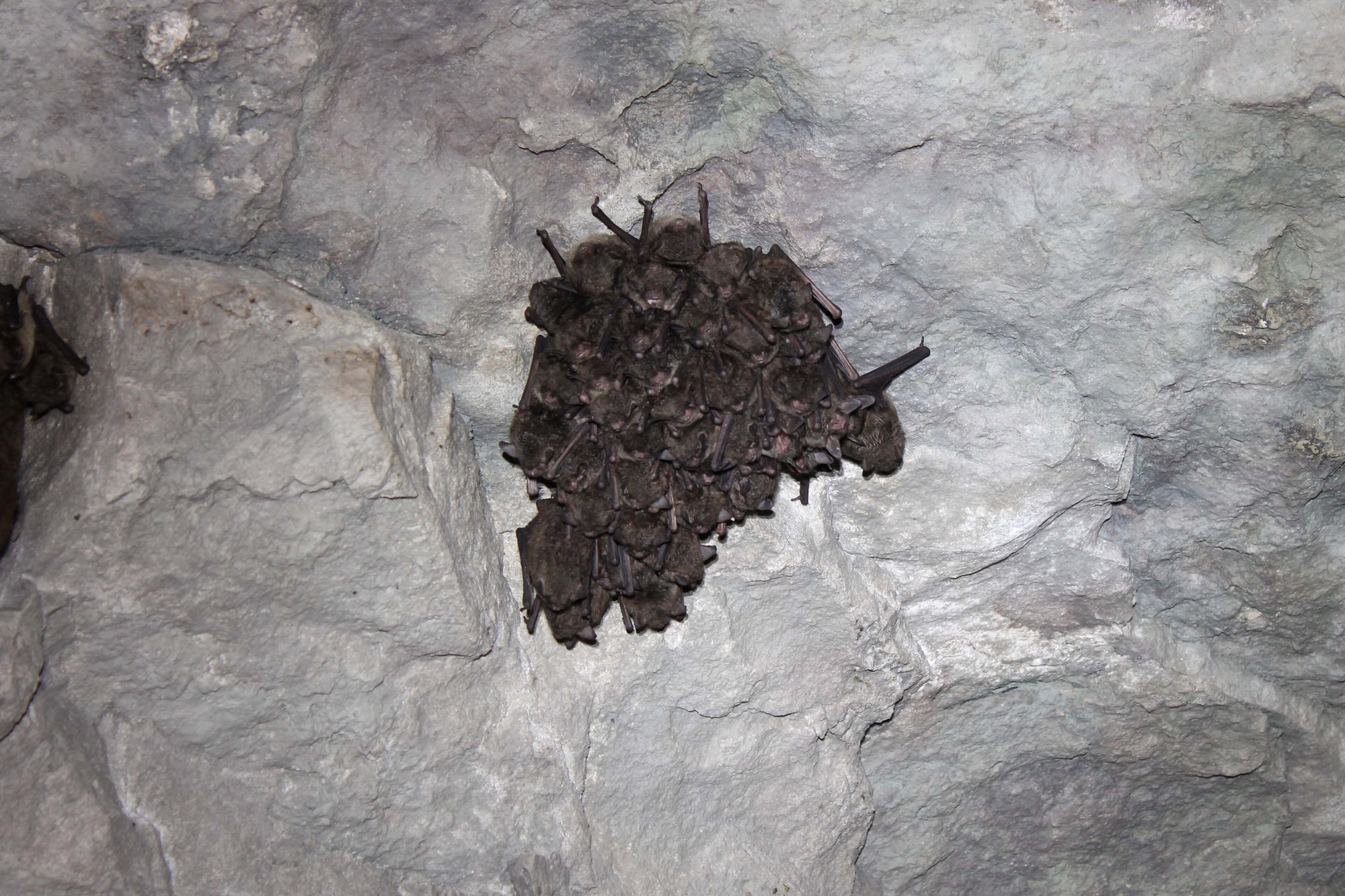
Photo USFWSmidwest (opens in a new tab) / Wikimedia Commons, Public domain (opens in a new tab)
At a glance
- Size
- Body about 7 to 9 cm; wingspan about 24 to 27 cm
- Weight
- About 6 to 9 g
- Habitat
- Forests and wooded stream corridors in summer; cold caves and mines in winter
- Diet
- Moths, beetles, flies and other flying insects
- Active
- Night
- Roost
- Under the loose bark of dead and dying trees in summer; tightly packed clusters in caves in winter
- Status
- Endangered in the United States since 1967
- Rabies vector
- Yes
Identification
- Key marks
- Dull greyish-brown fur; pinkish lips and nose; short, sparse toe hairs; a keel on the spur that supports the tail membrane
- Told apart from
- Little brown bat, which is glossier with long toe hairs
- Told apart from
- Gray bat, which is larger and uniformly grey
- Where to look
- Almost never seen outside hibernation caves, where it clusters in dense groups
Behaviour
Indiana bats hibernate in large, tightly packed clusters on cave ceilings, choosing a small number of caves and mines with just the right cold, stable temperatures. Most of the species spends the winter in only a few places.
In summer females form maternity colonies under the loose bark of dead or dying trees, often in forest near streams, and move between several roost trees. They hunt among the trees and along forest edges.
In Georgia they are known from only a few sites in the northwest.
Why they matter
The Indiana bat was among the first animals listed as endangered in the United States, in 1967, because so much of its population depended on so few caves. What happened in those caves — disturbance, then white-nose syndrome — decided the fate of the whole species.
Protecting it has meant protecting caves and the forests around them, which benefits many other animals too.
Reproduction and lifecycle
Mating — autumn at hibernation caves; fertilisation delayed until spring
Birth — June and early July, a single pup
Flight — at about three to four weeks old
Independence — by late summer
Lifespan — up to about 14 years has been recorded
Living around people
- Stay out of caves and mines where bats hibernate; waking a cluster costs every bat in it energy it cannot spare.
- Dead trees with peeling bark near streams are summer nurseries.
- Clean caving gear between sites to slow white-nose syndrome.
- Never handle a bat with bare hands; bats are rabies vector species.
Misconceptions
- One cave does not matter. For this bat a single cave can hold a large share of the whole species.
- Bats in a cluster are sick. Clustering is how Indiana bats hibernate.
- Endangered animals are only found in remote places. Indiana bats raise their young in ordinary farm woodlots and stream corridors.
Related species
Seasonal activity
When this species is breeding, and when there are nests on the ground. Mowing during the shaded months is how most nests are found.
| Jan | Feb | Mar | Apr | May | Jun | Jul | Aug | Sep | Oct | Nov | Dec | |
|---|---|---|---|---|---|---|---|---|---|---|---|---|
| Breeding | Jan: no | Feb: no | Mar: no | Apr: no | May: no | Jun: no | Jul: no | Aug: no | Sep: no | Oct: no | Nov: no | Dec: no |
| Active nests | Jan: no | Feb: no | Mar: no | Apr: no | May: no | Jun: no | Jul: no | Aug: no | Sep: no | Oct: no | Nov: no | Dec: no |
| Notes | Hibernating in dense clusters | Hibernation continues | Emerging from hibernation | Females travel to summer forest roosts | Maternity colonies form under loose bark | Pups are born, one per female | Young begin to fly at about three to four weeks old | Young are independent | Swarming and mating at hibernation caves | Entering hibernation | Hibernating | Hibernating |
Where it lives
Recorded in 19 states and provinces. Each one links to the other animals there, and to the rehabilitators licensed for them.
Treated as a rabies-vector species in Alabama, Arkansas, Georgia, Illinois, Indiana, Iowa, Kentucky, Maryland, Michigan, Missouri, New Jersey, New York, North Carolina, Ohio, Pennsylvania, Tennessee, Vermont, Virginia and West Virginia. There, only a certified rehabilitator may take one.
If you found one
Answer a few questions and you will get a specific answer for what you are looking at.
I found an animal