
Species
Gray bat
Myotis grisescens
An endangered cave bat that lives in caves all year and hunts over rivers and lakes.
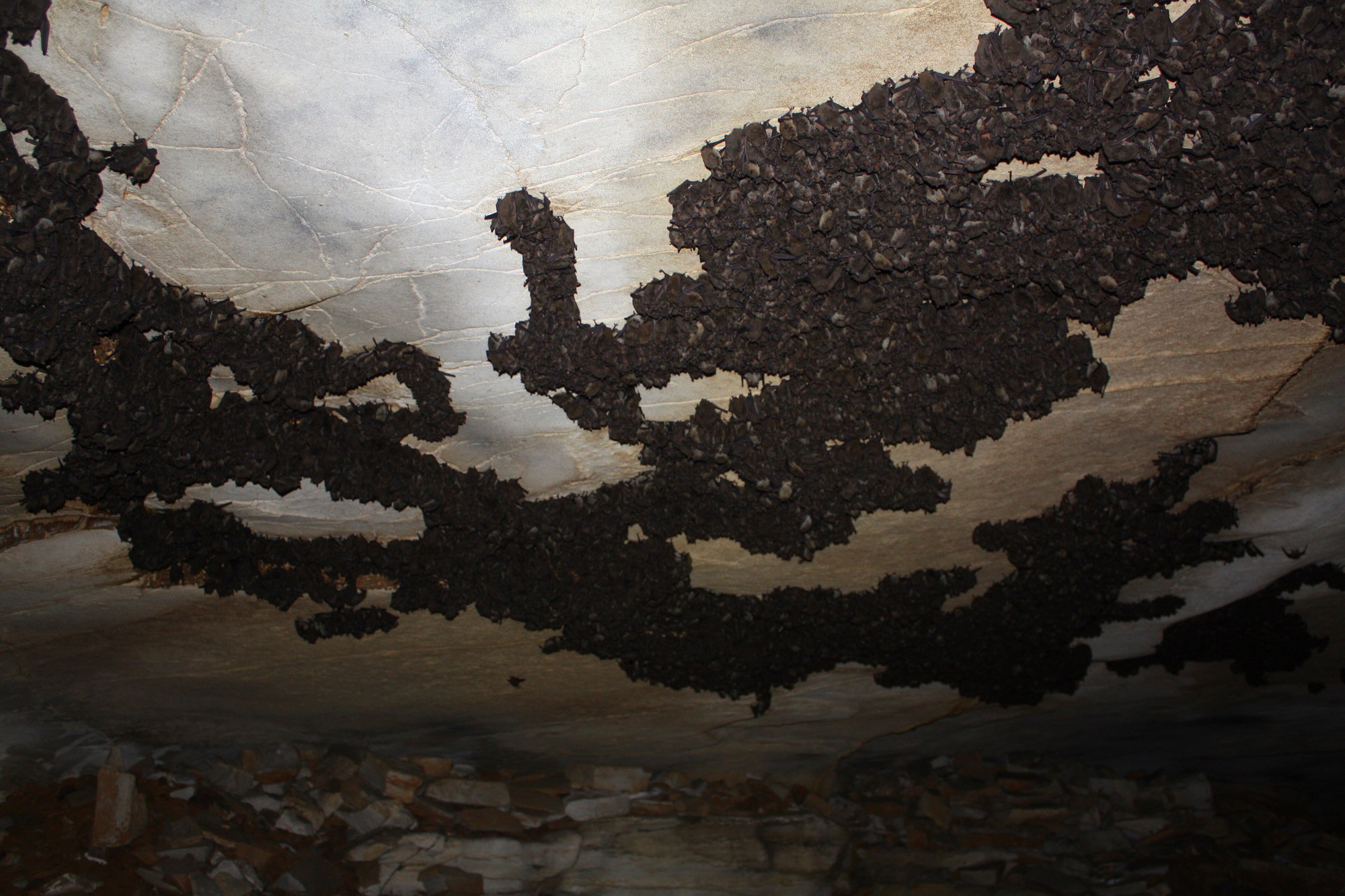
Photo Larisa Bishop-Boros (opens in a new tab) / Wikimedia Commons, CC BY-SA 3.0 (opens in a new tab)
At a glance
- Size
- Body about 8 to 10 cm; wingspan about 27 to 30 cm
- Weight
- About 7 to 16 g
- Habitat
- Limestone cave country near rivers and reservoirs
- Diet
- Mayflies, caddisflies, stoneflies, moths, beetles and other insects caught over water
- Active
- Night
- Roost
- Caves year-round, hibernating in only a small number of cold caves
- Status
- Endangered in the United States since 1976
- Rabies vector
- Yes
Identification
- Key marks
- The largest myotis bat in the East; uniformly grey fur, each hair the same colour from base to tip; the wing joins the ankle rather than the base of the toes
- Told apart from
- Little brown bat and Indiana bat, whose hairs are two-toned and whose wings attach at the toes
- Where to look
- Only in caves; outside them, hunting low over rivers and reservoirs at dusk
Behaviour
Gray bats live in caves all year. In summer, females form large maternity colonies in warm caves, and males and young gather in others. In winter the whole population concentrates in a small number of deep, cold caves to hibernate, packed together on the ceilings.
Each night they fly along wooded corridors to rivers and reservoirs, sometimes many kilometres away, and hunt low over the water for emerging aquatic insects.
In Georgia they occur only in the limestone caves of the northwest.
Why they matter
Gray bats connect underground and river life. The insects they eat hatch from the water, and the nutrients they carry back to their caves in their droppings feed cave ecosystems of invertebrates and other animals that live nowhere else.
Their story is also one of recovery. After their caves were gated and protected, many colonies grew, showing that bats can come back when people leave them alone.
Reproduction and lifecycle
Mating — autumn, at hibernation caves; sperm is stored over winter
Birth — late May and June, a single pup
Flight — at about three to four weeks old
Independence — by midsummer
Lifespan — up to about 15 years or more has been recorded
Living around people
- Stay out of caves with closure signs or gates; disturbing a hibernating or nursing colony can kill thousands of bats.
- Clean caving gear between caves to slow the spread of white-nose syndrome.
- Clear, healthy rivers and wooded stream banks provide their food and flight paths.
- Never handle a bat with bare hands; bats are rabies vector species.
Misconceptions
- Cave gates are there to keep people out for no reason. They protect bat colonies that are among the last of their kind.
- A cave full of bats is dangerous. The danger is to the bats, from disturbance.
- Endangered species cannot recover. Gray bat numbers rose in many places once their caves were protected.
Related species
Seasonal activity
When this species is breeding, and when there are nests on the ground. Mowing during the shaded months is how most nests are found.
| Jan | Feb | Mar | Apr | May | Jun | Jul | Aug | Sep | Oct | Nov | Dec | |
|---|---|---|---|---|---|---|---|---|---|---|---|---|
| Breeding | Jan: no | Feb: no | Mar: no | Apr: no | May: no | Jun: no | Jul: no | Aug: no | Sep: no | Oct: no | Nov: no | Dec: no |
| Active nests | Jan: no | Feb: no | Mar: no | Apr: no | May: no | Jun: no | Jul: no | Aug: no | Sep: no | Oct: no | Nov: no | Dec: no |
| Notes | Hibernating in cold caves | Hibernation continues | Emerging and moving toward summer caves | Females gather in warm maternity caves; pregnancy follows fertilisation from autumn mating | Maternity colonies at full size | Pups are born, one per female | Young begin to fly at about three to four weeks old | Young are independent; bats feed heavily over water | Bats move toward hibernation caves; mating takes place at the entrances | Mating continues; hibernation begins | Hibernating | Hibernating |
Where it lives
Recorded in 14 states and provinces. Each one links to the other animals there, and to the rehabilitators licensed for them.
Treated as a rabies-vector species in Alabama, Arkansas, Florida, Georgia, Illinois, Indiana, Kansas, Kentucky, Mississippi, Missouri, North Carolina, Oklahoma, Tennessee and Virginia. There, only a certified rehabilitator may take one.
If you found one
Answer a few questions and you will get a specific answer for what you are looking at.
I found an animal