
Species
Eastern red bat
Lasiurus borealis
A solitary, rust-red bat that spends the day hanging in the leaves like a dead leaf itself.
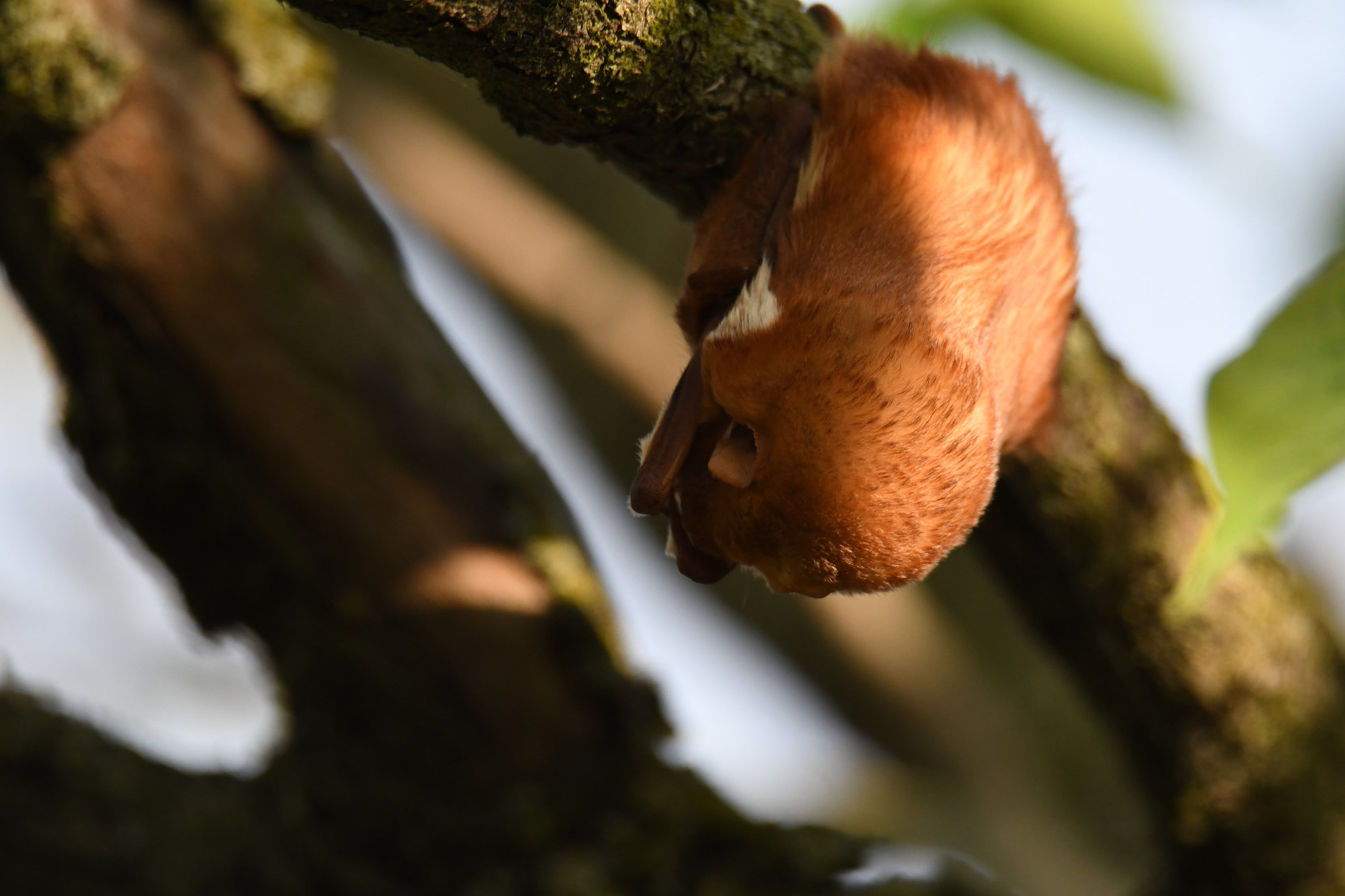
Photo lwolfartist (opens in a new tab) / Wikimedia Commons, CC BY 2.0 (opens in a new tab)
At a glance
- Size
- Body about 10 cm; wingspan about 28 to 33 cm
- Weight
- About 7 to 16 g
- Habitat
- Forests, wooded neighbourhoods, parks and farmland with trees
- Diet
- Moths above all, with beetles, flies, leafhoppers and other night-flying insects
- Active
- Night, from dusk; also on mild winter evenings
- Roost
- Alone in the foliage of trees and shrubs, hanging by one foot
- Young
- One to four pups, more than almost any other bat
- Rabies vector
- Yes
Identification
- Key marks
- Bright orange-red to brick-red fur, frosted white on the back; a white patch on each shoulder; short rounded ears
- Males and females
- Males are the brighter red; females are duller and more heavily frosted
- Tail membrane
- Thickly furred on top, used as a blanket when the bat wraps itself up to sleep
- Told apart from
- Seminole bat, which is a deeper mahogany red with less white frosting and lives mainly in the coastal plain
- Told apart from
- Hoary bat, which is larger, brown frosted with silver, and has a yellowish throat
- Where to look
- Hanging in the leaves of shrubs and trees by day, often low enough to see from a path
Behaviour
Eastern red bats roost alone in the canopy of trees and shrubs, never in caves and rarely in buildings. Hanging from a leaf stalk by one foot, wrapped in their furred tail membrane, they look so much like a dead leaf or a pine cone that most people walk past them.
They hunt in the open: over fields, along forest edges, around street lights, and above treetops, taking moths and other insects in flight. Each bat patrols a regular route and often returns to the same feeding area night after night.
Many red bats in the north migrate south for the winter, and in the Southeast they are present all year. In cold weather some hibernate in the leaf litter on the forest floor, which is why they are sometimes found on the ground in winter and early spring, and why fire and leaf blowers can disturb them.
Why they matter
A single eastern red bat can eat a large share of its body weight in insects on a summer night, and moths — including the adults of caterpillars that feed on crops and trees — are the main part of that. Across a landscape, tree bats like this one take a great many insects that nothing else is hunting at that hour.
They are also one of the few bats that regularly raise more than one young at once. A mother red bat carries litters of up to four pups, and has four nipples to feed them, where most North American bats have a single pup a year.
Reproduction and lifecycle
Mating — late summer and autumn, often in flight; the female stores sperm through the winter
Fertilisation — in spring, once she emerges from winter torpor
Gestation — about 80 to 90 days after fertilisation
Birth — late May to early July, litters of one to four pups
Nursing — pups cling to their mother at first, then are left hanging in the roost while she feeds
Flight — at three to six weeks old
Independence — by about five to six weeks, in mid-summer
Lifespan — not well recorded in the wild; a few years is typical for tree bats
Living around people
- Look before you trim: red bats roost in ornamental shrubs, hedges and fruit trees, and hedge cutting in summer can drop mothers and pups to the ground.
- Leaf blowers and yard fires in winter can disturb bats sheltering in leaf litter.
- Cats kill many red bats that roost low in shrubs; keeping cats indoors helps.
- A red bat on the ground in daylight is in trouble and should not be touched with bare hands; bats are rabies vector species, even though most individual bats are not rabid.
- Wind turbines kill large numbers of migrating tree bats, including this species.
Misconceptions
- A bat on the ground is healthy and will fly away if left. A grounded red bat is usually cold, injured, exhausted or a pup that has fallen, and it may die where it lies; it needs a licensed wildlife rehabilitator, and nobody should pick it up with bare hands.
- All bats live in caves. Red bats almost never enter caves; they live their whole lives among leaves.
- Bats get tangled in people's hair. Bats fly with great precision and have no interest in hair; a bat swooping close is catching an insect.
- A bat hanging in a shrub by day must be sick. Red bats sleep in the open like this by design, and a healthy one is best left alone.
Related species
Seasonal activity
When this species is breeding, and when there are nests on the ground. Mowing during the shaded months is how most nests are found.
| Jan | Feb | Mar | Apr | May | Jun | Jul | Aug | Sep | Oct | Nov | Dec | |
|---|---|---|---|---|---|---|---|---|---|---|---|---|
| Breeding | Jan: no | Feb: no | Mar: no | Apr: no | May: no | Jun: no | Jul: no | Aug: no | Sep: no | Oct: no | Nov: no | Dec: no |
| Active nests | Jan: no | Feb: no | Mar: no | Apr: no | May: no | Jun: no | Jul: no | Aug: no | Sep: no | Oct: no | Nov: no | Dec: no |
| Notes | Resident in the South; torpid in the leaf litter on cold days and active on mild evenings | Mostly inactive in cold weather; may forage on warm nights | Activity increases; northern migrants begin moving back north | Females settle into summer roosts; pregnancy continues from sperm stored since the autumn | Pups are born, from May in the South to June farther north | Mothers roost with their pups in the foliage, leaving them to hunt at night | Young begin to fly at three to six weeks old | Young are independent; mating begins, often in flight | Mating continues; northern bats start migrating south | Migration peaks; many bats pass through the Southeast | Migrants arrive in southern wintering areas | Active on warm nights, torpid on cold ones; some shelter in leaf litter |
Where it lives
Recorded in 52 states and provinces. Each one links to the other animals there, and to the rehabilitators licensed for them.
Treated as a rabies-vector species in Alabama, Arkansas, Colorado, Connecticut, Delaware, District of Columbia, Florida, Georgia, Illinois, Indiana, Iowa, Kansas, Kentucky, Louisiana, Maine, Maryland, Massachusetts, Michigan, Minnesota, Mississippi, Missouri, Montana, Nebraska, New Hampshire, New Jersey, New Mexico, New York, North Carolina, North Dakota, Ohio, Oklahoma, Pennsylvania, Rhode Island, South Carolina, South Dakota, Tennessee, Texas, Vermont, Virginia, West Virginia, Wisconsin, Wyoming, Alberta, Manitoba, New Brunswick, Nova Scotia, Ontario, Quebec, Saskatchewan, Coahuila, Nuevo Leon and Tamaulipas. There, only a certified rehabilitator may take one.
United States
- Alabama
- Arkansas
- Colorado
- Connecticut
- Delaware
- District of Columbia
- Florida
- Georgia
- Illinois
- Indiana
- Iowa
- Kansas
- Kentucky
- Louisiana
- Maine
- Maryland
- Massachusetts
- Michigan
- Minnesota
- Mississippi
- Missouri
- Montana
- Nebraska
- New Hampshire
- New Jersey
- New Mexico
- New York
- North Carolina
- North Dakota
- Ohio
- Oklahoma
- Pennsylvania
- Rhode Island
- South Carolina
- South Dakota
- Tennessee
- Texas
- Vermont
- Virginia
- West Virginia
- Wisconsin
- Wyoming
If you found one
Answer a few questions and you will get a specific answer for what you are looking at.
I found an animal