
Species
Seminole bat
Lasiurus seminolus
A deep mahogany-red bat of the southern coastal plain that sleeps hidden in Spanish moss.
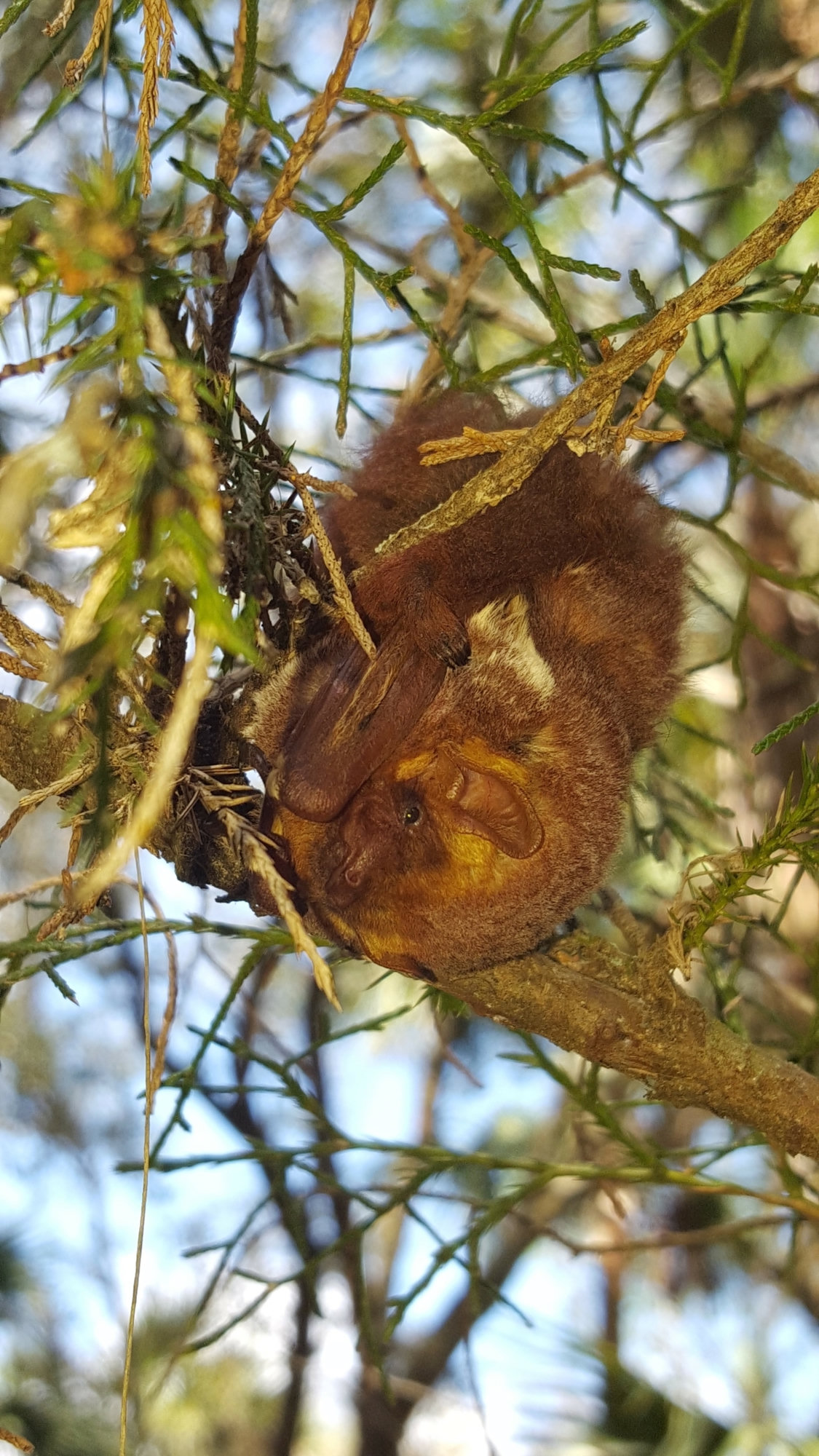
Photo Michelle Sevcovas (opens in a new tab) / iNaturalist, CC BY 4.0 (opens in a new tab)
At a glance
- Size
- Body about 10 cm; wingspan about 30 cm
- Weight
- About 7 to 14 g
- Habitat
- Pine forests, mixed woods, swamps and wooded neighbourhoods of the southern coastal plain
- Diet
- Moths, beetles, flies, leafhoppers and other flying insects
- Active
- Night, and on mild winter evenings
- Roost
- Alone in Spanish moss, pine needles and the leaves of trees
- Young
- Usually three or four pups
- Rabies vector
- Yes
Identification
- Key marks
- Rich mahogany or chestnut-red fur with light white frosting; furred tail membrane; short rounded ears
- Size
- Much like an eastern red bat
- Told apart from
- Eastern red bat, which is brighter orange-red, more heavily frosted, and more widespread
- Told apart from
- Northern yellow bat, which is yellowish-brown and larger
- Where to look
- Clumps of Spanish moss and the foliage of pines and oaks, a few metres above the ground
Behaviour
Seminole bats are tree bats of the Deep South. They roost alone in foliage, and in much of their range they choose Spanish moss, tucking themselves into a hanging clump where they are almost impossible to see. They also use pine needles and the leaves of oaks and sweetgums.
They feed early in the evening over clearings, along forest edges, above water and over the canopy, catching insects in flight. In the coastal plain they are active all year, flying on any evening warm enough for insects.
Some wander north in late summer and autumn, which is why they are occasionally found far outside their breeding range.
Why they matter
Seminole bats are part of the night shift that keeps southern insect numbers in check, feeding on moths and beetles over the pinewoods and swamps where the bats live all year round.
Their dependence on Spanish moss links them to the old live oaks and cypress where the moss hangs thickest. Where moss-draped trees are cleared, the bats lose the places they sleep.
Reproduction and lifecycle
Mating — autumn; sperm is stored until spring
Gestation — about 80 to 90 days after fertilisation in spring
Birth — late May and June, usually three or four pups
Nursing — pups are carried at first, then left in the roost while their mother feeds
Flight — at about three to four weeks old
Independence — by mid-summer
Lifespan — not well recorded in the wild
Living around people
- Spanish moss removal and tree trimming in spring and summer can drop mothers and pups; check moss clumps before cutting.
- Cats catch bats roosting low in shrubs and moss.
- A Seminole bat on the ground in daylight needs help and should not be handled with bare hands; bats are rabies vector species.
- Mature trees with moss in yards and parks give these bats a place to sleep.
Misconceptions
- Spanish moss is a pest to be pulled out of trees. It harms nothing and is a nursery for Seminole bats and many insects; removing it in summer can kill a whole litter.
- A bat found in the moss by day is sick. Seminole bats sleep in moss by choice and are best left alone.
- Red bats are all the same animal. The Seminole bat is its own species, darker and more southern than the eastern red bat.
Related species
Seasonal activity
When this species is breeding, and when there are nests on the ground. Mowing during the shaded months is how most nests are found.
| Jan | Feb | Mar | Apr | May | Jun | Jul | Aug | Sep | Oct | Nov | Dec | |
|---|---|---|---|---|---|---|---|---|---|---|---|---|
| Breeding | Jan: no | Feb: no | Mar: no | Apr: no | May: no | Jun: no | Jul: no | Aug: no | Sep: no | Oct: no | Nov: no | Dec: no |
| Active nests | Jan: no | Feb: no | Mar: no | Apr: no | May: no | Jun: no | Jul: no | Aug: no | Sep: no | Oct: no | Nov: no | Dec: no |
| Notes | Active on warm evenings; torpid through cold spells in moss or leaf litter | Activity rises with temperatures; females are pregnant from stored sperm | Regular evening foraging resumes | Females settle into maternity roosts in foliage | Pups are born, often three or four in a litter | Mothers leave pups hanging in the roost while they hunt | Young begin flying at about three to four weeks old | Young are independent; some bats wander north | Mating begins | Mating continues; wanderers return south | Active on mild nights as insects allow | Active on warm evenings; torpid on cold ones |
Where it lives
Recorded in 9 states and provinces. Each one links to the other animals there, and to the rehabilitators licensed for them.
Treated as a rabies-vector species in Alabama, Arkansas, Florida, Georgia, Louisiana, Mississippi, North Carolina, South Carolina and Texas. There, only a certified rehabilitator may take one.
If you found one
Answer a few questions and you will get a specific answer for what you are looking at.
I found an animal