
Species
Eastern mole
Scalopus aquaticus
A velvet-furred digger with shovel hands that eats earthworms and grubs, not plant roots.
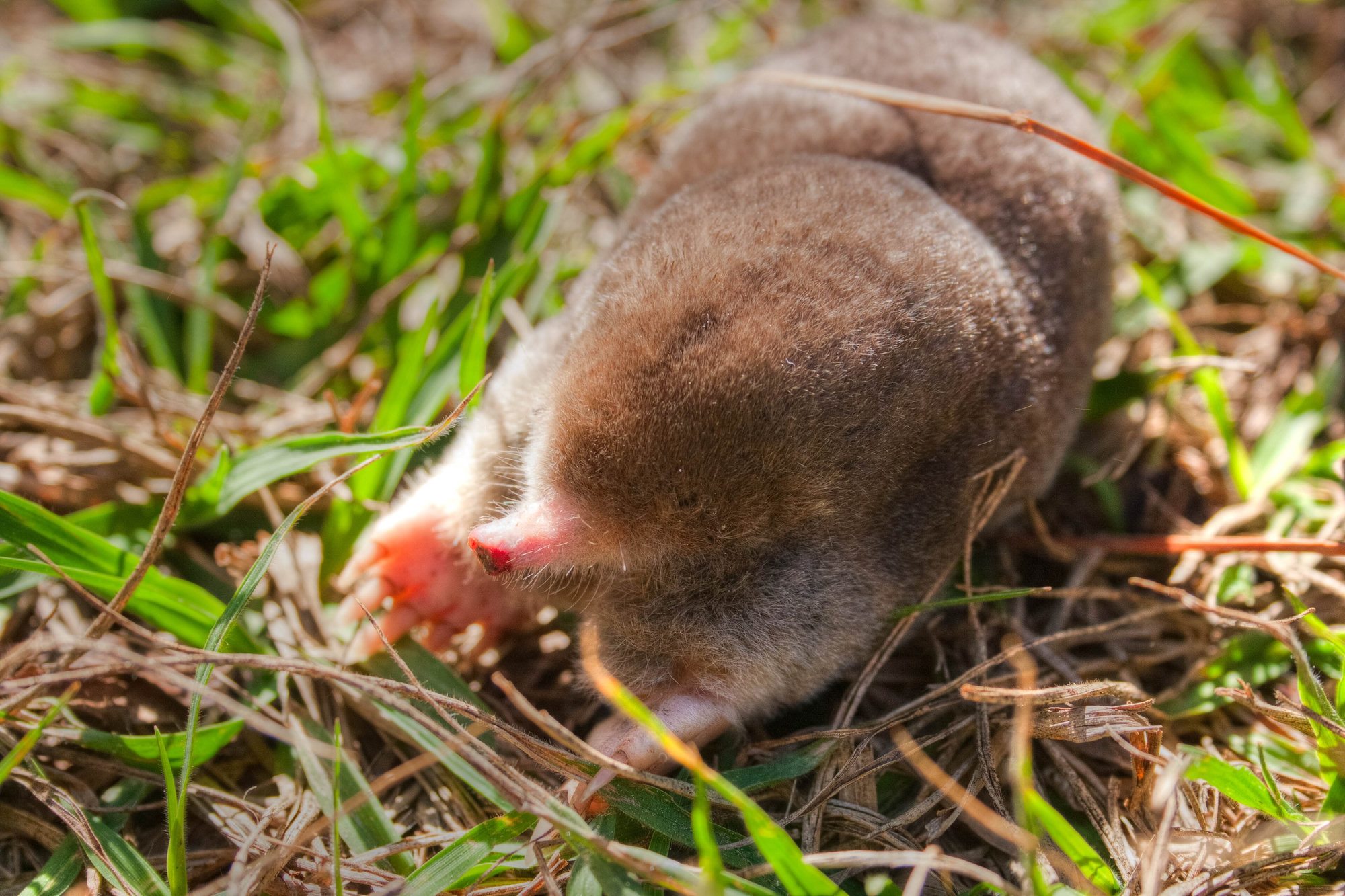
Photo Bert Cash from Brunswick , USA (opens in a new tab) / Wikimedia Commons, CC BY 2.0 (opens in a new tab)
At a glance
- Size
- Body about 13 to 17 cm; tail about 2.5 cm
- Weight
- About 40 to 140 g
- Habitat
- Lawns, fields, gardens and open woods with moist, loose soil
- Diet
- Earthworms, beetle grubs, insect larvae and other soil invertebrates
- Active
- Day and night, all year, underground
- Shelter
- Tunnels: shallow feeding runs and deeper permanent galleries
- Lifespan
- Several years
- Rabies vector
- No
Identification
- Key marks
- Short, velvety grey-brown fur; huge, broad, pink forefeet turned outwards with strong claws; pointed pink snout; no visible eyes or ears; short, nearly bare tail
- Signs
- Raised ridges across lawns and occasional small volcano-shaped mounds of soil
- Told apart from
- Voles, which have visible eyes and ears and leave open holes and surface runways
- Told apart from
- Star-nosed mole, which has a star of pink tentacles on its nose and a long tail
- Where to look
- Almost never above ground; its ridges and mounds are the usual sign
Behaviour
Eastern moles live nearly their whole lives underground. They dig shallow feeding tunnels just under the surface — the ridges seen in lawns — and deeper permanent tunnels where they rest and nest. They can dig several metres of shallow tunnel in an hour in soft soil.
Their eyes are tiny and covered by skin, and they find food by touch and smell, patrolling their tunnels for earthworms and grubs that fall in. They are solitary, and one mole's tunnels can cover a large part of a garden.
Why they matter
Moles are natural soil engineers. Their tunnels loosen and aerate soil, let water and air reach roots, and mix organic matter into the ground.
They also eat beetle grubs, including those of Japanese beetles and other lawn pests, far more effectively than most treatments do.
Reproduction and lifecycle
Mating — late winter and early spring
Gestation — about four to six weeks
Birth — March to May, one litter a year of usually two to five young
Leaving the nest — at about four weeks old
Independence — soon after; young disperse over the surface in early summer
Lifespan — up to several years
Living around people
- Moles do not eat plant roots or bulbs; voles using mole tunnels usually do.
- Poison baits and "mole peanuts" are grain-based and moles do not eat grain; they harm other animals instead.
- A healthy lawn with a mole is usually a lawn with a lot of earthworms.
- A mole found on the surface in daylight is often a youngster dispersing; it can be carried in a container to loose soil nearby.
Misconceptions
- Moles eat garden plants. They eat worms and grubs; damage to roots and bulbs is almost always from voles.
- Moles are blind rodents. They are not rodents at all, and their eyes, though tiny, can tell light from dark.
- The eastern mole swims. Its scientific name, aquaticus, comes from a mistaken belief that its webbed feet meant it lived in water.
Related species
Seasonal activity
When this species is breeding, and when there are nests on the ground. Mowing during the shaded months is how most nests are found.
| Jan | Feb | Mar | Apr | May | Jun | Jul | Aug | Sep | Oct | Nov | Dec | |
|---|---|---|---|---|---|---|---|---|---|---|---|---|
| Breeding | Jan: no | Feb: no | Mar: no | Apr: no | May: no | Jun: no | Jul: no | Aug: no | Sep: no | Oct: no | Nov: no | Dec: no |
| Active nests | Jan: no | Feb: no | Mar: no | Apr: no | May: no | Jun: no | Jul: no | Aug: no | Sep: no | Oct: no | Nov: no | Dec: no |
| Notes | Active in deeper tunnels in cold weather | Breeding season begins | Males search for mates; ridges appear in lawns in wet spring weather | Young born in a grass-lined nest deep underground | Young leave the nest at about a month old | Young disperse, sometimes crossing the surface | Feeding tunnels shift deeper in dry weather | Active in deeper, cooler soil | Surface ridges reappear after rain | Active near the surface in moist soil | Feeding tunnels move deeper as soil cools | Active in deeper tunnels |
Where it lives
Recorded in 40 states and provinces. Each one links to the other animals there, and to the rehabilitators licensed for them.
United States
- Alabama
- Arkansas
- Colorado
- Connecticut
- Delaware
- District of Columbia
- Florida
- Georgia
- Illinois
- Indiana
- Iowa
- Kansas
- Kentucky
- Louisiana
- Maryland
- Massachusetts
- Michigan
- Minnesota
- Mississippi
- Missouri
- Nebraska
- New Jersey
- New Mexico
- New York
- North Carolina
- Ohio
- Oklahoma
- Pennsylvania
- Rhode Island
- South Carolina
- South Dakota
- Tennessee
- Texas
- Virginia
- West Virginia
- Wisconsin
- Wyoming
Canada
Mexico
If you found one
Answer a few questions and you will get a specific answer for what you are looking at.
I found an animal