
Species
Northern short-tailed shrew
Blarina brevicauda
A slate-grey shrew with a venomous bite, a big appetite and a short tail, living under leaves and snow.
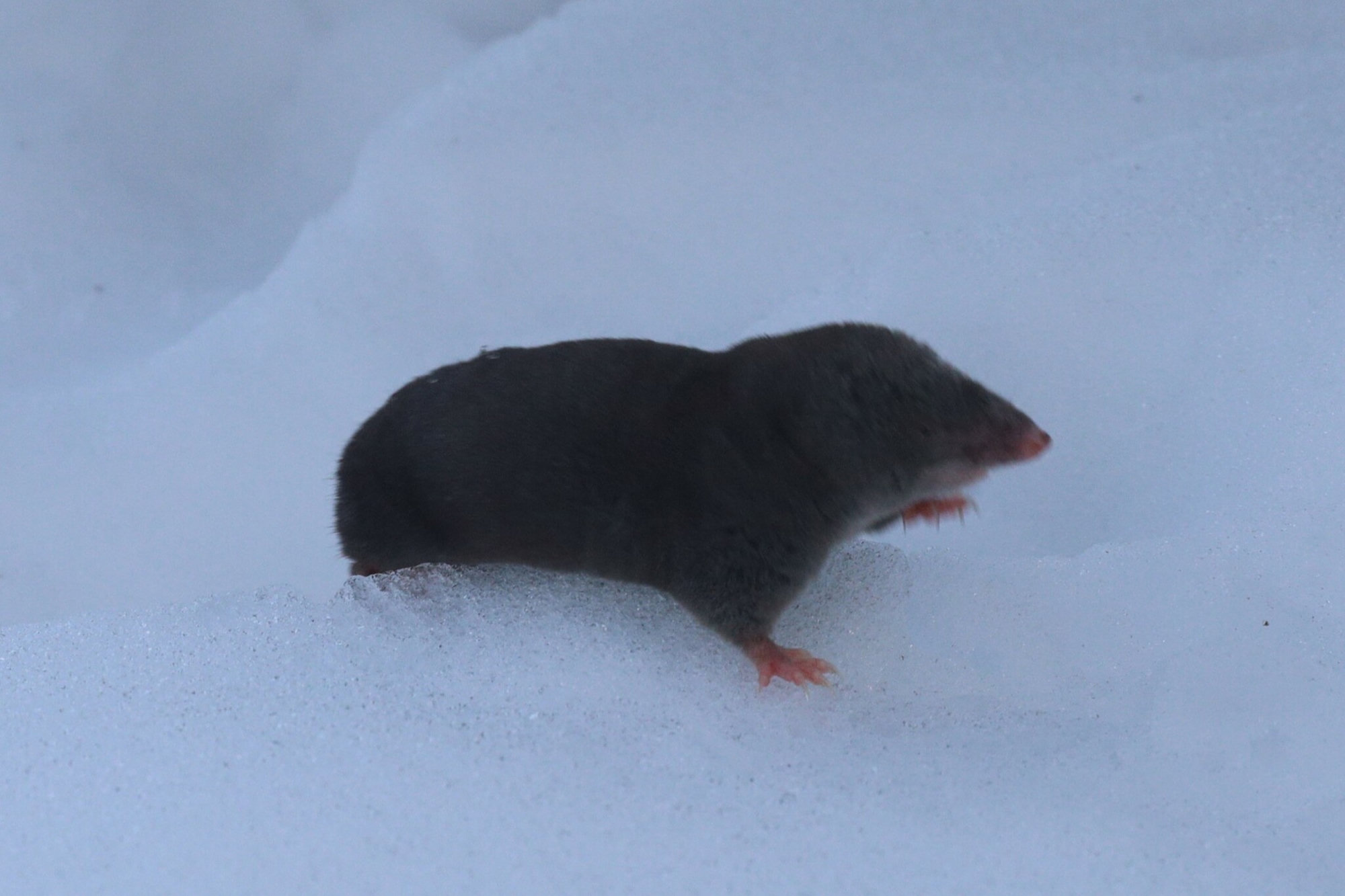
Photo Trent Massey (opens in a new tab) / iNaturalist, CC BY-NC 4.0 (opens in a new tab)
At a glance
- Size
- Body about 9 to 11 cm; tail about 2 to 3 cm
- Weight
- About 15 to 30 g
- Habitat
- Forests, fields, marsh edges and gardens with deep leaf litter or loose soil
- Diet
- Earthworms, insects, snails, slugs, spiders, fungi, seeds and small vertebrates
- Active
- Day and night, in short bursts, all year
- Shelter
- Runways under leaves and snow, and burrows it digs or borrows
- Lifespan
- Usually a year or two
- Rabies vector
- No
Identification
- Key marks
- Solid slate-grey, velvety fur; short tail; tiny eyes; ears hidden in the fur; pointed but not needle-thin snout
- Size
- About the size of a small mouse, but stockier
- Told apart from
- Southern short-tailed shrew, which is smaller and lives mainly in the coastal plain and piedmont
- Told apart from
- Moles, which have huge paddle-shaped forefeet
- Told apart from
- Voles and mice, which have larger eyes, visible ears and rodent teeth
- Where to look
- Crossing paths and roads, in leaf litter, and under boards and logs; in Georgia, mainly north of the Fall Line
Behaviour
Northern short-tailed shrews live mostly out of sight, in runways under leaf litter, in the tunnels of moles and voles, and in their own shallow burrows. They are active in bursts through the day and night and do not hibernate, hunting under snow in winter.
They are one of the few venomous mammals. Their saliva contains a toxin that paralyses prey such as earthworms, insects and snails, and lets them store living prey for later; it can also subdue mice. They are thought to use high-pitched clicks to help find their way through dark tunnels.
Why they matter
Short-tailed shrews eat large numbers of insects, larvae and slugs, including many that damage plants, and they are a regular food for owls, hawks, foxes and snakes.
They are also one of the best-studied venomous mammals, and the chemistry of their saliva has interested medical researchers looking at how its toxins act on nerves.
Reproduction and lifecycle
Breeding — spring to autumn, two or three litters a year
Gestation — about 21 to 22 days
Litter — usually three to seven young, born blind and hairless in an underground nest
Weaning — at about three to four weeks old
Independence — soon after weaning
Lifespan — rarely more than two years
Living around people
- Cats catch many shrews and often leave them uneaten, because shrews taste unpleasant to predators.
- Leaving leaf litter in beds and under shrubs gives them hunting ground.
- A shrew's bite can be painful; use gloves or a container to move one out of a building.
- They sometimes enter basements and garages in autumn; a gap under a door is usually how.
Misconceptions
- A shrew is a baby mouse or a young mole. Shrews are their own group, more closely related to moles than to mice.
- Shrews are harmful to gardens. They eat insects, grubs and slugs, not plants.
- A shrew left dead on the path was poisoned. Many are killed and discarded by cats and other predators that find them distasteful.
Related species
Seasonal activity
When this species is breeding, and when there are nests on the ground. Mowing during the shaded months is how most nests are found.
| Jan | Feb | Mar | Apr | May | Jun | Jul | Aug | Sep | Oct | Nov | Dec | |
|---|---|---|---|---|---|---|---|---|---|---|---|---|
| Breeding | Jan: no | Feb: no | Mar: no | Apr: no | May: no | Jun: no | Jul: no | Aug: no | Sep: no | Oct: no | Nov: no | Dec: no |
| Active nests | Jan: no | Feb: no | Mar: no | Apr: no | May: no | Jun: no | Jul: no | Aug: no | Sep: no | Oct: no | Nov: no | Dec: no |
| Notes | Active under snow and leaf litter; stored food helps through cold spells | Active; breeding may begin in mild areas | Breeding begins in earnest | First litters born in grass-and-leaf nests underground | Young leave the nest at about four weeks old | Second litters | Young of the year disperse; many are seen crossing paths and roads | Breeding continues | Last litters in the South | Numbers peak; young adults settle into winter ranges | Active through cold weather | Hunting under leaves and snow |
Where it lives
Recorded in 39 states and provinces. Each one links to the other animals there, and to the rehabilitators licensed for them.
United States
- Alabama
- Connecticut
- Delaware
- District of Columbia
- Georgia
- Illinois
- Indiana
- Iowa
- Kansas
- Kentucky
- Maine
- Maryland
- Massachusetts
- Michigan
- Minnesota
- Missouri
- Nebraska
- New Hampshire
- New Jersey
- New York
- North Carolina
- North Dakota
- Ohio
- Pennsylvania
- Rhode Island
- South Carolina
- South Dakota
- Tennessee
- Vermont
- Virginia
- West Virginia
- Wisconsin
If you found one
Answer a few questions and you will get a specific answer for what you are looking at.
I found an animal