
Species
Yellow-bellied sapsucker
Sphyrapicus varius
A quiet woodpecker that drills neat rows of holes in tree bark and returns to lap up the sap.
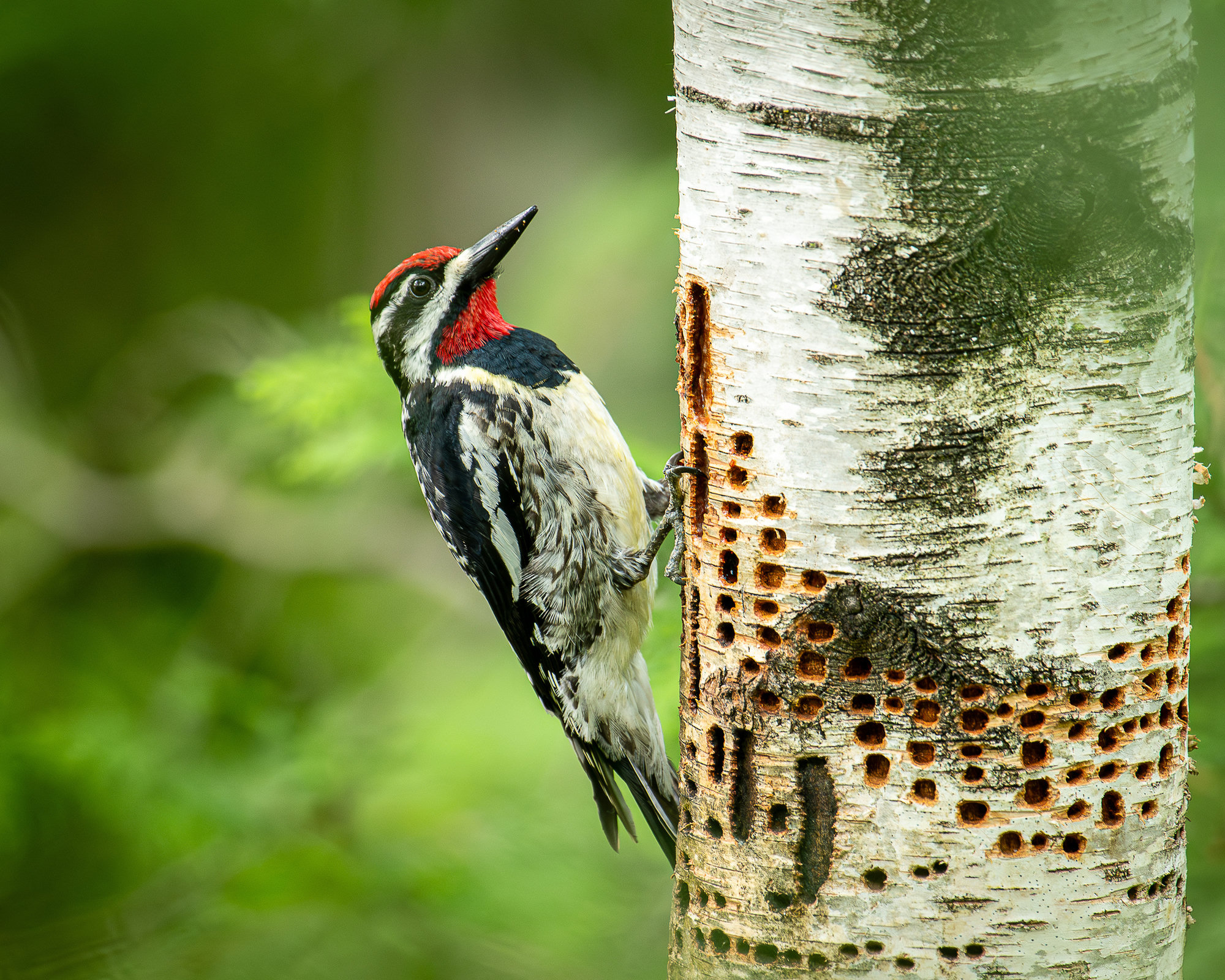
Photo Martin Tremblay (opens in a new tab) / iNaturalist, CC BY 4.0 (opens in a new tab)
At a glance
- Size
- About 19 to 21 cm long
- Weight
- About 35 to 55 g
- Habitat
- Woods, orchards and yards with trees
- Diet
- Tree sap, insects caught in the sap, and fruit
- In Georgia
- A common winter visitor, October to April
- Voice
- A mewing, cat-like call
- Rabies vector
- No
Identification
- Key marks
- Black-and-white striped face; red forehead; males with a red throat; long white stripe on the wing; mottled back
- Told apart from
- Downy and hairy woodpeckers, which have white backs and no wing stripe
- Where to look
- Trees with neat horizontal rows of small holes
Behaviour
Sapsuckers drill rows of shallow holes, called sap wells, and return to drink the sap and eat the insects it traps. They defend their wells from other birds.
Why they matter
The sap wells sapsuckers drill feed hummingbirds, warblers and even bats and butterflies. In spring in the north, ruby-throated hummingbirds depend on sapsucker wells before flowers bloom.
Reproduction and lifecycle
Nest — A cavity in a living tree, often one with heart rot
Eggs — Usually five or six
Incubation — About 10 to 13 days
Chicks — Fed by both parents
Flight — At about 25 to 29 days
Lifespan — Several years
Living around people
- Sapsucker holes rarely harm healthy trees; wrapping a favourite ornamental tree's trunk with burlap for the winter moves them on.
Misconceptions
- Sapsucker holes kill trees. Healthy trees usually recover.
Related species
Seasonal activity
When this species is breeding, and when there are nests on the ground. Mowing during the shaded months is how most nests are found.
| Jan | Feb | Mar | Apr | May | Jun | Jul | Aug | Sep | Oct | Nov | Dec | |
|---|---|---|---|---|---|---|---|---|---|---|---|---|
| Breeding | Jan: no | Feb: no | Mar: no | Apr: no | May: no | Jun: no | Jul: no | Aug: no | Sep: no | Oct: no | Nov: no | Dec: no |
| Active nests | Jan: no | Feb: no | Mar: no | Apr: no | May: no | Jun: no | Jul: no | Aug: no | Sep: no | Oct: no | Nov: no | Dec: no |
| Notes | Wintering | Wintering | Leaving | Last birds leave | Nesting farther north | Nesting | Young fledging | Present in the north | Migrating south | Arriving | Wintering | Wintering |
Where it lives
Recorded in 78 states and provinces. Each one links to the other animals there, and to the rehabilitators licensed for them.
United States
- Alabamain winter
- Arkansasin winter
- Connecticut
- Delawarein winter
- District of Columbiain winter
- Floridain winter
- Georgiain winter
- Illinoisin winter
- Indianain winter
- Iowa
- Kansasin winter
- Kentuckyin winter
- Louisianain winter
- Mainebreeding
- Marylandin winter
- Massachusetts
- Michiganbreeding
- Minnesotabreeding
- Mississippiin winter
- Missouriin winter
- Nebraskain winter
- New Hampshirebreeding
- New Jerseyin winter
- New York
- North Carolinain winter
- North Dakotabreeding
- Ohioin winter
- Oklahomain winter
- Pennsylvania
- Rhode Islandin winter
- South Carolinain winter
- South Dakotabreeding
- Tennesseein winter
- Texasin winter
- Vermontbreeding
- Virginiain winter
- West Virginiain winter
- Wisconsinbreeding
Canada
Mexico
- Aguascalientesin winter
- Campechein winter
- Chiapasin winter
- Chihuahuain winter
- Coahuilain winter
- Colimain winter
- Durangoin winter
- Guanajuatoin winter
- Guerreroin winter
- Hidalgoin winter
- Jaliscoin winter
- Mexico Cityin winter
- Michoacanin winter
- Morelosin winter
- Nayaritin winter
- Nuevo Leonin winter
- Oaxacain winter
- Pueblain winter
- Queretaroin winter
- Quintana Rooin winter
- San Luis Potosiin winter
- Sinaloain winter
- State of Mexicoin winter
- Tabascoin winter
- Tamaulipasin winter
- Tlaxcalapassing through
- Veracruzin winter
- Yucatanin winter
- Zacatecasin winter
If you found one
Answer a few questions and you will get a specific answer for what you are looking at.
I found an animal