
Species
Ruby-throated hummingbird
Archilochus colubris
Georgia's only nesting hummingbird, which crosses the Gulf of Mexico in a single non-stop flight.
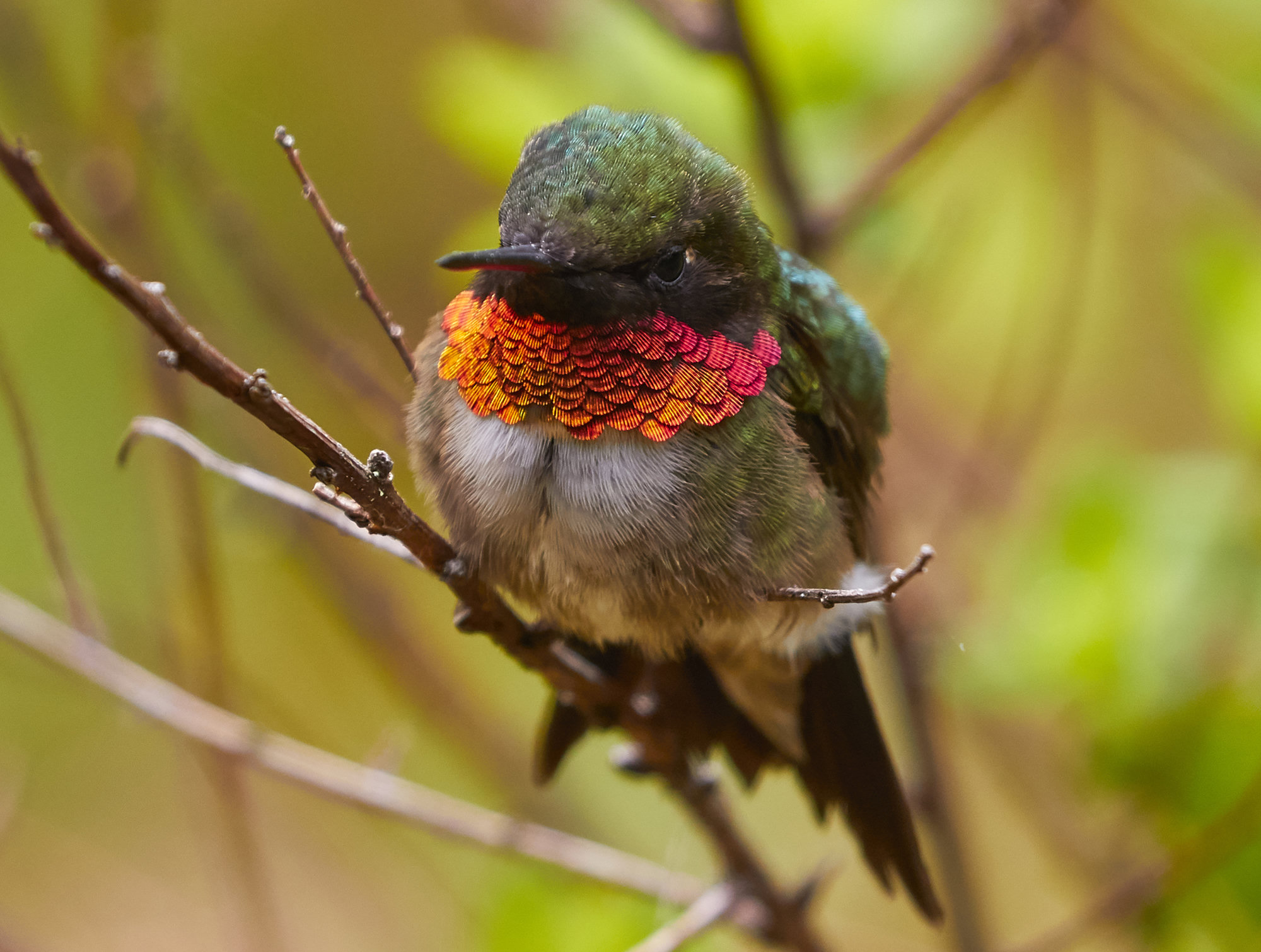
Photo Unknown photographer (opens in a new tab) / iNaturalist, CC0 1.0 (opens in a new tab)
At a glance
- Size
- About 7 to 9 cm long
- Weight
- About 3 g
- Habitat
- Woodland edges, gardens, parks and yards
- Diet
- Nectar and small insects and spiders
- In Georgia
- A common summer resident, March to October
- Voice
- Squeaky chips; the wings hum
- Rabies vector
- No
Identification
- Male
- Bright metallic green back; ruby-red throat that can look black; forked tail
- Female
- Green back; white throat and underparts; white tail tips
- Told apart from
- Rufous hummingbird, a winter visitor, which is orange-brown
- Told apart from
- Hummingbird moths, which are fuzzy insects with antennae
- Where to look
- Flowers and feeders from spring to autumn
Behaviour
Ruby-throated hummingbirds hover at flowers and feeders, and males chase rivals fiercely from favourite feeding spots. They eat many small insects as well as nectar, and their young are raised mostly on insects.
Before migrating, they nearly double their weight in fat to fuel the flight across the Gulf of Mexico, up to about 800 km non-stop.
Why they matter
These hummingbirds pollinate many native flowers, including trumpet vine, coral honeysuckle and cardinal flower, whose red tubular shapes have evolved alongside them. Their migration, crossing the Gulf on a few grams of fat, is one of the most remarkable feats of any bird.
Reproduction and lifecycle
Nest — A walnut-sized cup of plant down bound with spider silk and covered in lichen
Eggs — Two, the size of a pea
Incubation — About 12 to 14 days, by the female alone
Nestlings — Fledge at about 18 to 22 days
Broods — One or two a year
Lifespan — Usually three to five years
Living around people
- Native flowers such as coral honeysuckle, cardinal flower and red buckeye feed them better than any feeder.
- A nectar feeder does no harm if the sugar water is one part sugar to four parts water, with no red dye, and changed every few days in heat.
- Hummingbirds get trapped in garages, often drawn in by the red release handle on the door opener; opening the door fully and switching off the lights usually lets them find the way out.
- Pesticides remove the tiny insects they feed their young.
Misconceptions
- Feeders stop hummingbirds migrating. Day length, not food, triggers migration.
- Hummingbirds ride on the backs of geese. They migrate alone, under their own power.
Related species
Seasonal activity
When this species is breeding, and when there are nests on the ground. Mowing during the shaded months is how most nests are found.
| Jan | Feb | Mar | Apr | May | Jun | Jul | Aug | Sep | Oct | Nov | Dec | |
|---|---|---|---|---|---|---|---|---|---|---|---|---|
| Breeding | Jan: no | Feb: no | Mar: no | Apr: no | May: no | Jun: no | Jul: no | Aug: no | Sep: no | Oct: no | Nov: no | Dec: no |
| Active nests | Jan: no | Feb: no | Mar: no | Apr: no | May: no | Jun: no | Jul: no | Aug: no | Sep: no | Oct: no | Nov: no | Dec: no |
| Notes | In Central America | In Central America | First males arrive in south Georgia | Arriving statewide | Nesting | Nesting; second broods | Young fledging | Feeding heavily; migrants passing through | Peak migration | Last birds leaving | A few stragglers | In Central America |
Where it lives
Recorded in 73 states and provinces. Each one links to the other animals there, and to the rehabilitators licensed for them.
United States
- Alabamabreeding
- Arkansasbreeding
- Connecticutbreeding
- Delawarebreeding
- District of Columbiabreeding
- Florida
- Georgiabreeding
- Illinoisbreeding
- Indianabreeding
- Iowabreeding
- Kansasbreeding
- Kentuckybreeding
- Louisiana
- Mainebreeding
- Marylandbreeding
- Massachusettsbreeding
- Michiganbreeding
- Minnesotabreeding
- Mississippibreeding
- Missouribreeding
- Nebraskabreeding
- New Hampshirebreeding
- New Jerseybreeding
- New Yorkbreeding
- North Carolinabreeding
- North Dakotabreeding
- Ohiobreeding
- Oklahomabreeding
- Pennsylvaniabreeding
- Rhode Islandbreeding
- South Carolinabreeding
- South Dakotabreeding
- Tennesseebreeding
- Texasbreeding
- Vermontbreeding
- Virginiabreeding
- West Virginiabreeding
- Wisconsinbreeding
Canada
Mexico
- Aguascalientespassing through
- Campechein winter
- Chiapasin winter
- Coahuilapassing through
- Colimain winter
- Durangoin winter
- Guanajuatoin winter
- Guerreroin winter
- Hidalgopassing through
- Jaliscoin winter
- Mexico Citypassing through
- Michoacanin winter
- Morelosin winter
- Nayaritin winter
- Nuevo Leonpassing through
- Oaxacain winter
- Pueblain winter
- Queretaropassing through
- Quintana Rooin winter
- San Luis Potosipassing through
- State of Mexicoin winter
- Tabascoin winter
- Tamaulipaspassing through
- Tlaxcalapassing through
- Veracruzin winter
- Yucatanin winter
If you found one
Answer a few questions and you will get a specific answer for what you are looking at.
I found an animal