
Species
Wood stork
Mycteria americana
North America's only stork, a bald-headed wader that feeds by touch and nests in Georgia's swamps.
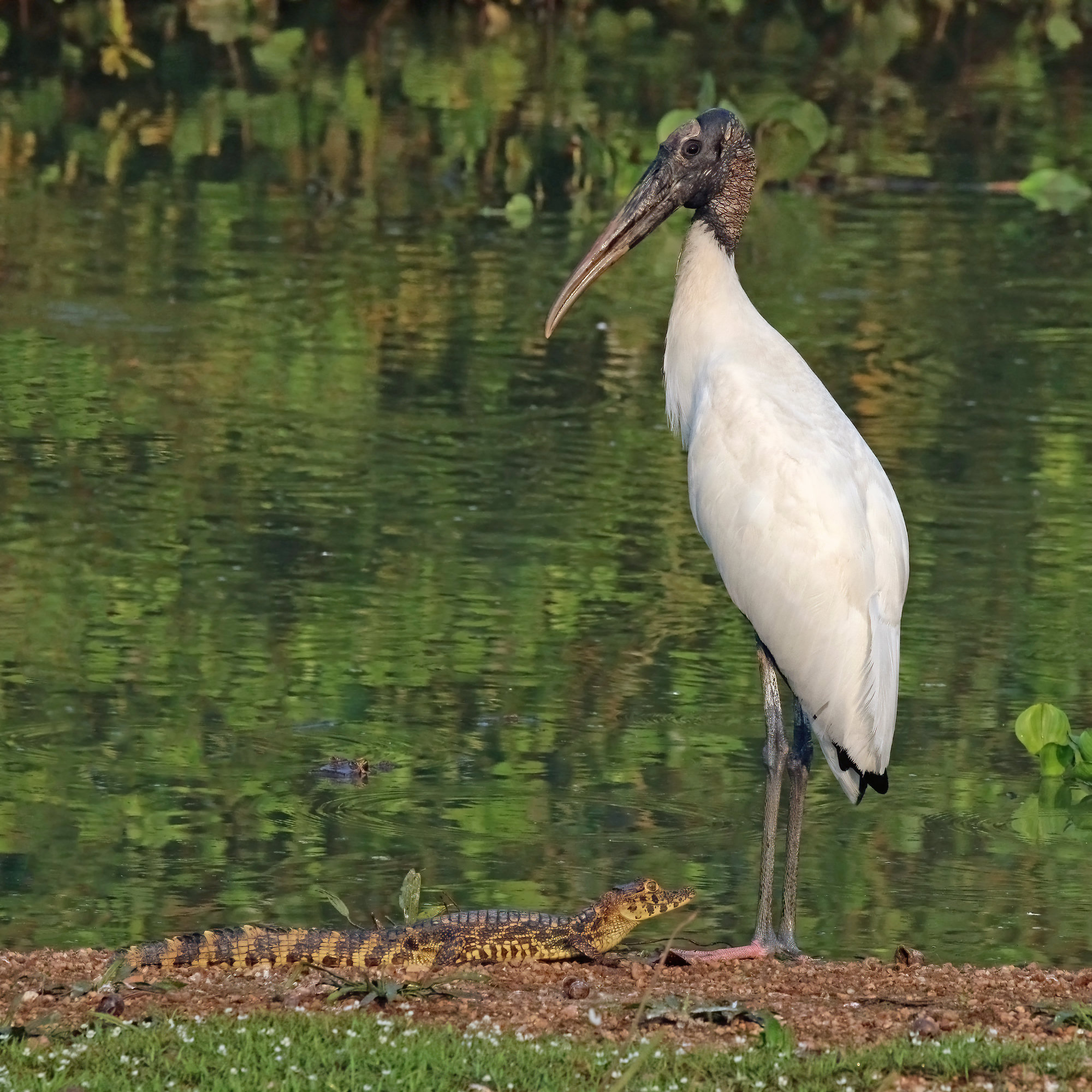
Photo Charles J. Sharp (opens in a new tab) / Wikimedia Commons, CC BY-SA 4.0 (opens in a new tab)
At a glance
- Size
- About 85 to 115 cm tall; wingspan about 1.5 to 1.8 m
- Weight
- About 2 to 3.3 kg
- Habitat
- Swamps, marshes, ponds and ditches
- Diet
- Fish, crayfish and frogs
- In Georgia
- A summer resident; nests in colonies in the south and on the coast
- Voice
- Silent as adults; nestlings are noisy
- Rabies vector
- No
Identification
- Key marks
- Large white wader; bare, scaly grey head and neck; thick, down-curved bill; black flight feathers and tail
- Told apart from
- White ibis, which is smaller with a red face and thin curved bill
- Told apart from
- Great egret, which is white all over with a yellow bill
- Where to look
- Swamps and roadside ditches in summer; soaring on thermals
Behaviour
Wood storks feed by touch, sweeping an open bill through muddy water. When a fish touches the bill, it snaps shut in a fraction of a second, among the fastest reflexes known in vertebrates.
They nest in colonies in cypress swamps and depend on water levels falling at just the right time to concentrate fish for their chicks.
Why they matter
The wood stork was listed as endangered in 1984 after its Florida colonies collapsed. It has since spread north into Georgia and the Carolinas, where new colonies helped it improve enough to be reclassified as threatened in 2014. Georgia's swamps are now central to its recovery.
Reproduction and lifecycle
Nest — A platform of sticks in cypress or other trees over water, in colonies
Eggs — Usually three
Incubation — About 28 to 32 days
Chicks — Fed by both parents; a brood needs hundreds of kilograms of fish
Flight — At about eight weeks
Lifespan — Wild birds over twenty years are recorded
Living around people
- Colonies are sensitive to disturbance; boats and people near nests can cause adults to abandon them.
- Draining of wetlands that dry down in spring removes the fish-rich pools chicks depend on.
Misconceptions
- The bald head means the bird is old or sick. Adult wood storks naturally have bare heads.
Related species
Seasonal activity
When this species is breeding, and when there are nests on the ground. Mowing during the shaded months is how most nests are found.
| Jan | Feb | Mar | Apr | May | Jun | Jul | Aug | Sep | Oct | Nov | Dec | |
|---|---|---|---|---|---|---|---|---|---|---|---|---|
| Breeding | Jan: no | Feb: no | Mar: no | Apr: no | May: no | Jun: no | Jul: no | Aug: no | Sep: no | Oct: no | Nov: no | Dec: no |
| Active nests | Jan: no | Feb: no | Mar: no | Apr: no | May: no | Jun: no | Jul: no | Aug: no | Sep: no | Oct: no | Nov: no | Dec: no |
| Notes | Mostly in Florida | Arriving in Georgia | Nesting begins | Nesting | Chicks | Chicks | Young fledging | Young flying; post-breeding flocks | Flocks feeding in ponds | Many leave for Florida | Few remain | Few remain |
Where it lives
Recorded in 30 states and provinces. Each one links to the other animals there, and to the rehabilitators licensed for them.
United States
If you found one
Answer a few questions and you will get a specific answer for what you are looking at.
I found an animal