
Species
American white pelican
Pelecanus erythrorhynchos
A huge white pelican with a wingspan of nearly three metres that fishes in cooperating groups, wintering on Georgia's coast.
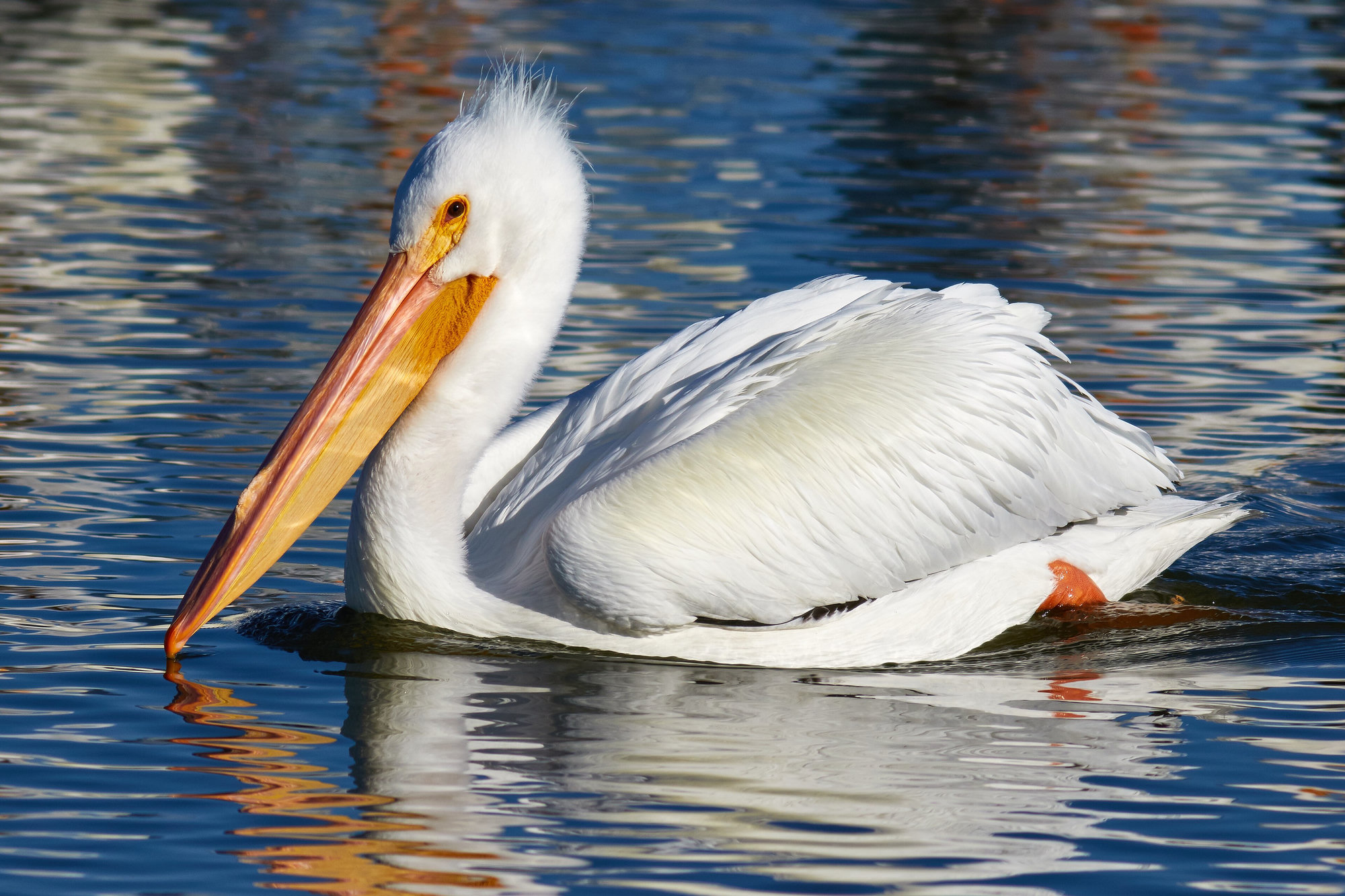
Photo Frank Schulenburg (opens in a new tab) / Wikimedia Commons, CC BY-SA 4.0 (opens in a new tab)
At a glance
- Size
- About 1.3 to 1.8 m long; wingspan about 2.4 to 2.9 m
- Weight
- About 5 to 9 kg
- Habitat
- Lakes, reservoirs, coastal lagoons and marshes
- Diet
- Fish, crayfish and salamanders
- In Georgia
- An uncommon but increasing winter visitor, mostly on the coast
- Voice
- Silent away from colonies
- Rabies vector
- No
Identification
- Key marks
- Huge; white with black flight feathers; bright orange-yellow bill and pouch; in spring a flat plate grows on the upper bill
- Told apart from
- Brown pelican, which is grey-brown and plunge-dives
- Told apart from
- Wood stork, which has a bare grey head and long legs
- Where to look
- Coastal impoundments and reservoirs in winter
Behaviour
White pelicans do not dive. Groups swim together in lines or circles, herding fish into shallow water and scooping them up. They soar in large flocks on thermals.
Why they matter
With one of the longest wingspans of any North American bird, the white pelican is a spectacular sight. Its cooperative fishing is one of the clearest examples of teamwork among birds, and its growing presence in Georgia in winter is a recent change.
Reproduction and lifecycle
Nest — A scrape or mound on islands in inland lakes
Eggs — Usually two
Incubation — About 29 to 36 days
Chicks — Gather in creches; each fed by its own parents
Flight — At about nine to ten weeks
Lifespan — Wild birds over twenty years are recorded
Living around people
- Pelicans tangled in fishing line need a rehabilitator; their size and bills make them hard to handle safely.
Misconceptions
- Pelicans store fish in their pouch. The pouch is a scoop; fish are swallowed at once.
Related species
Seasonal activity
When this species is breeding, and when there are nests on the ground. Mowing during the shaded months is how most nests are found.
| Jan | Feb | Mar | Apr | May | Jun | Jul | Aug | Sep | Oct | Nov | Dec | |
|---|---|---|---|---|---|---|---|---|---|---|---|---|
| Breeding | Jan: no | Feb: no | Mar: no | Apr: no | May: no | Jun: no | Jul: no | Aug: no | Sep: no | Oct: no | Nov: no | Dec: no |
| Active nests | Jan: no | Feb: no | Mar: no | Apr: no | May: no | Jun: no | Jul: no | Aug: no | Sep: no | Oct: no | Nov: no | Dec: no |
| Notes | Wintering | Wintering | Leaving for western lakes | Nesting on inland lakes in the West | Nesting | Chicks | Chicks in creches | Young flying | Migration begins | Moving south | Arriving | Wintering |
Where it lives
Recorded in 79 states and provinces. Each one links to the other animals there, and to the rehabilitators licensed for them.
United States
- Alabamain winter
- Arizonain winter
- Arkansasin winter
- California
- Coloradobreeding
- Delaware
- Floridain winter
- Georgiain winter
- Idahobreeding
- Illinois
- Indiana
- Iowa
- Kansas
- Kentuckyin winter
- Louisianain winter
- Marylandin winter
- Michiganbreeding
- Minnesotabreeding
- Mississippiin winter
- Missouri
- Montanabreeding
- Nebraskabreeding
- Nevada
- New Jersey
- New Mexico
- New York
- North Carolinain winter
- North Dakotabreeding
- Ohiobreeding
- Oklahomain winter
- Oregonbreeding
- South Carolinain winter
- South Dakotabreeding
- Tennesseein winter
- Texasin winter
- Utahbreeding
- Virginia
- Washingtonbreeding
- Wisconsinbreeding
- Wyomingbreeding
Canada
Mexico
- Aguascalientesin winter
- Baja California
- Baja California Sur
- Campechein winter
- Chiapasin winter
- Chihuahuain winter
- Coahuilain winter
- Colimain winter
- Durangoin winter
- Guanajuatoin winter
- Guerreroin winter
- Hidalgoin winter
- Jalisco
- Mexico Cityin winter
- Michoacanin winter
- Morelosin winter
- Nayaritin winter
- Nuevo Leonin winter
- Oaxacain winter
- Pueblain winter
- Queretaroin winter
- Quintana Rooin winter
- San Luis Potosi
- Sinaloain winter
- Sonorain winter
- State of Mexicoin winter
- Tabascoin winter
- Tamaulipasin winter
- Tlaxcalain winter
- Veracruzin winter
- Yucatanin winter
- Zacatecasin winter
If you found one
Answer a few questions and you will get a specific answer for what you are looking at.
I found an animal