
Species
Great egret
Ardea alba
A tall, pure-white heron with a yellow bill, whose plumes nearly caused its extinction and started the bird protection movement.
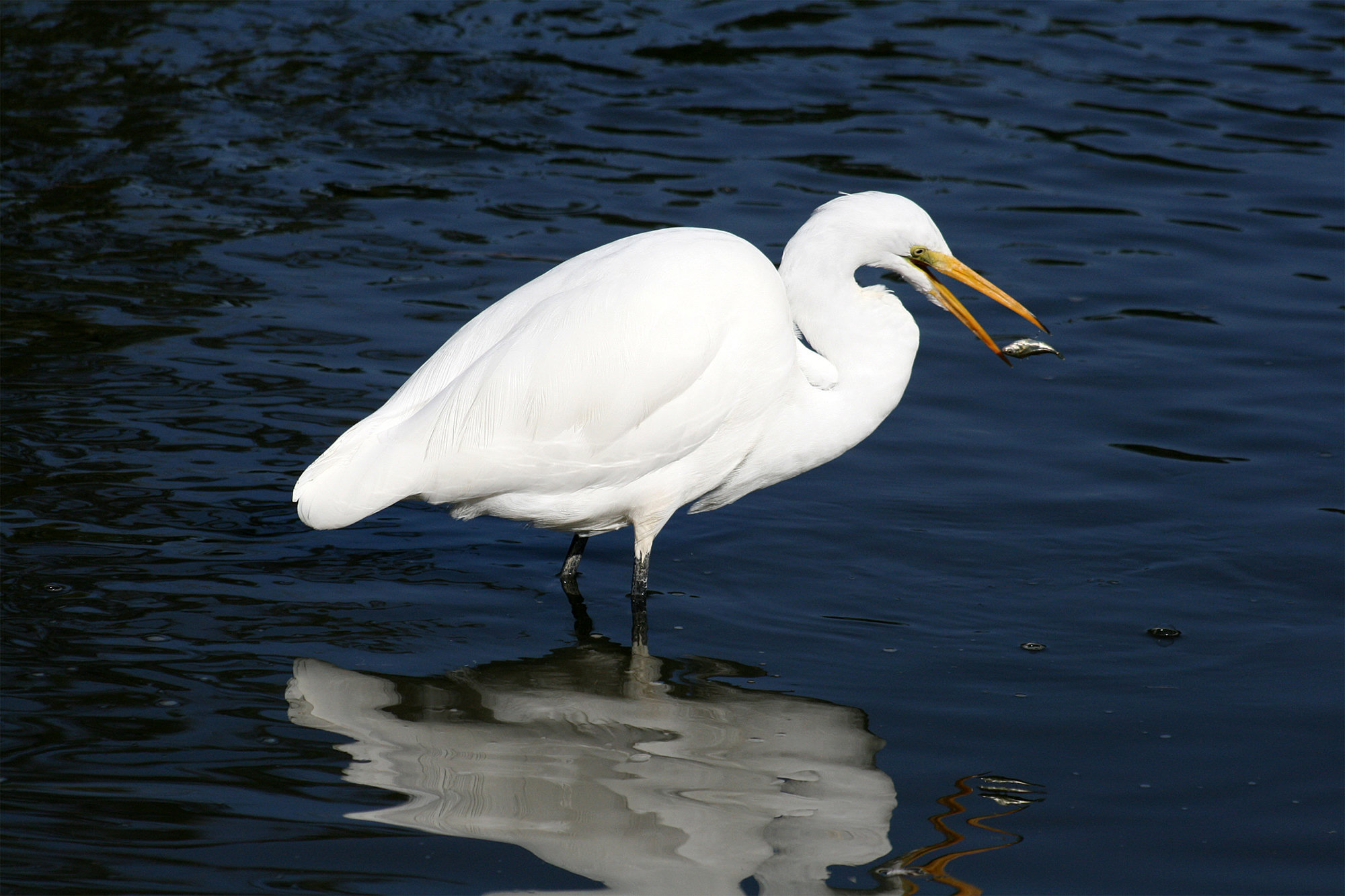
Photo Brocken Inaglory (opens in a new tab) / Wikimedia Commons, CC BY-SA 3.0 (opens in a new tab)
At a glance
- Size
- About 94 to 104 cm tall; wingspan about 1.3 to 1.5 m
- Weight
- About 700 to 1,500 g
- Habitat
- Marshes, ponds, rivers, ditches and coastal wetlands
- Diet
- Fish, frogs, crayfish, snakes and small mammals
- In Georgia
- Common all year; more on the coast in winter
- Voice
- A low, croaking "kraak"
- Rabies vector
- No
Identification
- Key marks
- Large, all white; long yellow bill; black legs and feet
- Told apart from
- Snowy egret, which is smaller with a black bill and yellow feet
- Told apart from
- Young little blue heron, which is smaller with a grey-tipped bill and greenish legs
- Where to look
- Almost any wetland, standing tall and still
Behaviour
Great egrets hunt by standing still or walking slowly, then striking. In breeding season they grow long, lacy plumes on their backs.
Why they matter
In the late 1800s, great egrets were killed by the millions for their plumes, which decorated hats. Outrage at the slaughter helped found the early Audubon societies and led to laws protecting birds. The great egret became the symbol of the National Audubon Society and a lasting sign of what protection can achieve.
Reproduction and lifecycle
Nest — A platform of sticks in trees over water, in colonies
Eggs — Usually three or four
Incubation — About 23 to 27 days
Chicks — Fed by both parents; siblings compete fiercely
Flight — At about six to seven weeks
Lifespan — Wild birds over twenty years are recorded
Living around people
- Herons and egrets tangled in fishing line need a rehabilitator.
- Colonies near homes are protected; disturbing them in nesting season can cause failure.
Misconceptions
- All white herons are the same bird. Georgia has several, told apart by size, bill and leg colour.
Related species
Seasonal activity
When this species is breeding, and when there are nests on the ground. Mowing during the shaded months is how most nests are found.
| Jan | Feb | Mar | Apr | May | Jun | Jul | Aug | Sep | Oct | Nov | Dec | |
|---|---|---|---|---|---|---|---|---|---|---|---|---|
| Breeding | Jan: no | Feb: no | Mar: no | Apr: no | May: no | Jun: no | Jul: no | Aug: no | Sep: no | Oct: no | Nov: no | Dec: no |
| Active nests | Jan: no | Feb: no | Mar: no | Apr: no | May: no | Jun: no | Jul: no | Aug: no | Sep: no | Oct: no | Nov: no | Dec: no |
| Notes | Present | Colonies forming | Nesting | Nesting | Chicks | Chicks | Young fledging | Young dispersing | Present | Present | Present | Present |
Where it lives
Recorded in 84 states and provinces. Each one links to the other animals there, and to the rehabilitators licensed for them.
United States
- Alabama
- Arizonain winter
- Arkansas
- California
- Coloradobreeding
- Connecticutbreeding
- Delawarebreeding
- District of Columbiabreeding
- Florida
- Georgia
- Idaho
- Illinoisbreeding
- Indianabreeding
- Iowabreeding
- Kansasbreeding
- Kentuckybreeding
- Louisiana
- Mainebreeding
- Marylandbreeding
- Massachusettsbreeding
- Michiganbreeding
- Minnesotabreeding
- Mississippi
- Missouribreeding
- Nebraskabreeding
- Nevada
- New Hampshirebreeding
- New Jerseybreeding
- New Mexico
- New Yorkbreeding
- North Carolina
- North Dakotabreeding
- Ohiobreeding
- Oklahomabreeding
- Oregon
- Pennsylvaniabreeding
- Rhode Islandbreeding
- South Carolina
- South Dakotabreeding
- Tennesseebreeding
- Texas
- Utah
- Vermontbreeding
- Virginia
- Washington
- West Virginiabreeding
- Wisconsinbreeding
Mexico
- Aguascalientes
- Baja California
- Baja California Sur
- Campeche
- Chiapas
- Chihuahua
- Coahuilain winter
- Colima
- Durango
- Guanajuato
- Guerrero
- Hidalgo
- Jalisco
- Mexico City
- Michoacan
- Morelosin winter
- Nayarit
- Nuevo Leon
- Oaxaca
- Puebla
- Queretaro
- Quintana Roo
- San Luis Potosi
- Sinaloa
- Sonora
- State of Mexico
- Tabasco
- Tamaulipas
- Tlaxcalain winter
- Veracruz
- Yucatan
- Zacatecasin winter
If you found one
Answer a few questions and you will get a specific answer for what you are looking at.
I found an animal