
Species
Wood duck
Aix sponsa
Georgia's most colourful duck, a tree-nester whose ducklings leap from their nest hole the day after they hatch.
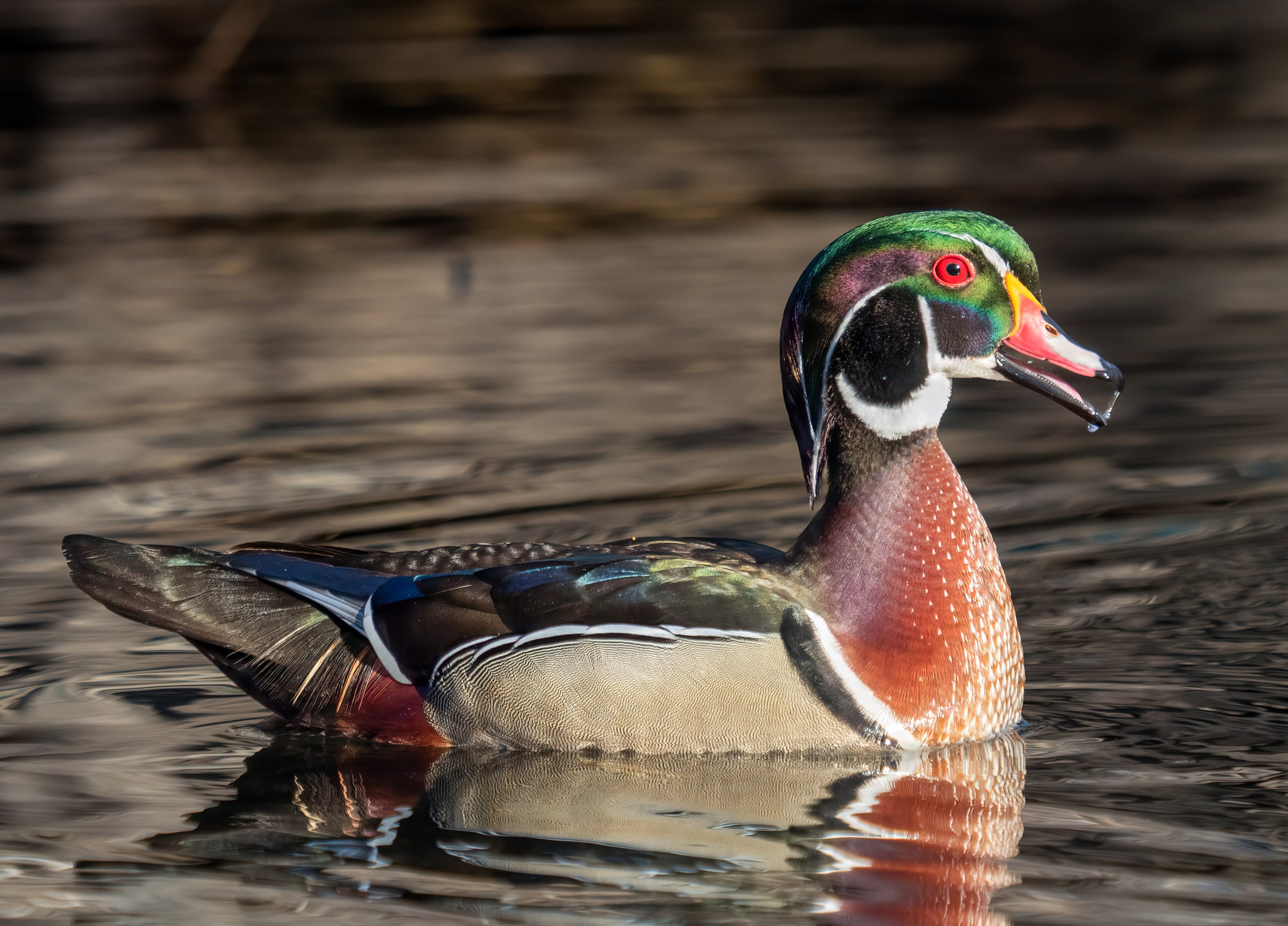
Photo Rhododendrites (opens in a new tab) / Wikimedia Commons, CC BY-SA 4.0 (opens in a new tab)
At a glance
- Size
- About 47 to 54 cm long
- Weight
- About 450 to 880 g
- Habitat
- Wooded swamps, beaver ponds, creeks and ponds with trees around them
- Diet
- Acorns, seeds, fruits, aquatic plants and insects
- In Georgia
- Common all year and breeds statewide
- Voice
- A rising, squealing "oo-eek" from the female; males give a thin whistle
- Rabies vector
- No
Identification
- Male
- Glossy green crested head with bold white lines; red eye; chestnut breast; buff sides
- Female
- Grey-brown with a white teardrop patch around the eye and a small crest
- Told apart from
- Hooded merganser, which has a thin bill and a fan-shaped crest
- Told apart from
- Mallard females, which are streaked brown with no white eye patch
- Where to look
- Quiet backwaters under overhanging trees; often perched on branches
Behaviour
Wood ducks nest in tree hollows and nest boxes, sometimes high above the ground and some distance from water. They perch readily on branches and fly nimbly through woods.
A day after hatching, the ducklings climb to the entrance of the nest hole and jump, sometimes falling many metres to the ground unharmed, then follow their mother to water.
Why they matter
Wood ducks were nearly wiped out by 1900 through hunting and the loss of old swamp forests. Hunting limits and nest boxes brought them back, and they are one of the great recovery stories in North American conservation.
They eat large numbers of acorns and other tree seeds, and they depend on the old, hollow trees and beaver ponds that many other animals also need.
Reproduction and lifecycle
Nest — A tree hollow or nest box lined with down
Eggs — Usually 9 to 15; females sometimes lay in each other's nests
Incubation — About 30 days
Leaving the nest — About a day after hatching, by jumping to the ground or water
Young — Feed themselves; the mother guards them for about five to six weeks
Flight — At about eight to ten weeks
Lifespan — Usually a few years; some over fifteen
Living around people
- Nest boxes mounted over or near water, with a predator guard, are used readily.
- Ducklings dropping from a box or tree to the ground is normal and part of the plan.
- Old hollow trees near water are nest sites; leaving them standing where safe helps.
- Fishing line at pond edges tangles ducks and ducklings.
Misconceptions
- Ducklings on the ground under a tree need rescuing. They jumped from the nest, as wood duck young always do; the mother gathers them and leads them to water.
- Wood ducks are rare. They were, a century ago. They are now common across Georgia.
Related species
Seasonal activity
When this species is breeding, and when there are nests on the ground. Mowing during the shaded months is how most nests are found.
| Jan | Feb | Mar | Apr | May | Jun | Jul | Aug | Sep | Oct | Nov | Dec | |
|---|---|---|---|---|---|---|---|---|---|---|---|---|
| Breeding | Jan: no | Feb: no | Mar: no | Apr: no | May: no | Jun: no | Jul: no | Aug: no | Sep: no | Oct: no | Nov: no | Dec: no |
| Active nests | Jan: no | Feb: no | Mar: no | Apr: no | May: no | Jun: no | Jul: no | Aug: no | Sep: no | Oct: no | Nov: no | Dec: no |
| Notes | Pairs forming | Females searching for nest holes | Egg laying | Incubation; first broods leave the nest | Broods on the water | Some females nest a second time | Adults moulting | Young flying | Flocks gather in swamps | Feeding on acorns | Northern migrants arrive | Wintering in swamps and ponds |
Where it lives
Recorded in 66 states and provinces. Each one links to the other animals there, and to the rehabilitators licensed for them.
United States
- Alabama
- Alaska
- Arizona
- Arkansas
- California
- Colorado
- Connecticutbreeding
- Delawarebreeding
- District of Columbia
- Florida
- Georgia
- Idaho
- Illinoisbreeding
- Indianabreeding
- Iowabreeding
- Kansas
- Kentuckybreeding
- Louisiana
- Mainebreeding
- Marylandbreeding
- Massachusettsbreeding
- Michiganbreeding
- Minnesotabreeding
- Mississippi
- Missouribreeding
- Montana
- Nebraskabreeding
- Nevada
- New Hampshirebreeding
- New Jersey
- New Mexico
- New York
- North Carolina
- North Dakotabreeding
- Ohiobreeding
- Oklahoma
- Oregon
- Pennsylvaniabreeding
- Rhode Islandbreeding
- South Carolina
- South Dakota
- Tennessee
- Texas
- Utahin winter
- Vermontbreeding
- Virginia
- Washington
- West Virginiabreeding
- Wisconsinbreeding
- Wyoming
Canada
If you found one
Answer a few questions and you will get a specific answer for what you are looking at.
I found an animal