
Species
Black-bellied whistling-duck
Dendrocygna autumnalis
A long-legged, pink-billed duck that whistles instead of quacking and nests in tree hollows and boxes.
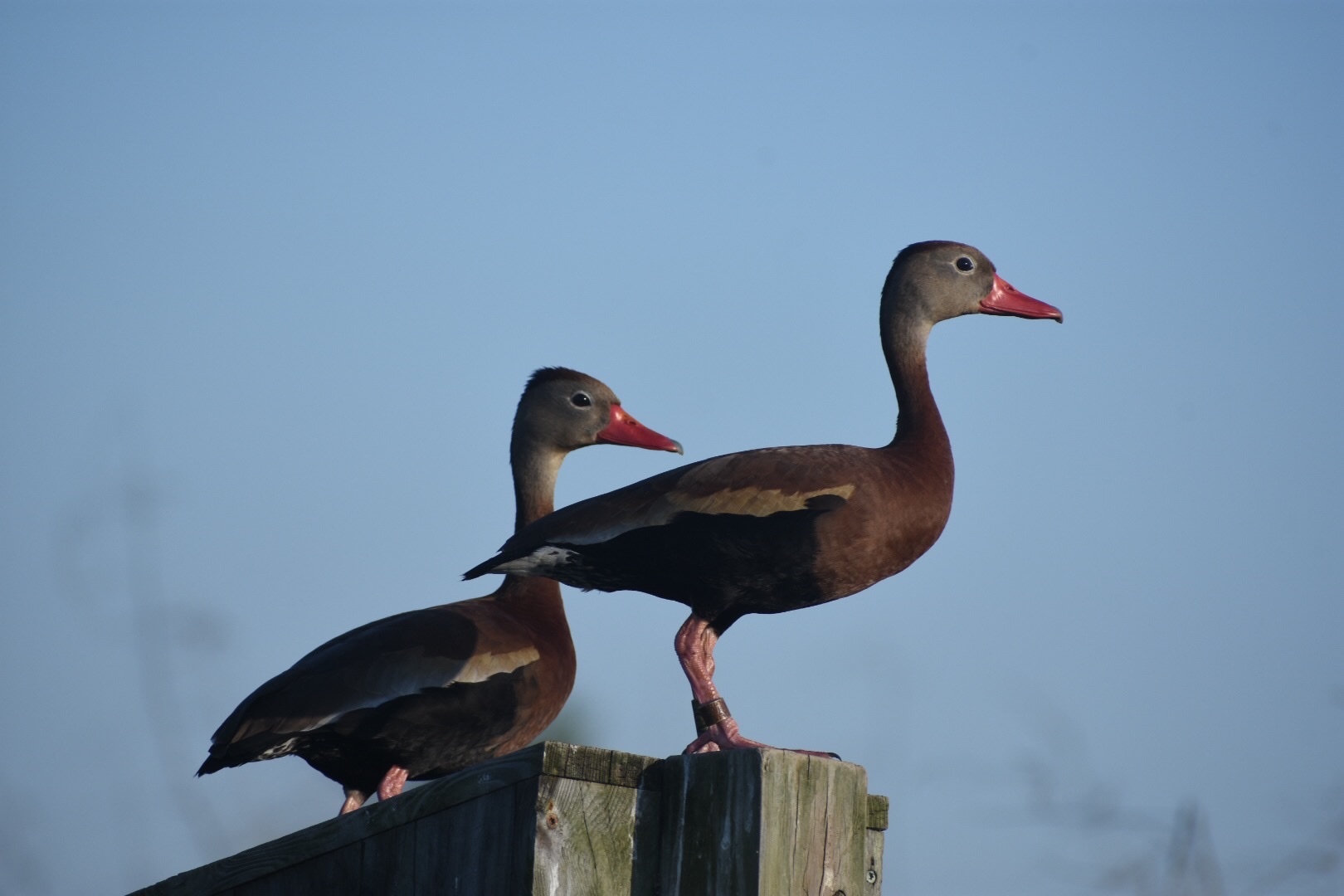
Photo Unknown photographer (opens in a new tab) / iNaturalist, CC0 1.0 (opens in a new tab)
At a glance
- Size
- About 47 to 53 cm long
- Weight
- About 650 to 1,000 g
- Habitat
- Ponds, lakes, marshes, farm fields and golf-course lakes
- Diet
- Seeds, grain, grasses and small amounts of insects and snails
- In Georgia
- Increasing; now breeds across much of the state and stays year-round in the south
- Voice
- A high, squealing whistle, often in flight
- Rabies vector
- No
Identification
- Key marks
- Bright coral-pink bill and legs; chestnut breast and back; black belly; grey face with a white eye-ring; a broad white stripe along the wing, bold in flight
- Posture
- Stands upright on long legs, more like a small goose than a duck
- Told apart from
- Fulvous whistling-duck, which is tawny all over and lacks the black belly and pink bill
- Told apart from
- Wood duck, which nests in the same cavities but has a crest, short legs and a dark bill
- Where to look
- Perched on fences, rooftops and dead trees near water, or grazing in fields
Behaviour
Black-bellied whistling-ducks spend much of their time out of the water, standing on banks, perching on branches and fences, and grazing in fields and lawns. They feed mostly at dusk and through the night, and flocks call constantly in flight with a squealing, whistled "pe-che-che-ne".
They pair for long periods, often for life, and both parents care for the young, which is unusual among ducks.
Why they matter
These ducks eat large amounts of weed seed and waste grain, and their spread across the Southeast since the 1980s is one of the clearest recent changes in the region's birdlife.
They take readily to nest boxes, and in places where old hollow trees have been cleared the boxes put up for wood ducks now raise both species.
Reproduction and lifecycle
Nest — A tree hollow, nest box or sometimes a spot on the ground, with no added lining
Eggs — Usually 12 to 16 white eggs; some boxes hold more laid by several females
Incubation — About 25 to 30 days, shared by both parents
Hatching — Ducklings leave the nest within a day or two, dropping to the ground
Young — Both parents guard them; they feed themselves from the start
Flight — At about eight weeks old
Lifespan — Several years; wild birds over eight years are recorded
Living around people
- Nest boxes built for wood ducks suit them too, mounted over water or at a pond's edge with a predator guard below.
- They graze lawns and golf courses beside ponds and do no harm there.
- Ducklings dropping from a nest box to the ground is normal; the parents lead them to water.
- Fishing line and hooks left at pond edges tangle legs and bills.
Misconceptions
- Ducklings alone on the ground under a nest box have fallen out. They jumped, as they are meant to. The parents call them together and walk them to water; keeping people and pets back is the help they need.
- Ducks that perch in trees must be escaped pets. Whistling-ducks perch as naturally as they swim.
- They are a tropical bird that got lost. They have spread north and now breed widely in Georgia.
Related species
Seasonal activity
When this species is breeding, and when there are nests on the ground. Mowing during the shaded months is how most nests are found.
| Jan | Feb | Mar | Apr | May | Jun | Jul | Aug | Sep | Oct | Nov | Dec | |
|---|---|---|---|---|---|---|---|---|---|---|---|---|
| Breeding | Jan: no | Feb: no | Mar: no | Apr: no | May: no | Jun: no | Jul: no | Aug: no | Sep: no | Oct: no | Nov: no | Dec: no |
| Active nests | Jan: no | Feb: no | Mar: no | Apr: no | May: no | Jun: no | Jul: no | Aug: no | Sep: no | Oct: no | Nov: no | Dec: no |
| Notes | Flocks on ponds in south Georgia; fewer farther north | Pairs forming | Pairs searching for tree hollows and nest boxes | Egg laying begins | Nesting; males share incubation | First broods on the water | Broods on ponds; some pairs nest twice | Late broods | Young flying; flocks gather | Flocks feed in harvested fields | Many move south; flocks remain in the south of the state | Wintering flocks |
Where it lives
Recorded in 52 states and provinces. Each one links to the other animals there, and to the rehabilitators licensed for them.
United States
- Alabamabreeding
- Arizonabreeding
- Arkansasbreeding
- Delaware
- Florida
- Georgiabreeding
- Illinoisbreeding
- Indianabreeding
- Iowabreeding
- Kansasbreeding
- Kentuckybreeding
- Louisiana
- Michigan
- Mississippibreeding
- Missouribreeding
- Nebraskabreeding
- New Jerseybreeding
- North Carolina
- Ohiobreeding
- Oklahomabreeding
- South Carolina
- Tennesseebreeding
- Texas
Canada
Mexico
- Aguascalientespassing through
- Baja California Sur
- Campeche
- Chiapas
- Chihuahua
- Coahuilabreeding
- Colima
- Durangobreeding
- Guanajuatobreeding
- Guerrero
- Hidalgopassing through
- Jalisco
- Michoacanbreeding
- Morelos
- Nayarit
- Nuevo Leon
- Oaxaca
- Pueblabreeding
- Queretarobreeding
- Quintana Roo
- San Luis Potosibreeding
- Sinaloa
- Sonora
- State of Mexicobreeding
- Tabasco
- Tamaulipas
- Veracruz
- Yucatan
If you found one
Answer a few questions and you will get a specific answer for what you are looking at.
I found an animal