
Species
Mallard
Anas platyrhynchos
The familiar green-headed duck of park ponds, ancestor of most farmyard ducks.
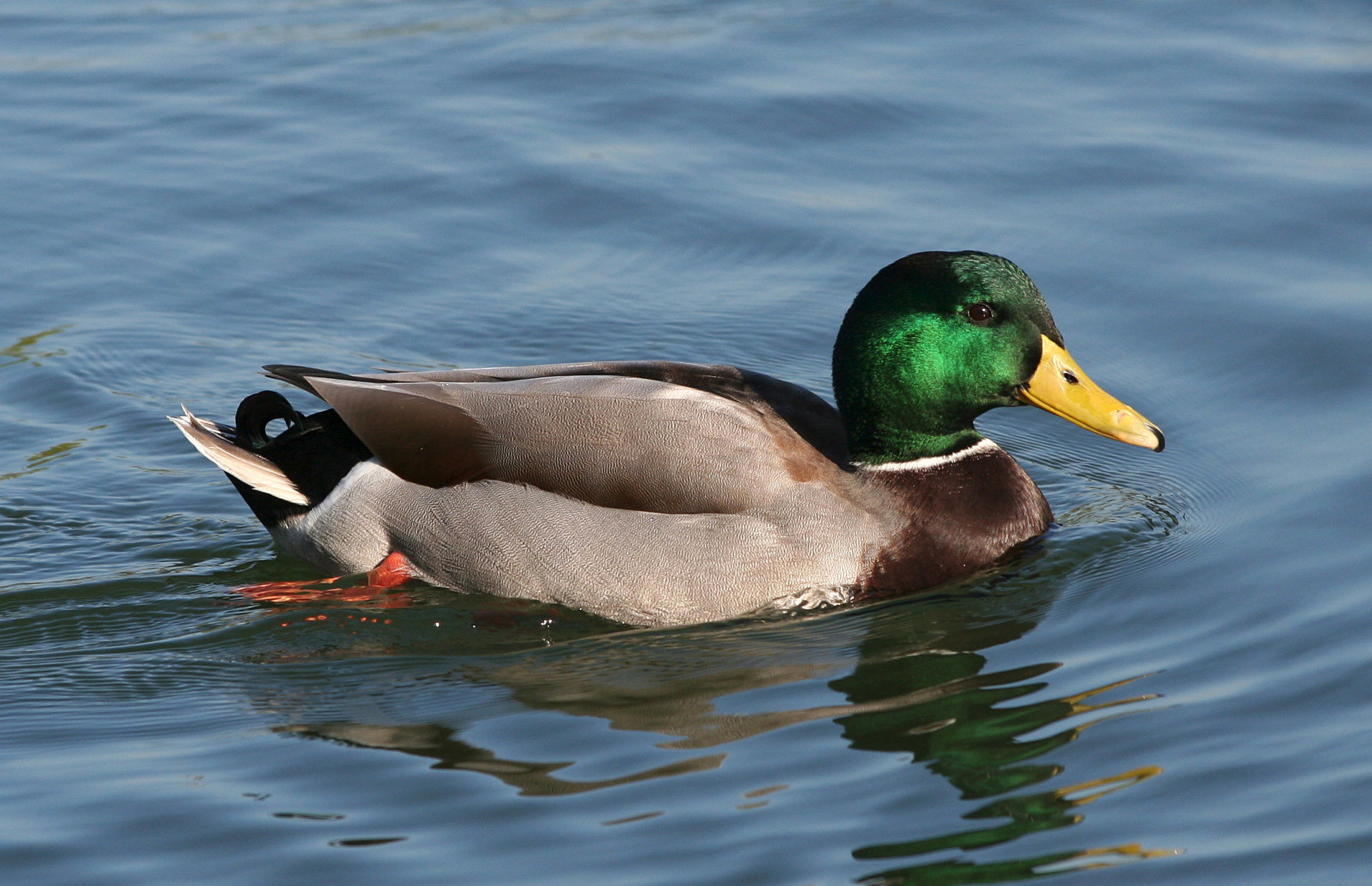
Photo Calibas (edit by Aqwis ) (opens in a new tab) / Wikimedia Commons, CC BY-SA 3.0 (opens in a new tab)
At a glance
- Size
- About 50 to 65 cm long
- Weight
- About 1 to 1.3 kg
- Habitat
- Almost any fresh water: ponds, lakes, rivers, marshes and city parks
- Diet
- Seeds, plants, insects, snails and grain
- In Georgia
- Common all year; wild migrants join resident and park birds in winter
- Voice
- The female's loud "quack"; the male's softer, rasping note
- Rabies vector
- No
Identification
- Male
- Glossy green head; white neck ring; chestnut breast; grey body; yellow bill
- Female
- Mottled brown with an orange-and-black bill
- Both
- A blue wing patch edged with white on both sides
- Told apart from
- Mottled duck and American black duck, which are darker and lack the white borders to the wing patch
- Told apart from
- Domestic ducks, which are often heavier, blotchy or all white and fly poorly
- Where to look
- Nearly any pond, lake or stream
Behaviour
Mallards dabble, tipping forward to feed below the surface with their tails in the air. They adapt to almost anything, which is why they are the most familiar duck in the world.
Females raise the ducklings alone. The male leaves once incubation begins.
Why they matter
Mallards are the wild ancestor of almost every domestic duck breed, and they have lived alongside people longer than most wild birds. They also carry seeds of wetland plants from pond to pond on their feet and in their gut, helping plants reach new water.
Reproduction and lifecycle
Nest — A bowl of plants and down on the ground, hidden in vegetation, sometimes far from water
Eggs — Usually 8 to 13
Incubation — About 26 to 30 days, by the female alone
Ducklings — Leave the nest within a day; the female leads them to water
Flight — At about eight weeks
Lifespan — Usually a few years; some over twenty
Living around people
- Mallards nest in gardens, planters and courtyards far from water. A nest in an odd place is best left alone; the mother will walk the ducklings to water.
- Ducklings following their mother across a road need only time; stopping traffic briefly is the kindest help.
- Bread swells in a duck's stomach and fills it without nourishing it, and crowds of fed ducks spread disease.
- Released domestic ducks interbreed with wild mallards and cannot survive long on their own.
Misconceptions
- A mallard nesting far from water has made a mistake. She will lead the ducklings to water within a day of hatching.
- Ducklings need to be fed bread. Ducklings feed themselves on insects and plants from the start.
- A lone duckling can be reunited by putting it anywhere near ducks. Other females may attack it; it needs its own mother or a rehabilitator.
Related species
Seasonal activity
When this species is breeding, and when there are nests on the ground. Mowing during the shaded months is how most nests are found.
| Jan | Feb | Mar | Apr | May | Jun | Jul | Aug | Sep | Oct | Nov | Dec | |
|---|---|---|---|---|---|---|---|---|---|---|---|---|
| Breeding | Jan: no | Feb: no | Mar: no | Apr: no | May: no | Jun: no | Jul: no | Aug: no | Sep: no | Oct: no | Nov: no | Dec: no |
| Active nests | Jan: no | Feb: no | Mar: no | Apr: no | May: no | Jun: no | Jul: no | Aug: no | Sep: no | Oct: no | Nov: no | Dec: no |
| Notes | Pairs forming; courtship displays | Pairs searching for nest sites | Egg laying | Incubation; first broods | Broods on the water | Late broods; males moulting | Adults flightless for a few weeks | Young flying | Flocks gather | Northern migrants begin arriving | Wintering flocks | Courtship begins again |
Where it lives
Recorded in 78 states and provinces. Each one links to the other animals there, and to the rehabilitators licensed for them.
United States
- Alabama
- Alaska
- Arizona
- Arkansasin winter
- California
- Colorado
- Connecticut
- Delaware
- District of Columbia
- Florida
- Georgia
- Hawaiiintroduced
- Idaho
- Illinois
- Indiana
- Iowa
- Kansasin winter
- Kentuckyin winter
- Louisiana
- Maine
- Maryland
- Massachusetts
- Michigan
- Minnesota
- Mississippi
- Missouri
- Montana
- Nebraska
- Nevada
- New Hampshire
- New Jersey
- New Mexico
- New York
- North Carolina
- North Dakota
- Ohio
- Oklahoma
- Oregon
- Pennsylvania
- Rhode Island
- South Carolina
- South Dakota
- Tennessee
- Texas
- Utah
- Vermont
- Virginia
- Washington
- West Virginiain winter
- Wisconsin
- Wyoming
Canada
If you found one
Answer a few questions and you will get a specific answer for what you are looking at.
I found an animal