
Species
Wild pig
Sus scrofa
A clever, adaptable pig brought to North America by people, now living wild across much of the South.
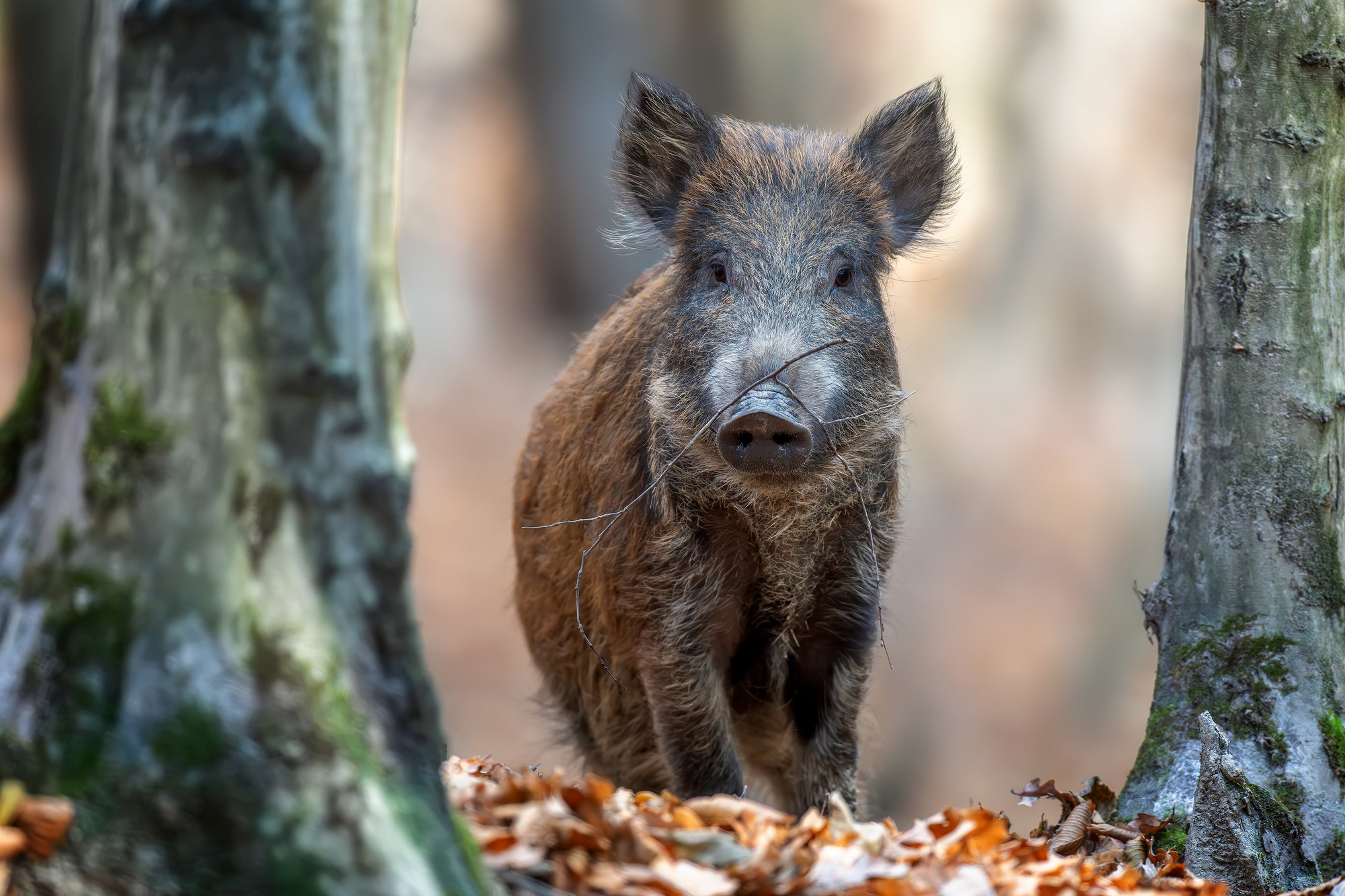
Photo Byrdyak (opens in a new tab) / Wikimedia Commons, CC BY-SA 4.0 (opens in a new tab)
At a glance
- Size
- Body about 1.3 to 1.8 m long; about 60 to 90 cm tall at the shoulder
- Weight
- Usually about 40 to 110 kg; large males can be heavier
- Habitat
- Forests, swamps, river bottoms, farmland and brushland
- Diet
- Roots, tubers, acorns, fruit, grasses, insects, worms, eggs, small animals and carrion
- Active
- Mostly night and dusk, especially where hunted
- Shelter
- Beds of grass and brush in thick cover; wallows in mud
- Origin
- Descended from domestic pigs and Eurasian wild boar brought by people
- Rabies vector
- No
Identification
- Key marks
- Stocky body; long snout ending in a flat disc; coarse, bristly hair in black, brown, red or mixed colours; small eyes; males have curved tusks
- Signs
- Large areas of rooted-up soil; muddy wallows; rubs on trees
- Told apart from
- Domestic pigs, which are usually larger, less bristly and pinker, though feral pigs vary
- Where to look
- Bottomland forests and farmland across much of Georgia; signs of rooting are far more often seen than the animals
Behaviour
Wild pigs live in groups called sounders, made up of related females and their young; adult males usually travel alone and join sounders to mate. They are highly intelligent, learn quickly and change their habits when disturbed, becoming more active at night where they are hunted.
They root through the soil with their snouts for food, and wallow in mud to cool off and protect their skin, as they have no sweat glands.
In the Southeast their ancestors include pigs brought by Spanish expeditions in the 1500s, later domestic pigs that went wild, and Eurasian wild boar released for hunting.
Why they matter
Wild pigs are intelligent, sociable animals with deep family bonds, and their ability to thrive almost anywhere is a mark of how capable they are.
They are also an introduced animal whose rooting damages farmland, forest floors, wetlands and the nests of ground-nesting birds and turtles, and which can spread diseases to livestock, pets and people. That problem was made by people moving pigs; the animals are living as pigs do.
Reproduction and lifecycle
Breeding — all year, often with peaks in winter and summer
Gestation — about 114 days
Litter — usually four to eight piglets, born in a grass nest
Weaning — at about three months old
Maturity — females can breed at six to eight months old
Litters per year — up to two
Lifespan — several years
Living around people
- Never feed wild pigs; it draws them close to homes and makes them bolder.
- Keep dogs away from wild pigs; a cornered pig or a sow with piglets can injure a dog seriously.
- Wear gloves when handling a dead wild pig; they can carry diseases such as brucellosis.
- Secure rubbish, pet food and compost to keep them from visiting.
Misconceptions
- Wild pigs are native wildlife. They are descended from pigs brought by people.
- Wild pigs are stupid. They are among the most intelligent animals in the forest.
- Wild pigs are villains. They are pigs, living where people put them.
Related species
Seasonal activity
When this species is breeding, and when there are nests on the ground. Mowing during the shaded months is how most nests are found.
| Jan | Feb | Mar | Apr | May | Jun | Jul | Aug | Sep | Oct | Nov | Dec | |
|---|---|---|---|---|---|---|---|---|---|---|---|---|
| Breeding | Jan: no | Feb: no | Mar: no | Apr: no | May: no | Jun: no | Jul: no | Aug: no | Sep: no | Oct: no | Nov: no | Dec: no |
| Active nests | Jan: no | Feb: no | Mar: no | Apr: no | May: no | Jun: no | Jul: no | Aug: no | Sep: no | Oct: no | Nov: no | Dec: no |
| Notes | Sounders feed on acorns and roots | Breeding can occur year-round | Piglets born in grass nests | Rooting increases in soft spring soil | Piglets follow the sounder | Wallowing increases in heat | More active at night in hot weather | Piglets weaned | Feeding on early acorns and crops | Acorn crop draws pigs into oak woods | Breeding | Feeding heavily on acorns |
Where it lives
Recorded in 25 states and provinces. Each one links to the other animals there, and to the rehabilitators licensed for them.
United States
- Alabamaintroduced
- Arizonaintroduced
- Arkansasintroduced
- Californiaintroduced
- Floridaintroduced
- Georgiaintroduced
- Hawaiiintroduced
- Kentuckyintroduced
- Louisianaintroduced
- Mississippiintroduced
- Missouriintroduced
- Nevadaintroduced
- New Mexicointroduced
- North Carolinaintroduced
- Ohiointroduced
- Oklahomaintroduced
- Oregonintroduced
- South Carolinaintroduced
- Tennesseeintroduced
- Texasintroduced
- Virginiaintroduced
- West Virginiaintroduced
If you found one
Answer a few questions and you will get a specific answer for what you are looking at.
I found an animal