
Species
Virginia opossum
Didelphis virginiana
North America's only native marsupial, a nocturnal omnivore with a bare prehensile tail and an unusually short pregnancy.
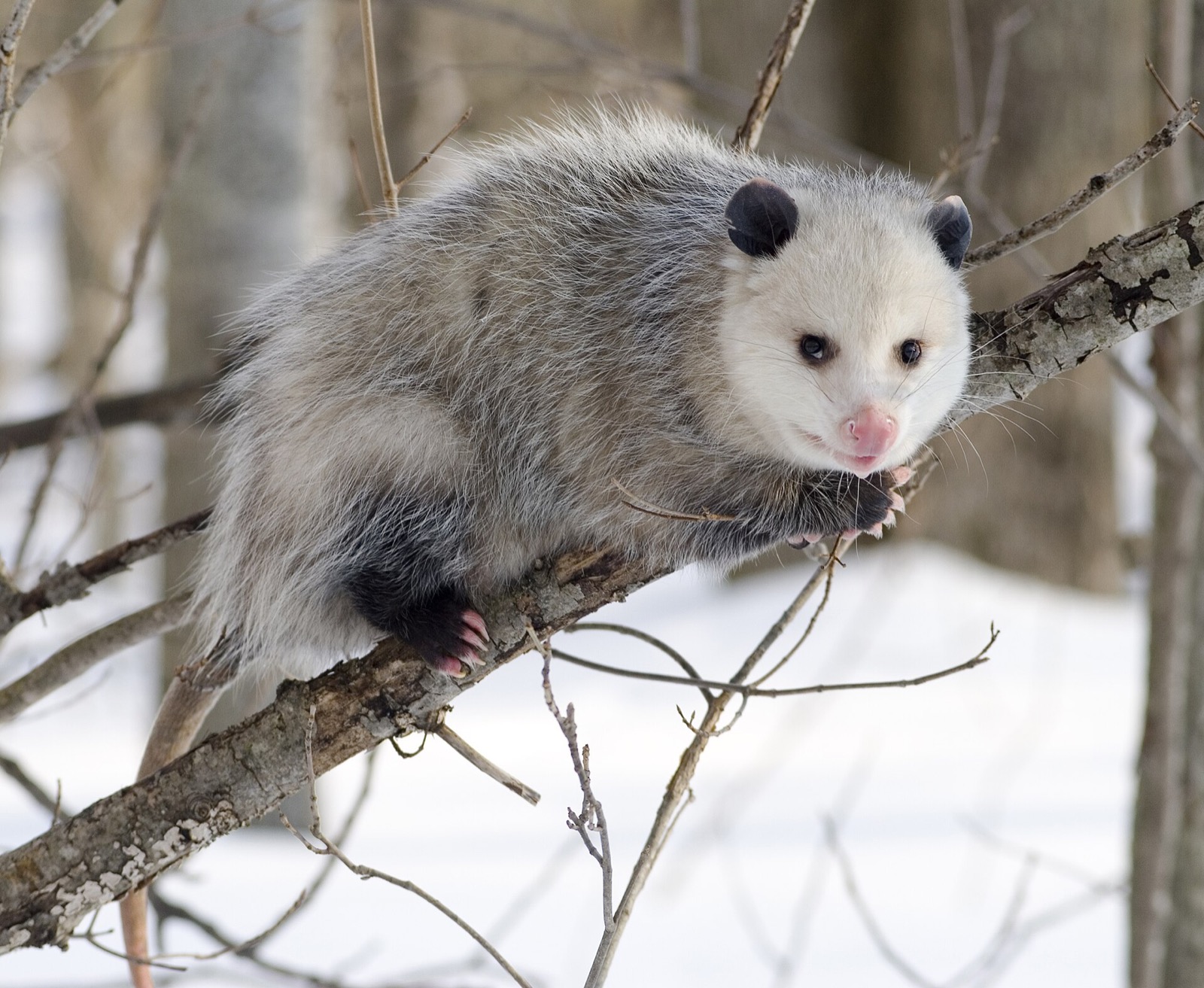
Photo Cody Pope (opens in a new tab), CC BY-SA 2.5 (opens in a new tab)
At a glance
- Occurrence
- Native to North America
- Habitat
- Woodlands, wetlands, farms, suburbs and towns, especially where cover and food are close together
- Diet
- Insects, carrion, fruit, seeds, small animals and other available foods
- Activity
- Mostly nocturnal, with some daylight activity when food demands are high
- Shelter
- Tree cavities, hollow logs, brush piles and sheltered spaces; dens are usually temporary
- Social pattern
- Mostly solitary outside breeding and a mother with young
- Rabies vector
- No
Identification
- Key marks
- A pointed pale face, dark rounded ears, coarse grey body fur and a long nearly hairless tail
- Told apart from
- Raccoon, which has a black facial mask and a furry ringed tail
- Where to look
- Woodlands, wetlands, farms, suburbs and towns, especially where cover and food are close together
Behaviour
It is mostly nocturnal, with some daylight activity when food demands are high. It uses habitats including woodlands, wetlands, farms, suburbs and towns, especially where cover and food are close together. It feeds on insects, carrion, fruit, seeds, small animals and other available foods.
It moves deliberately on the ground and climbs well. The tail can grip branches and nesting material but is not used to hang for long periods.
Females carry very small newborns in a pouch; older young may ride on the mother's back.
Why they matter
Opossums consume carrion, insects, fruit and many other foods, moving nutrients through both forest and neighbourhood food webs. They are also prey for larger carnivores and owls.
Their marsupial reproduction is unlike that of every other native North American mammal: development continues in the pouch after a pregnancy of less than two weeks.
Reproduction and lifecycle
Mating — breeding can begin in late winter and continue through much of the warm season, starting later in the north.
Gestation — about 12–13 days, one of the shortest pregnancies of any mammal.
Pouch stage — newborns attach to teats in the pouch for roughly two months.
Dependent juvenile — young later ride on the mother and use the den, becoming independent at roughly 3–4 months.
Living around people
- Keep pet food, rubbish and compost secured; accessible food can draw opossums into conflict with people.
- Check under decks, sheds and brush piles before sealing openings or moving material, especially in spring and summer.
- Drive carefully at night; opossums often freeze or move slowly when crossing roads.
- Keep cats and dogs from cornering one. An opossum's open mouth and hissing are defensive warnings, not pursuit.
Misconceptions
- Opossums are major rabies carriers. They can contract rabies, but they are not a rabies vector species and rabies is uncommon in opossums.
- An opossum showing its teeth is attacking. Hissing, drooling and showing many teeth are defensive displays used when escape feels impossible.
- A mother will notice every youngster that falls off. Young ride on the mother's back after leaving the pouch, and a separated juvenile may be left behind if it cannot keep up.
Seasonal activity
When this species is breeding, and when there are nests on the ground. Mowing during the shaded months is how most nests are found.
| Jan | Feb | Mar | Apr | May | Jun | Jul | Aug | Sep | Oct | Nov | Dec | |
|---|---|---|---|---|---|---|---|---|---|---|---|---|
| Breeding | Jan: no | Feb: no | Mar: no | Apr: no | May: no | Jun: no | Jul: no | Aug: no | Sep: no | Oct: no | Nov: no | Dec: no |
| Active nests | Jan: no | Feb: no | Mar: no | Apr: no | May: no | Jun: no | Jul: no | Aug: no | Sep: no | Oct: no | Nov: no | Dec: no |
| Notes | Active on mild nights; the first breeding period can begin and females may be carrying pouch young. | Breeding continues; adults forage widely and some females have tiny pouch young. | Young are developing in the pouch while a second wave of breeding may occur. | Many females have pouch young or older young beginning to ride outside the pouch. | Warm nights support heavy foraging; dependent young may travel with the mother. | Juveniles from early litters become independent; later litters may still be in the pouch. | Active nightly; fruit, insects and other summer foods are abundant. | Young animals disperse and road crossings increase as they establish ranges. | Foraging remains strong as late-summer fruit and insects are available. | Animals build body reserves but do not hibernate. | Active on mild nights; colder spells can keep opossums sheltered for longer periods. | Still active through winter whenever temperatures allow; no true hibernation occurs. |
If you found one
Answer a few questions and you will get a specific answer for what you are looking at.
I found an animal