
Species
Nine-banded armadillo
Dasypus mexicanus
An armoured insect-eater that spread north into the Southeast and always gives birth to identical quadruplets.
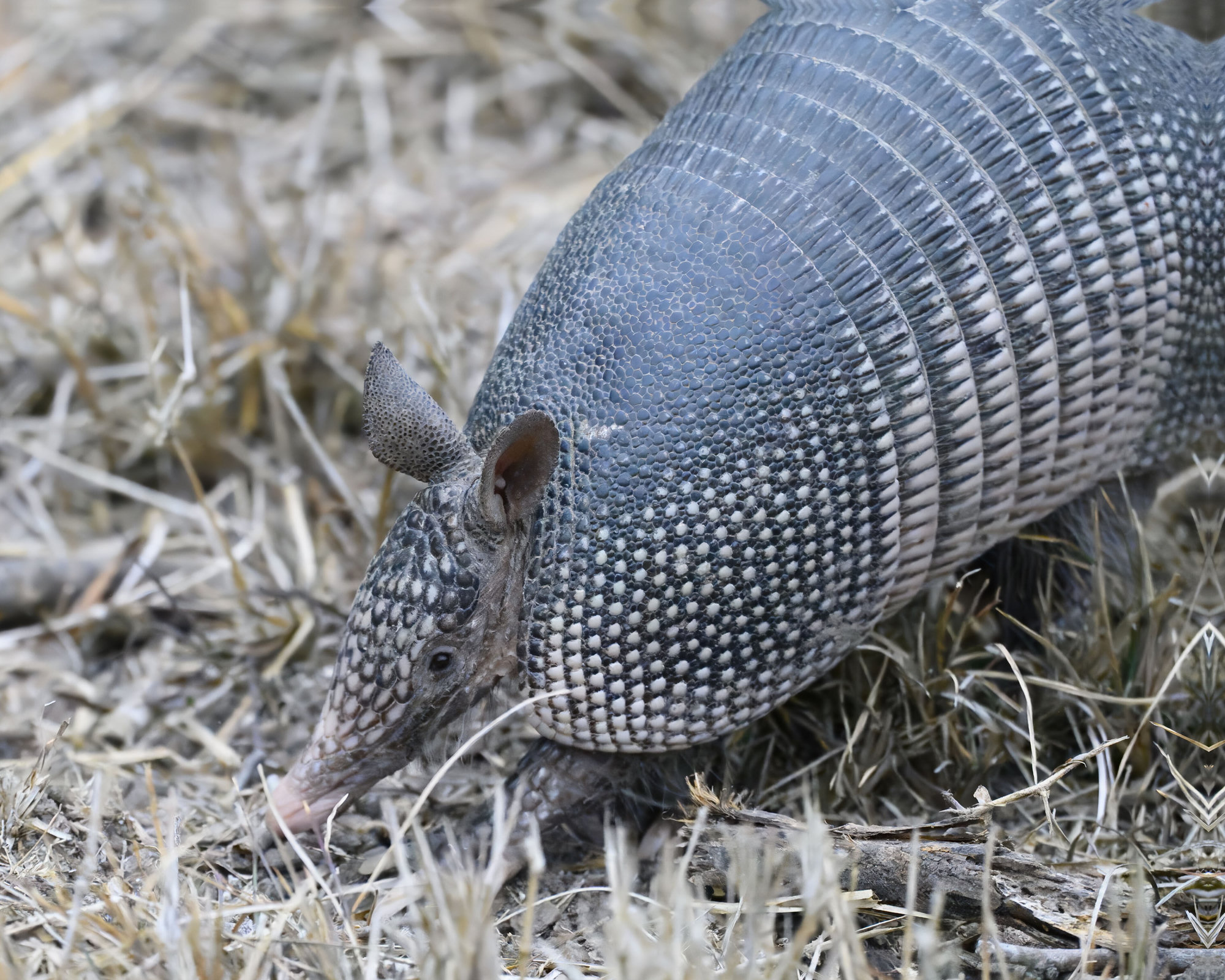
Photo lwolfartist (opens in a new tab) / Wikimedia Commons, CC BY 2.0 (opens in a new tab)
At a glance
- Size
- Body about 38 to 58 cm; tail about 26 to 37 cm
- Weight
- About 2.5 to 6.5 kg
- Habitat
- Woods, fields, brushland and suburbs with loose soil, across the southern United States
- Diet
- Beetles and their grubs, ants, termites, earthworms, other invertebrates, and some fruit and carrion
- Active
- Mostly night in summer; more by day in cool weather
- Shelter
- Burrows it digs, often several, in banks, under stumps and beneath buildings
- Young
- Almost always four identical young
- Rabies vector
- No
Identification
- Key marks
- A shell of bony plates covered in leathery skin, with nine (sometimes eight to eleven) flexible bands across the middle; long, pointed snout; long, tapering, armoured tail; large ears
- Signs
- Small, cone-shaped holes rooted in lawns and beds, and burrow entrances about 15 to 20 cm across
- Told apart from
- No other North American animal
- Where to look
- Crossing roads at night; rooting in lawns, gardens and woods
Behaviour
Armadillos find food by smell, snuffling along with their snout close to the ground and digging quickly with their strong claws to reach grubs and insects. They have poor eyesight and can be surprisingly oblivious to people.
When startled, they often jump straight up — which is why so many are killed by cars that would otherwise have passed over them. They can cross streams by walking along the bottom, holding their breath for several minutes, or by gulping air to float.
The species expanded north from Mexico across Texas and the Gulf states during the nineteenth and twentieth centuries, spreading into Georgia over the last century, and it continues to move north.
Why they matter
Armadillos eat vast numbers of insects and their larvae, including fire ants and beetle grubs, and their burrows are used as shelter by rabbits, snakes, opossums and other animals.
They are also a biological puzzle: each litter comes from a single fertilised egg that splits into four, so all four young are genetically identical — a quirk that has made them useful to medical research.
Reproduction and lifecycle
Mating — summer
Delayed implantation — the fertilised egg rests for about three to four months before implanting
Pregnancy — about four months after implantation
Birth — late winter and spring, almost always four identical young, born with soft shells
Weaning — at about two to three months old
Independence — within several months
Lifespan — often several years in the wild
Living around people
- Most armadillo deaths are on roads at night; they jump up when startled rather than running.
- They root in lawns for grubs; reducing grubs reduces digging.
- Wear gloves if handling an armadillo; some carry the bacterium that causes Hansen's disease (leprosy), though the risk from casual contact is very low.
- A burrow under a porch can be closed after the animal has left, making sure no young are inside.
Misconceptions
- Armadillos roll into a ball. Only the three-banded armadillos of South America can do that; the nine-banded armadillo runs or digs.
- Armadillos are pests that harm the garden. They eat grubs, beetles and fire ants; the holes are the price of that service.
- An armadillo on the road will run out of the way. It is more likely to leap straight up.
Related species
Seasonal activity
When this species is breeding, and when there are nests on the ground. Mowing during the shaded months is how most nests are found.
| Jan | Feb | Mar | Apr | May | Jun | Jul | Aug | Sep | Oct | Nov | Dec | |
|---|---|---|---|---|---|---|---|---|---|---|---|---|
| Breeding | Jan: no | Feb: no | Mar: no | Apr: no | May: no | Jun: no | Jul: no | Aug: no | Sep: no | Oct: no | Nov: no | Dec: no |
| Active nests | Jan: no | Feb: no | Mar: no | Apr: no | May: no | Jun: no | Jul: no | Aug: no | Sep: no | Oct: no | Nov: no | Dec: no |
| Notes | More active in the daytime during cold weather | Four young born, identical quadruplets | Young follow their mother on foraging trips | Young begin feeding on their own | Active mostly at dusk and night as it warms | Mating season begins | Mating; the fertilised egg does not implant for several months | Active at night | Young of the year disperse | Active at night; feeding heavily on grubs | Implantation takes place; pregnancy develops | More active by day in cool weather |
Where it lives
Recorded in 46 states and provinces. Each one links to the other animals there, and to the rehabilitators licensed for them.
United States
If you found one
Answer a few questions and you will get a specific answer for what you are looking at.
I found an animal