
Species
Southeastern pocket gopher
Geomys pinetis
An almost wholly underground rodent of southern sandhills, known in Georgia as the salamander.
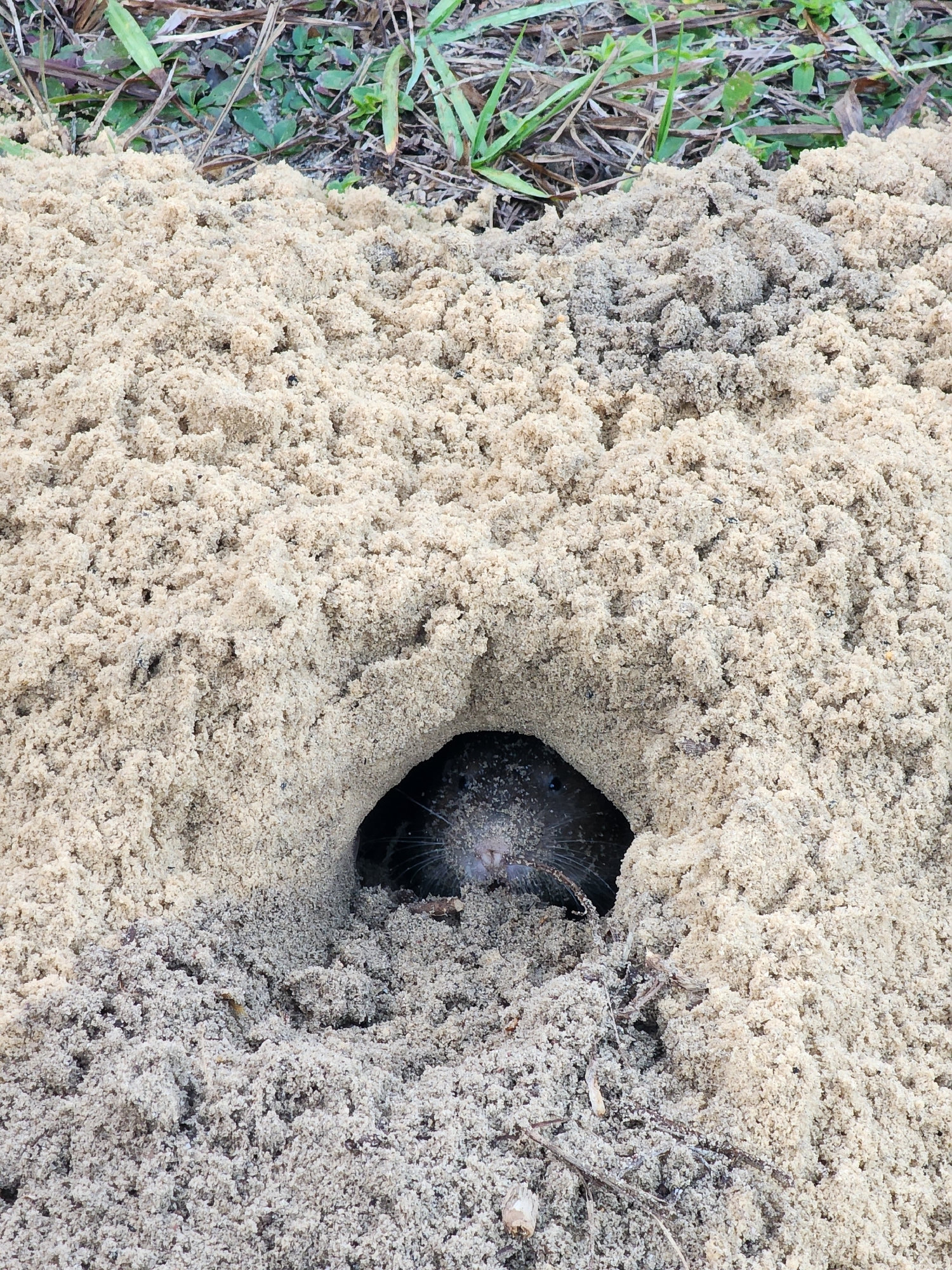
Photo lawnkiller (opens in a new tab) / iNaturalist, CC BY-NC 4.0 (opens in a new tab)
At a glance
- Size
- Body about 15 to 20 cm; tail about 7 to 10 cm
- Weight
- About 150 to 250 g
- Habitat
- Deep, sandy soils in longleaf pine sandhills, old fields, pastures and lawns of the coastal plain
- Diet
- Roots, tubers, bulbs and the stems of grasses and other plants, often pulled underground
- Active
- Day and night, underground
- Shelter
- Extensive burrow systems with nest and food chambers
- Lifespan
- A few years
- Rabies vector
- No
Identification
- Key marks
- Stocky; cinnamon to brown fur; large, strong front claws; small eyes and ears; fur-lined cheek pouches opening outside the mouth
- Signs
- Rows of loose sand mounds, with no open hole, running across fields and lawns
- Told apart from
- Moles, whose ridges are raised tunnels rather than separate mounds and whose front feet are broad paddles
- Where to look
- The animal itself is seldom seen above ground; its mounds are common in south Georgia sandhills
Behaviour
Pocket gophers spend almost their entire lives underground, digging long tunnel systems with their claws and teeth and pushing the loose sand to the surface in mounds, then plugging the opening. Each gopher lives alone in its own burrow system.
They carry food and nesting material in their external cheek pouches, which they can turn inside out to empty and clean.
Their Georgia name, "salamander", is thought to be a corruption of "sandy mounder".
Why they matter
Pocket gophers are important soil engineers of the southern sandhills. Their digging turns over large amounts of sand, mixing nutrients into the soil and creating bare patches where wildflowers and grasses can take root.
Their burrows are also used by other animals, and in longleaf pine country they are part of the same underground world as the gopher tortoise.
Reproduction and lifecycle
Breeding — much of the year, with peaks in late winter and summer
Litter — usually one to three young
Leaving the burrow — within a few weeks
Lifespan — a few years
Much of this species' breeding biology is not well recorded.
Living around people
- Mounds in lawns and pastures are a sign of a gopher; they do not harm people or pets.
- Poisons used on gophers can harm other wildlife and pets.
- Longleaf sandhills with deep, loose sand are their home; development and soil compaction remove it.
Misconceptions
- A "salamander" in Georgia is always an amphibian. In sandhill country it is also the local name for this gopher.
- Gophers and moles are the same. Pocket gophers are rodents that eat plants; moles are insect-eaters.
- Gophers and gopher tortoises are related. They share a name and a habitat, not a family.
Related species
Seasonal activity
When this species is breeding, and when there are nests on the ground. Mowing during the shaded months is how most nests are found.
| Jan | Feb | Mar | Apr | May | Jun | Jul | Aug | Sep | Oct | Nov | Dec | |
|---|---|---|---|---|---|---|---|---|---|---|---|---|
| Breeding | Jan: no | Feb: no | Mar: no | Apr: no | May: no | Jun: no | Jul: no | Aug: no | Sep: no | Oct: no | Nov: no | Dec: no |
| Active nests | Jan: no | Feb: no | Mar: no | Apr: no | May: no | Jun: no | Jul: no | Aug: no | Sep: no | Oct: no | Nov: no | Dec: no |
| Notes | Digging continues; new mounds appear after rain | Breeding begins | Young born in an underground nest | Breeding continues | Young leave their mother's burrow system | Young establish burrows of their own | Breeding continues | Second litters in some areas | Mounds are especially visible after rain | Active underground | Active underground | Active underground |
Where it lives
Recorded in 3 states and provinces. Each one links to the other animals there, and to the rehabilitators licensed for them.
If you found one
Answer a few questions and you will get a specific answer for what you are looking at.
I found an animal