
Species
Snow goose
Anser caerulescens
A white goose with black wingtips that winters in noisy flocks, a few of them reaching Georgia's coast and fields.
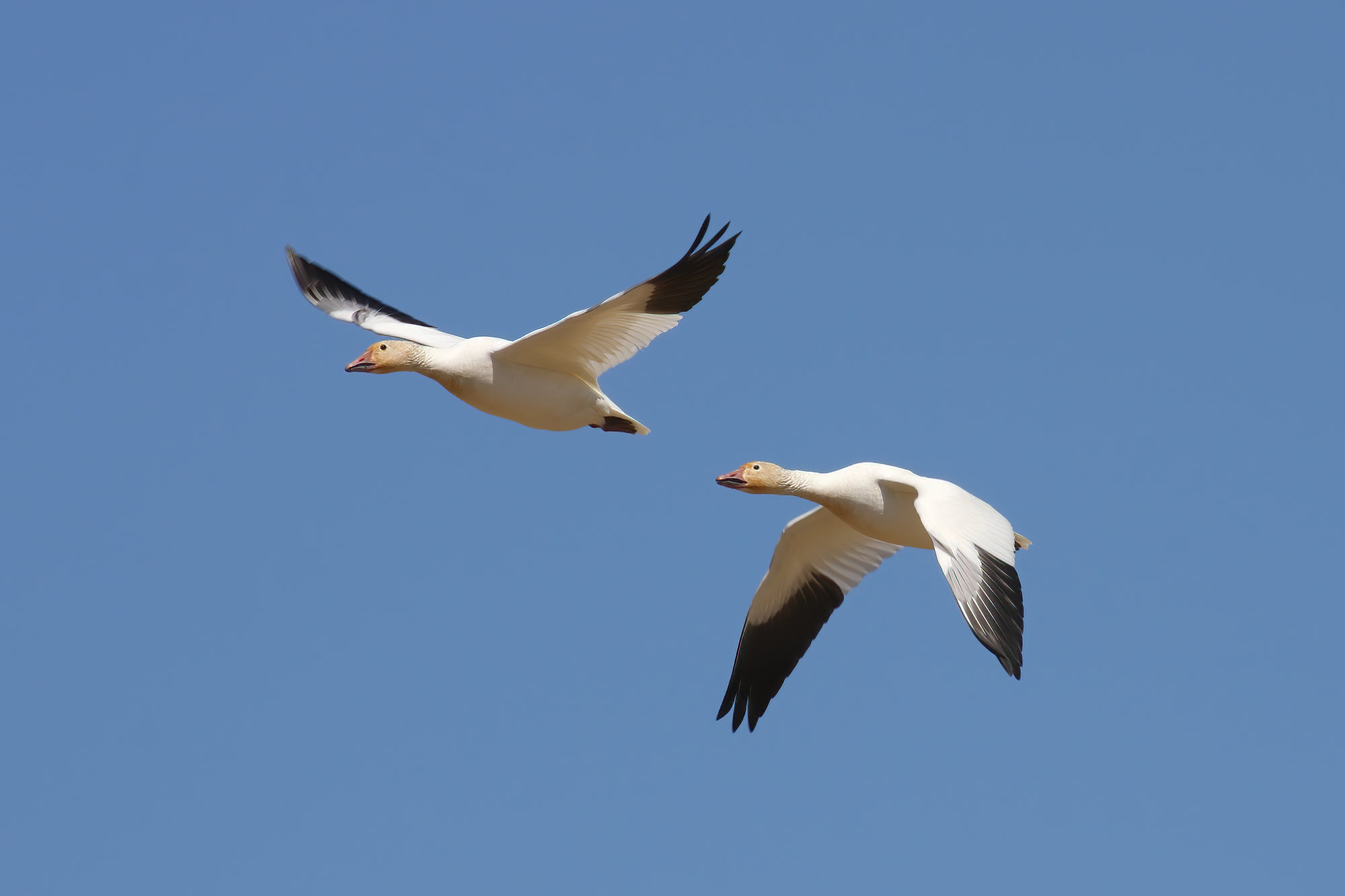
Photo Cephas (opens in a new tab) / Wikimedia Commons, CC BY-SA 3.0 (opens in a new tab)
At a glance
- Size
- About 64 to 79 cm long; wingspan about 1.4 m
- Weight
- About 2 to 3.5 kg
- Habitat
- Marshes, flooded fields and grassy fields in winter
- Diet
- Grasses, sedge roots, grain and shoots
- In Georgia
- An uncommon winter visitor, usually a few birds among Canada geese
- Voice
- A high, barking honk, constant in flocks
- Rabies vector
- No
Identification
- Key marks
- White with black wingtips, or a dark "blue" form with a white head; pink bill with a dark "grinning patch" along the edge
- Told apart from
- Ross's goose, which is smaller with a short, stubby bill and no grinning patch
- Told apart from
- Domestic white geese, which are heavier, lack black wingtips and do not fly far
- Where to look
- With Canada geese in fields, on reservoirs and at coastal refuges, November to March
Behaviour
Snow geese travel in family groups within huge flocks, and families stay together through their first winter. They feed by grubbing up roots and shoots, pulling plants from wet ground.
Most of the population winters west of Georgia, in the Mississippi Valley and on the mid-Atlantic coast; the birds that reach Georgia are usually singles or small groups.
Why they matter
Snow geese have increased greatly in the last half-century, largely by feeding on waste grain in winter. Their numbers now affect the Arctic tundra where they breed, where heavy grazing strips vegetation — a clear example of how farming on one continent reaches the far north.
A snow goose's white feathers and black wingtips are not decoration: the dark pigment strengthens the feathers that take the most wear in flight.
Reproduction and lifecycle
Nest — A shallow bowl of plants and down on the Arctic tundra
Eggs — Usually three to five
Incubation — About 22 to 25 days, by the female while the male guards
Goslings — Leave the nest within a day and feed themselves
Flight — At about six to seven weeks old
Family — Young stay with their parents through their first winter
Lifespan — Often ten years or more; some over twenty
Living around people
- A lone white goose on a pond in winter may be a lost snow goose rather than a farm bird; it needs no help unless injured.
- Geese in fields are grazing on shoots and waste grain; they move on as the season turns.
- Bread fills waterfowl without nourishing them and draws crowds that spread disease.
Misconceptions
- A white goose alone must be a domestic bird. A wild snow goose separated from its flock is usually able to fly and will rejoin others.
- The blue form is a different species. "Blue geese" are snow geese with dark feathers.
Related species
Seasonal activity
When this species is breeding, and when there are nests on the ground. Mowing during the shaded months is how most nests are found.
| Jan | Feb | Mar | Apr | May | Jun | Jul | Aug | Sep | Oct | Nov | Dec | |
|---|---|---|---|---|---|---|---|---|---|---|---|---|
| Breeding | Jan: no | Feb: no | Mar: no | Apr: no | May: no | Jun: no | Jul: no | Aug: no | Sep: no | Oct: no | Nov: no | Dec: no |
| Active nests | Jan: no | Feb: no | Mar: no | Apr: no | May: no | Jun: no | Jul: no | Aug: no | Sep: no | Oct: no | Nov: no | Dec: no |
| Notes | Wintering, usually among other geese | Wintering; some begin moving north | Most gone north | Breeding grounds in the Arctic | Nesting in the Arctic | Goslings hatch on the tundra | Adults flightless while moulting | Young learning to fly | Migration south begins | Flocks on the move through the Midwest | First birds reach Georgia | Wintering |
Where it lives
Recorded in 71 states and provinces. Each one links to the other animals there, and to the rehabilitators licensed for them.
United States
- Alabamain winter
- Alaskabreeding
- Arizonain winter
- Arkansasin winter
- Californiain winter
- Coloradoin winter
- Connecticutin winter
- Delawarein winter
- District of Columbiain winter
- Georgiain winter
- Idahoin winter
- Illinoisin winter
- Indianain winter
- Iowain winter
- Kansasin winter
- Kentuckyin winter
- Louisianain winter
- Mainein winter
- Marylandin winter
- Massachusettsin winter
- Michiganin winter
- Minnesotapassing through
- Mississippiin winter
- Missouriin winter
- Montanain winter
- Nebraskain winter
- Nevadain winter
- New Hampshirein winter
- New Jerseyin winter
- New Mexicoin winter
- New Yorkin winter
- North Carolinain winter
- North Dakotapassing through
- Ohioin winter
- Oklahomain winter
- Oregonin winter
- Pennsylvaniain winter
- Rhode Islandin winter
- South Carolinain winter
- South Dakotain winter
- Tennesseein winter
- Texasin winter
- Utahin winter
- Vermontin winter
- Virginiain winter
- Washingtonin winter
- West Virginiain winter
- Wisconsinin winter
- Wyomingin winter
Canada
If you found one
Answer a few questions and you will get a specific answer for what you are looking at.
I found an animal