
Species
Ross's goose
Anser rossii
A small white goose with a short, stubby bill, like a snow goose in miniature, seen rarely in Georgia in winter.
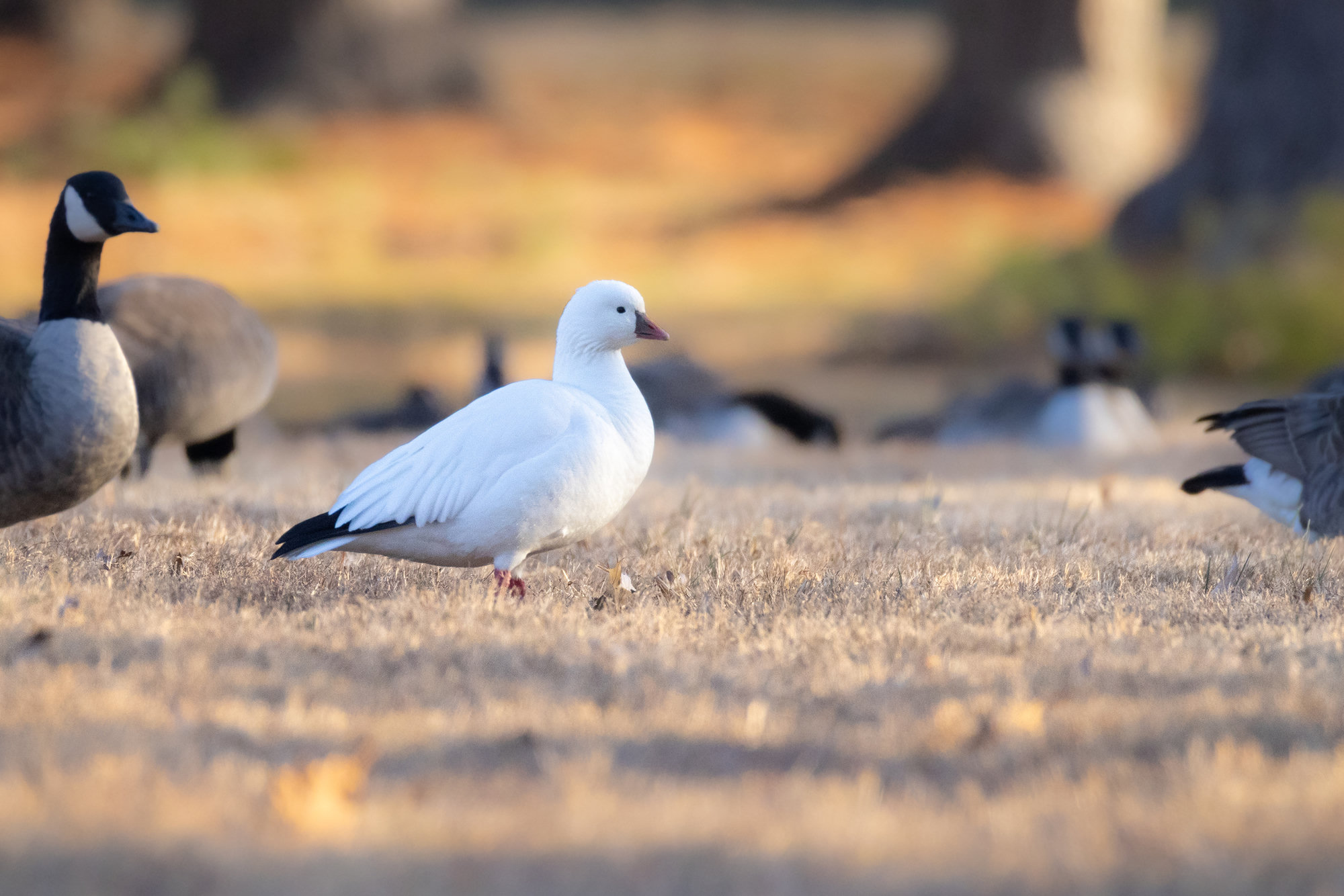
Photo Unknown photographer (opens in a new tab) / iNaturalist, CC0 1.0 (opens in a new tab)
At a glance
- Size
- About 53 to 66 cm long
- Weight
- About 1.2 to 1.6 kg
- Habitat
- Fields, marshes and ponds in winter
- Diet
- Grasses, grain and shoots
- In Georgia
- A rare but regular winter visitor, usually with snow or Canada geese
- Voice
- A soft, high cackle, higher than a snow goose
- Rabies vector
- No
Identification
- Key marks
- White with black wingtips; small rounded head; short, triangular pink bill without a dark edge; often warty-looking at the base
- Told apart from
- Snow goose, which is larger with a longer bill and a black "grinning patch"
- Told apart from
- Domestic white geese and white ducks, which lack the black wingtips
- Where to look
- Among flocks of geese on reservoirs and in fields, November to February
Behaviour
Ross's geese graze more than they dig, clipping short grass and shoots. In winter they mix with snow geese, and a single Ross's goose among Canada geese on a Georgia reservoir is a typical find.
Why they matter
The Ross's goose was once one of the rarest geese in North America, known from a small breeding area in Arctic Canada. It has since increased and spread, and its story shows how quickly a population can change when its winter food supply does.
Its small size and short bill suit it to grazing short grasses, and it can use feeding places too cropped for larger geese.
Reproduction and lifecycle
Nest — A bowl of plants and down, in colonies on Arctic islands
Eggs — Usually three to five
Incubation — About 21 to 23 days
Goslings — Leave the nest within a day
Flight — At about 40 to 45 days old
Lifespan — Wild birds over twenty years old are recorded
Living around people
- A small white goose on a farm pond in winter is worth a second look; it may be a wild Ross's goose rather than a stray domestic bird.
- Like all waterfowl, they are best left unfed.
Misconceptions
- It is a young snow goose. Young snow geese are greyish; a white goose this small with a stubby bill is a Ross's goose.
Related species
Seasonal activity
When this species is breeding, and when there are nests on the ground. Mowing during the shaded months is how most nests are found.
| Jan | Feb | Mar | Apr | May | Jun | Jul | Aug | Sep | Oct | Nov | Dec | |
|---|---|---|---|---|---|---|---|---|---|---|---|---|
| Breeding | Jan: no | Feb: no | Mar: no | Apr: no | May: no | Jun: no | Jul: no | Aug: no | Sep: no | Oct: no | Nov: no | Dec: no |
| Active nests | Jan: no | Feb: no | Mar: no | Apr: no | May: no | Jun: no | Jul: no | Aug: no | Sep: no | Oct: no | Nov: no | Dec: no |
| Notes | Wintering with other geese | Wintering; starting north late in the month | Migrating north | On the way to the Arctic | Nesting in colonies in the Arctic | Goslings hatch | Adults moult | Young learning to fly | Migration begins | Moving south through the Great Plains | A few reach the Southeast | Wintering |
Where it lives
Recorded in 58 states and provinces. Each one links to the other animals there, and to the rehabilitators licensed for them.
United States
- Alabamain winter
- Alaskabreeding
- Arizonain winter
- Arkansasin winter
- Californiain winter
- Coloradoin winter
- Connecticutin winter
- Delawarein winter
- Georgiain winter
- Idahoin winter
- Illinoisin winter
- Indianain winter
- Iowain winter
- Kansasin winter
- Kentuckyin winter
- Louisianain winter
- Marylandin winter
- Massachusettsin winter
- Michiganin winter
- Minnesotapassing through
- Mississippiin winter
- Missouriin winter
- Montanapassing through
- Nebraskain winter
- Nevadain winter
- New Hampshirepassing through
- New Jerseyin winter
- New Mexicoin winter
- New Yorkin winter
- North Carolinain winter
- North Dakotapassing through
- Ohioin winter
- Oklahomain winter
- Oregonin winter
- Pennsylvaniain winter
- Rhode Islandin winter
- South Carolinain winter
- South Dakotain winter
- Tennesseein winter
- Texasin winter
- Utahin winter
- Vermontpassing through
- Virginiain winter
- Washingtonin winter
- West Virginiain winter
- Wisconsinin winter
- Wyomingin winter
Canada
If you found one
Answer a few questions and you will get a specific answer for what you are looking at.
I found an animal