
Species
Canada goose
Branta canadensis
The big black-necked goose with the white chinstrap, now a year-round resident on Georgia's lakes and lawns.
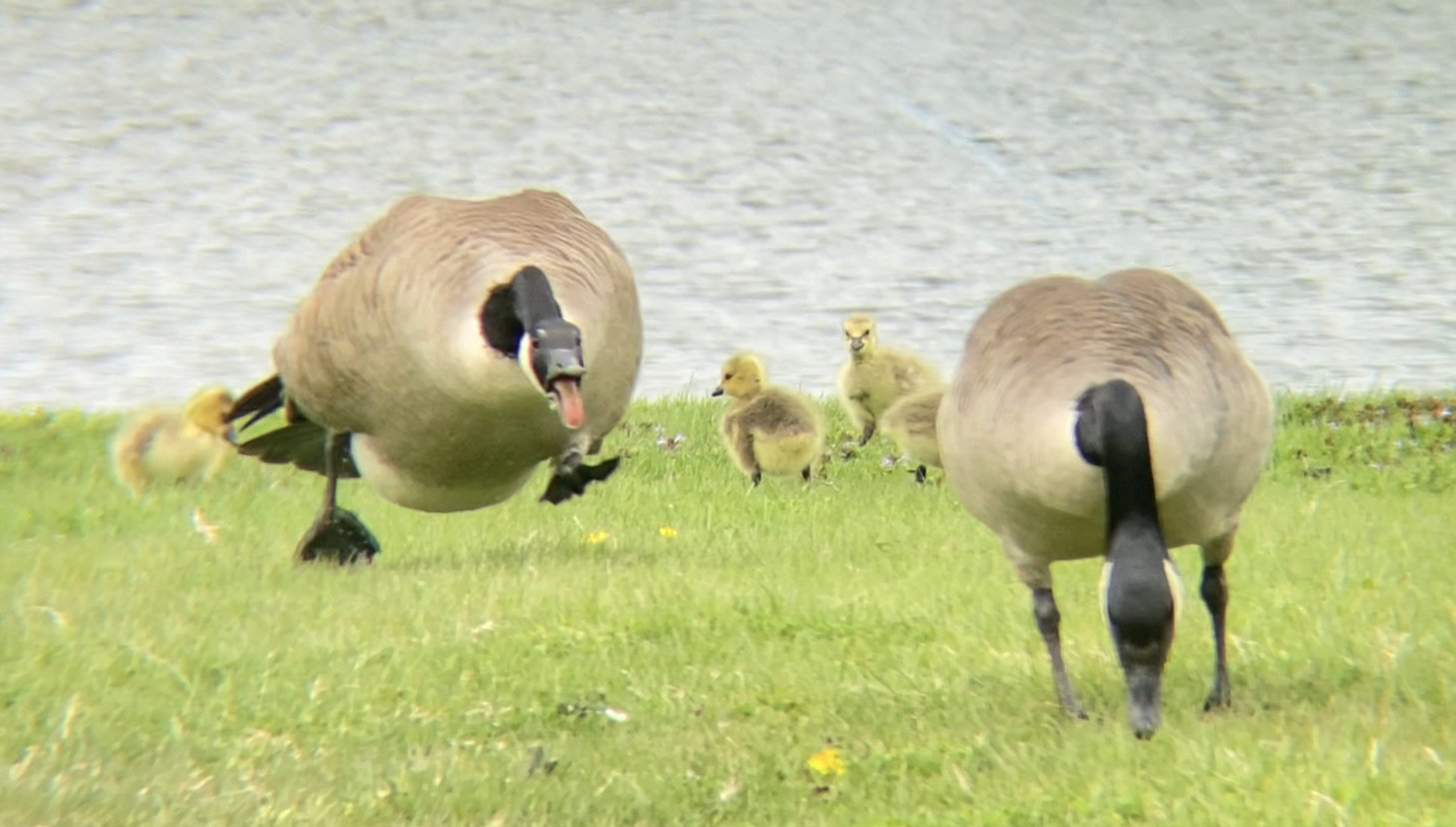
Photo Unknown photographer (opens in a new tab) / iNaturalist, CC0 1.0 (opens in a new tab)
At a glance
- Size
- About 76 to 110 cm long; wingspan up to 1.8 m
- Weight
- About 3 to 6.5 kg
- Habitat
- Lakes, ponds, rivers, parks, golf courses and fields
- Diet
- Grasses, shoots, seeds, grain and aquatic plants
- In Georgia
- Common all year; most are resident birds rather than migrants
- Voice
- A deep, honking "ah-honk"
- Rabies vector
- No
Identification
- Key marks
- Black head and neck with a white chinstrap; brown-grey body; pale breast; black tail with a white band above it
- Told apart from
- Cackling goose, a rare winter visitor, which is much smaller with a short neck and stubby bill
- Told apart from
- Brant, a rare coastal visitor, which has no white chinstrap
- Where to look
- Almost any lake or park pond, and mowed grass beside water
Behaviour
Canada geese graze on short grass, which is why lawns and golf courses beside water suit them so well. Pairs usually stay together for life, and both parents guard the goslings fiercely, hissing and charging at people and dogs that come close.
In summer adults moult all their flight feathers at once and cannot fly for about six weeks; during that time they stay close to water.
Why they matter
Most of Georgia's Canada geese descend from birds released in the twentieth century to restore populations, and they now breed wherever there is water and grass. Their grazing and droppings shape the edges of ponds and lakes, and their goslings feed foxes, hawks, snapping turtles and alligators.
A goose family on a lawn is also one of the easiest places to watch cooperative parenting: parents take turns feeding and watching, and several families often merge their goslings into a single guarded group.
Reproduction and lifecycle
Nest — A bowl of plants and down on the ground near water, often on an island or bank
Eggs — Usually four to seven
Incubation — About 25 to 30 days, by the female while the male stands guard
Goslings — Leave the nest within a day; feed themselves, guarded by both parents
Flight — At about nine weeks old
Family — Young stay with their parents through their first winter
Lifespan — Often 10 to 24 years in the wild
Living around people
- Geese defending a nest or goslings will hiss and charge; backing away slowly ends it.
- Goslings on a road or path are following their parents; waiting for the family to cross is enough.
- Bread fills geese without nourishing them and gathers flocks that foul lawns and water.
- Tall grass or plantings along a pond's edge make a lawn far less attractive to geese than any scaring device.
- Fishing line and hooks tangle legs and bills and should never be left at the water's edge.
Misconceptions
- A gosling alone for a moment is orphaned. Goose parents rarely stray far; wait at a distance before doing anything.
- Canada geese mate for life, so a widowed goose will die of grief. Pairs are long-lasting, but a goose that loses its mate usually pairs again.
- All Canada geese migrate. Most in Georgia live here all year.
Related species
Seasonal activity
When this species is breeding, and when there are nests on the ground. Mowing during the shaded months is how most nests are found.
| Jan | Feb | Mar | Apr | May | Jun | Jul | Aug | Sep | Oct | Nov | Dec | |
|---|---|---|---|---|---|---|---|---|---|---|---|---|
| Breeding | Jan: no | Feb: no | Mar: no | Apr: no | May: no | Jun: no | Jul: no | Aug: no | Sep: no | Oct: no | Nov: no | Dec: no |
| Active nests | Jan: no | Feb: no | Mar: no | Apr: no | May: no | Jun: no | Jul: no | Aug: no | Sep: no | Oct: no | Nov: no | Dec: no |
| Notes | Pairs forming and defending territories | Pairs choose nest sites | Egg laying and incubation | Goslings hatch; families on the water | Goslings growing; parents very protective | Adults moulting and flightless for several weeks | Young learning to fly | Families flying together | Flocks gather on lakes and fields | Flocks feeding; a few northern migrants arrive | Flocks on reservoirs | Flocks; some pairs already defending sites |
Where it lives
Recorded in 63 states and provinces. Each one links to the other animals there, and to the rehabilitators licensed for them.
United States
- Alabama
- Alaska
- Arizona
- Arkansas
- California
- Colorado
- Connecticutin winter
- Delaware
- District of Columbia
- Florida
- Georgia
- Idaho
- Illinois
- Indianain winter
- Iowa
- Kansasin winter
- Kentuckyin winter
- Louisiana
- Maine
- Marylandin winter
- Massachusetts
- Michigan
- Minnesota
- Mississippi
- Missouriin winter
- Montana
- Nebraska
- Nevada
- New Hampshire
- New Jersey
- New Mexicoin winter
- New York
- North Carolina
- North Dakota
- Ohioin winter
- Oklahoma
- Oregon
- Pennsylvaniain winter
- Rhode Islandin winter
- South Carolina
- South Dakota
- Tennessee
- Texas
- Utah
- Vermont
- Virginiain winter
- Washington
- West Virginia
- Wisconsin
- Wyoming
If you found one
Answer a few questions and you will get a specific answer for what you are looking at.
I found an animal