
Species
Greater white-fronted goose
Anser albifrons
A brown goose with a white face patch and orange legs, found in Georgia in small numbers each winter.
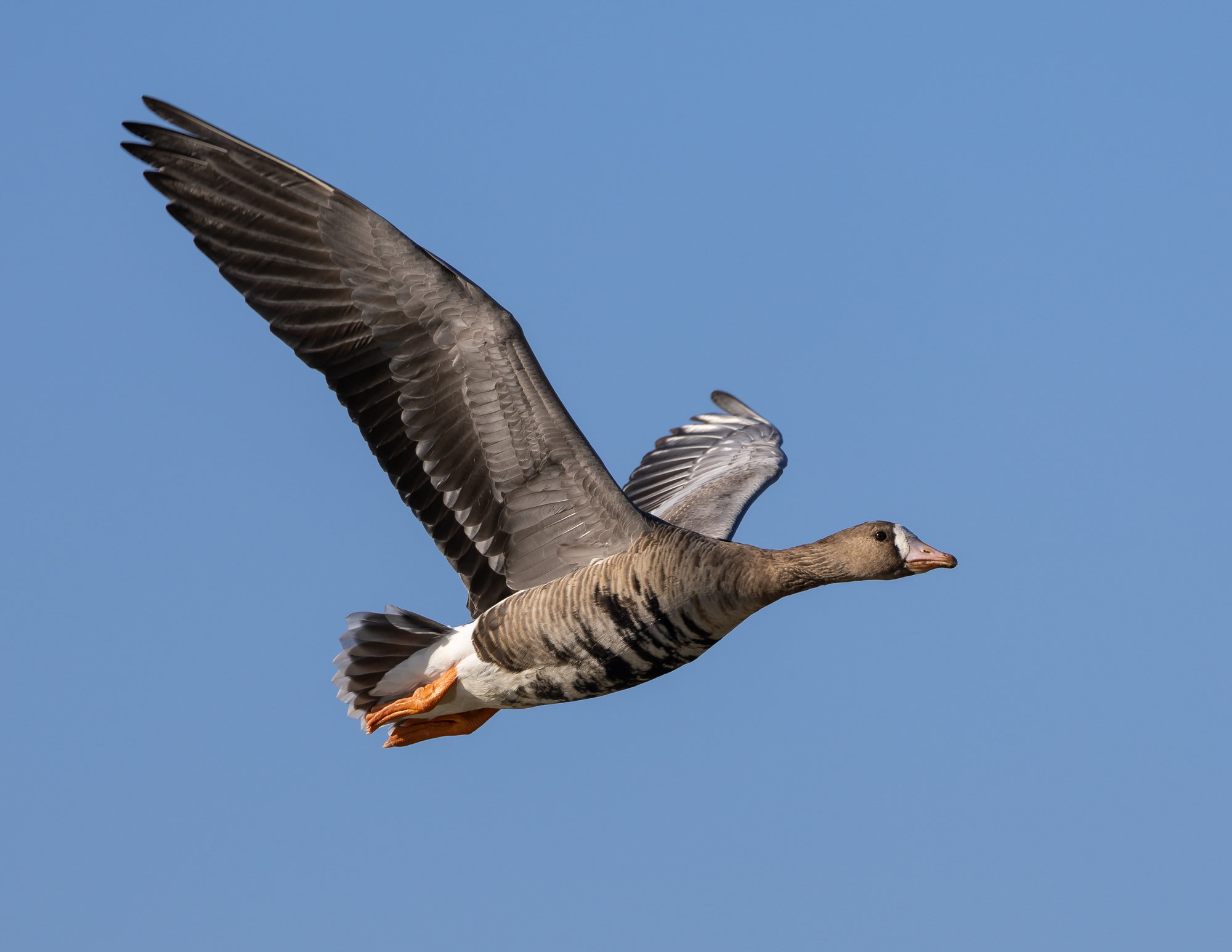
Photo Frank Schulenburg (opens in a new tab) / Wikimedia Commons, CC BY-SA 4.0 (opens in a new tab)
At a glance
- Size
- About 64 to 78 cm long
- Weight
- About 1.9 to 3.3 kg
- Habitat
- Fields, marshes and reservoirs in winter
- Diet
- Grasses, grain, seeds and roots
- In Georgia
- An uncommon winter visitor, often with Canada geese
- Voice
- A high, laughing "kah-lah-a-luck"
- Rabies vector
- No
Identification
- Key marks
- Grey-brown body; white band at the base of a pink or orange bill; black bars across the belly; bright orange legs
- Told apart from
- Canada goose, which has a black neck and white chinstrap
- Told apart from
- Farm geese of the greylag type, which are heavier, paler and lack the black belly bars
- Where to look
- With Canada geese on reservoirs and in fields, November to March
Behaviour
White-fronted geese graze in fields and roost on open water. They are wary, and flocks rise at the first sign of danger with a high, laughing chorus. Families stay together through winter and migrate as a unit.
Why they matter
These geese breed across the Arctic of both North America and Eurasia, and those that reach Georgia have usually come from the far north of Canada or Alaska. Their lifelong family bonds are among the strongest in waterfowl: young learn migration routes and stopover places by travelling with their parents.
Reproduction and lifecycle
Nest — A shallow bowl lined with down, on tundra near water
Eggs — Usually four to six
Incubation — About 23 to 25 days
Goslings — Leave the nest within a day
Flight — At about six to seven weeks
Family — Young stay with their parents for their first year
Lifespan — Wild birds over twenty years are recorded
Living around people
- Wild white-fronted geese are wary and keep their distance from people; one that lets you walk up to it may be ill or injured.
- Domestic geese with a white face look similar but are heavier and do not fly.
Misconceptions
- Any brown goose is a domestic one. Wild white-fronted geese reach Georgia every winter.
Related species
Seasonal activity
When this species is breeding, and when there are nests on the ground. Mowing during the shaded months is how most nests are found.
| Jan | Feb | Mar | Apr | May | Jun | Jul | Aug | Sep | Oct | Nov | Dec | |
|---|---|---|---|---|---|---|---|---|---|---|---|---|
| Breeding | Jan: no | Feb: no | Mar: no | Apr: no | May: no | Jun: no | Jul: no | Aug: no | Sep: no | Oct: no | Nov: no | Dec: no |
| Active nests | Jan: no | Feb: no | Mar: no | Apr: no | May: no | Jun: no | Jul: no | Aug: no | Sep: no | Oct: no | Nov: no | Dec: no |
| Notes | Wintering in small numbers | Wintering | Migrating north | Moving north through the prairies | Nesting in the Arctic | Goslings hatch | Adults moult and cannot fly for a time | Young learn to fly | Migration south begins | Flocks passing through the plains | First arrivals in the Southeast | Wintering |
Where it lives
Recorded in 39 states and provinces. Each one links to the other animals there, and to the rehabilitators licensed for them.
United States
- Alabamain winter
- Alaskabreeding
- Arkansasin winter
- Californiain winter
- Georgiain winter
- Idahoin winter
- Illinoisin winter
- Indianain winter
- Iowain winter
- Kansasin winter
- Kentuckyin winter
- Louisianain winter
- Minnesotapassing through
- Mississippiin winter
- Missouriin winter
- Nebraskain winter
- Nevadain winter
- North Dakotapassing through
- Oklahomain winter
- Oregonin winter
- South Dakotain winter
- Tennesseein winter
- Texasin winter
- Washingtonin winter
- Wisconsinin winter
Canada
If you found one
Answer a few questions and you will get a specific answer for what you are looking at.
I found an animal