
Species
Red-bellied woodpecker
Melanerpes carolinus
The common, zebra-backed woodpecker of Georgia yards, whose name refers to a faint blush most people never see.
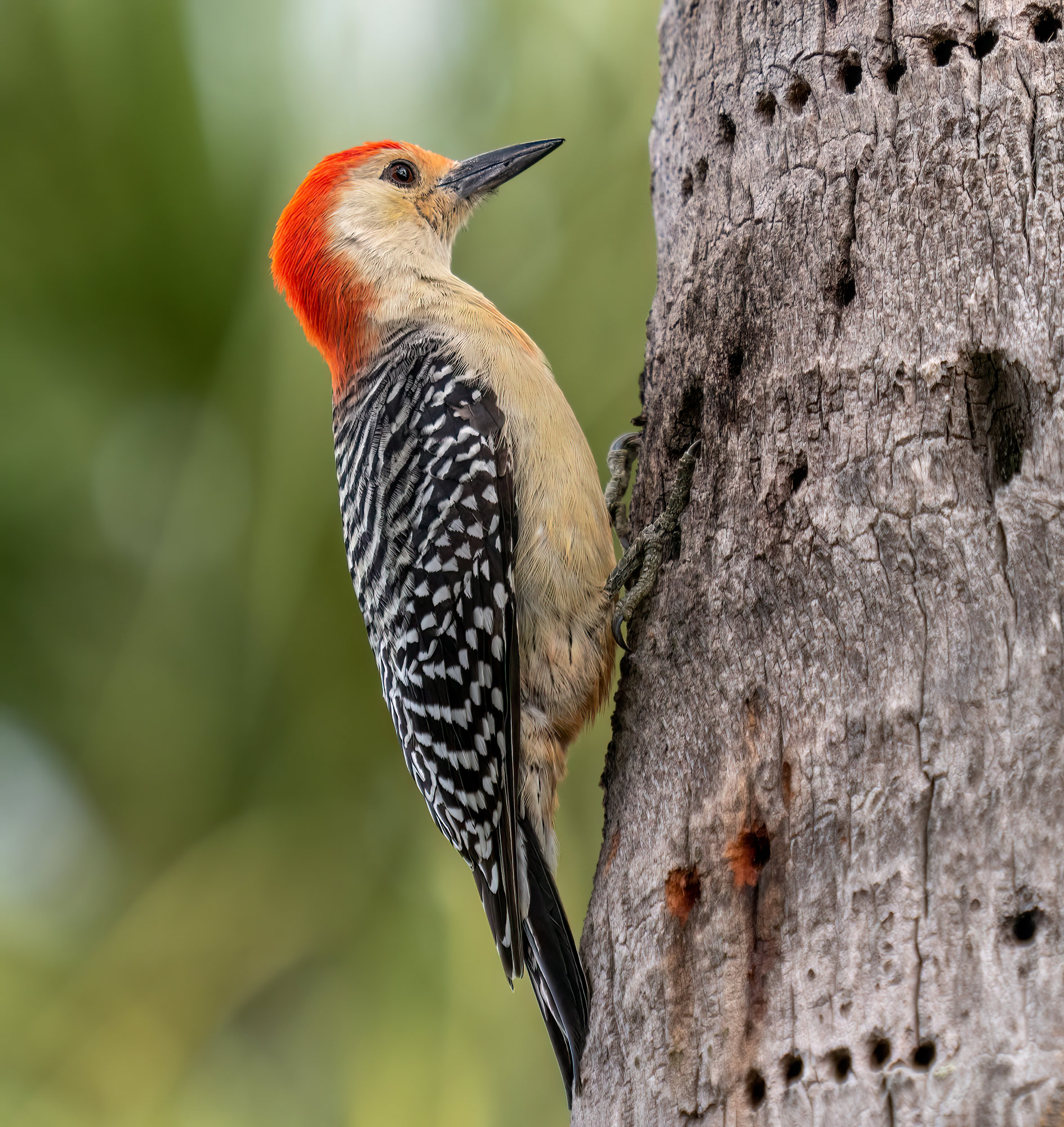
Photo Rhododendrites (opens in a new tab) / Wikimedia Commons, CC BY-SA 4.0 (opens in a new tab)
At a glance
- Size
- About 23 to 27 cm long
- Weight
- About 55 to 90 g
- Habitat
- Woodland, suburbs, parks and yards
- Diet
- Insects, nuts, acorns, fruit and seeds
- In Georgia
- Common resident statewide
- Voice
- A rolling "churr" or "kwirr"
- Rabies vector
- No
Identification
- Key marks
- Black-and-white barred back; red cap from bill to nape in males, only on the nape in females; pale underparts with a faint reddish wash on the belly
- Told apart from
- Red-headed woodpecker, which has an all-red head and solid black back
- Told apart from
- Northern flicker, which is brown with a spotted breast
- Where to look
- Almost any wooded yard
Behaviour
Red-bellied woodpeckers probe bark for insects and wedge nuts and seeds into cracks to crack or store them. Their tongues can reach about 5 cm beyond the bill tip, with a barbed, sticky end.
Why they matter
Red-bellied woodpeckers dig cavities used later by other animals, from chickadees to flying squirrels. They have spread north in recent decades and are one of the most familiar woodpeckers in Georgia.
Reproduction and lifecycle
Nest — A cavity dug in a dead tree or branch
Eggs — Usually four or five
Incubation — About 12 days
Chicks — Fed by both parents
Flight — At about 24 to 27 days
Lifespan — Several years
Living around people
- Woodpeckers drumming on houses are usually signalling or feeding on insects in the siding; hanging reflective tape or netting over the spot usually ends it.
- Dead branches left where safe provide nest sites.
Misconceptions
- It is a red-headed woodpecker. Its red is only on the crown; the red-headed woodpecker's whole head is red.
Related species
Seasonal activity
When this species is breeding, and when there are nests on the ground. Mowing during the shaded months is how most nests are found.
| Jan | Feb | Mar | Apr | May | Jun | Jul | Aug | Sep | Oct | Nov | Dec | |
|---|---|---|---|---|---|---|---|---|---|---|---|---|
| Breeding | Jan: no | Feb: no | Mar: no | Apr: no | May: no | Jun: no | Jul: no | Aug: no | Sep: no | Oct: no | Nov: no | Dec: no |
| Active nests | Jan: no | Feb: no | Mar: no | Apr: no | May: no | Jun: no | Jul: no | Aug: no | Sep: no | Oct: no | Nov: no | Dec: no |
| Notes | Present | Drumming | Pairs forming | Nesting | Chicks | Young fledging | Second broods | Present | Storing nuts | Present | Present | Present |
Where it lives
Recorded in 43 states and provinces. Each one links to the other animals there, and to the rehabilitators licensed for them.
United States
- Alabama
- Arkansas
- Colorado
- Connecticut
- Delaware
- District of Columbia
- Florida
- Georgia
- Illinois
- Indiana
- Iowa
- Kansas
- Kentucky
- Louisiana
- Maine
- Maryland
- Massachusetts
- Michigan
- Minnesota
- Mississippi
- Missouri
- Nebraska
- New Hampshire
- New Jersey
- New York
- North Carolina
- North Dakota
- Ohio
- Oklahoma
- Pennsylvania
- Rhode Island
- South Carolina
- South Dakota
- Tennessee
- Texas
- Vermont
- Virginia
- West Virginia
- Wisconsin
If you found one
Answer a few questions and you will get a specific answer for what you are looking at.
I found an animal