
Species
Red-headed woodpecker
Melanerpes erythrocephalus
A strikingly tricoloured woodpecker that stores acorns and catches insects in flight, declining across Georgia.
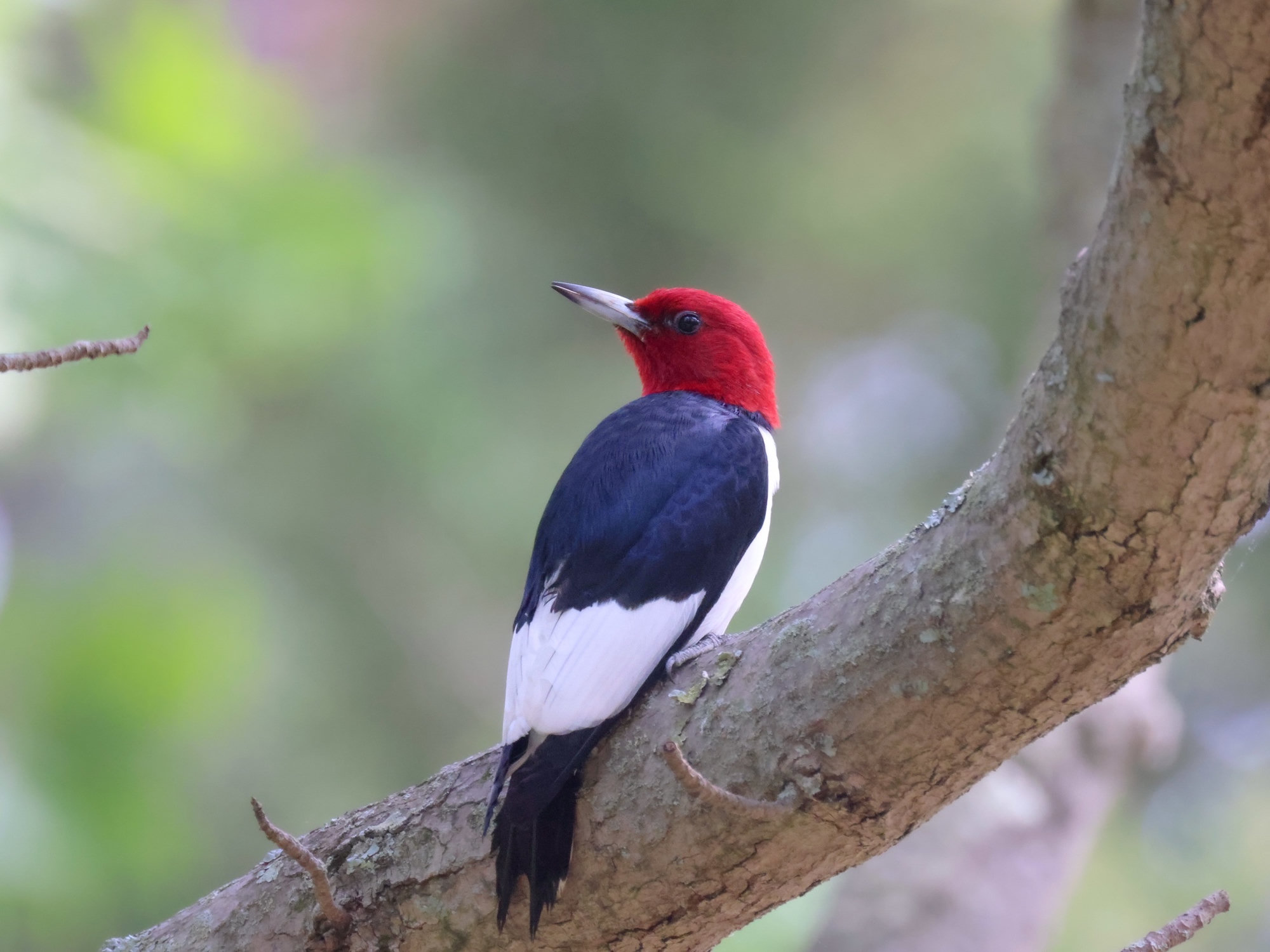
Photo Unknown photographer (opens in a new tab) / iNaturalist, CC0 1.0 (opens in a new tab)
At a glance
- Size
- About 19 to 23 cm long
- Weight
- About 55 to 90 g
- Habitat
- Open woods with dead trees, beaver swamps, pine savannas and golf courses
- Diet
- Insects, acorns, nuts, seeds and fruit
- In Georgia
- An uncommon resident statewide
- Voice
- A harsh "queer"
- Rabies vector
- No
Identification
- Key marks
- Entirely red head; black back; big white wing patches; white underparts
- Told apart from
- Red-bellied woodpecker, which has a barred back and only a red cap
- Where to look
- Open woods with dead snags, and beaver ponds
Behaviour
Red-headed woodpeckers catch insects in flight like flycatchers, and store nuts and insects in cracks and under bark, sometimes covering them with wood or bark.
Why they matter
Red-headed woodpeckers have declined by more than half over recent decades as dead trees and open woods were cleared. They need standing dead trees for nesting and are a sign of healthy, open woods with snags.
Reproduction and lifecycle
Nest — A cavity in a dead tree or dead branch
Eggs — Usually four or five
Incubation — About 12 to 14 days
Chicks — Fed by both parents
Flight — At about four weeks
Lifespan — Several years
Living around people
- Dead trees left standing where safe give them nest sites.
- They are often hit by cars when catching insects over roads.
Misconceptions
- Any woodpecker with red on its head is a red-headed woodpecker. Only this one has an entirely red head.
Related species
Seasonal activity
When this species is breeding, and when there are nests on the ground. Mowing during the shaded months is how most nests are found.
| Jan | Feb | Mar | Apr | May | Jun | Jul | Aug | Sep | Oct | Nov | Dec | |
|---|---|---|---|---|---|---|---|---|---|---|---|---|
| Breeding | Jan: no | Feb: no | Mar: no | Apr: no | May: no | Jun: no | Jul: no | Aug: no | Sep: no | Oct: no | Nov: no | Dec: no |
| Active nests | Jan: no | Feb: no | Mar: no | Apr: no | May: no | Jun: no | Jul: no | Aug: no | Sep: no | Oct: no | Nov: no | Dec: no |
| Notes | Feeding on stored acorns | Present | Pairs forming | Nesting | Nesting | Chicks | Young fledging | Second broods | Storing acorns | Storing acorns | Present | Present |
Where it lives
Recorded in 41 states and provinces. Each one links to the other animals there, and to the rehabilitators licensed for them.
United States
- Alabama
- Arkansas
- Coloradobreeding
- Delaware
- District of Columbiain winter
- Florida
- Georgia
- Illinois
- Indiana
- Iowa
- Kansas
- Kentucky
- Louisiana
- Maryland
- Michigan
- Minnesotabreeding
- Mississippi
- Missouri
- Montanabreeding
- Nebraskabreeding
- New Jersey
- New Mexicobreeding
- New York
- North Carolina
- North Dakotabreeding
- Ohio
- Oklahoma
- Pennsylvania
- Rhode Islandin winter
- South Carolina
- South Dakotabreeding
- Tennessee
- Texas
- Virginia
- West Virginia
- Wisconsin
- Wyomingbreeding
If you found one
Answer a few questions and you will get a specific answer for what you are looking at.
I found an animal