
Species
Northern flicker
Colaptes auratus
A brown, spotted woodpecker that feeds on ants on the ground and flashes yellow under its wings in flight.
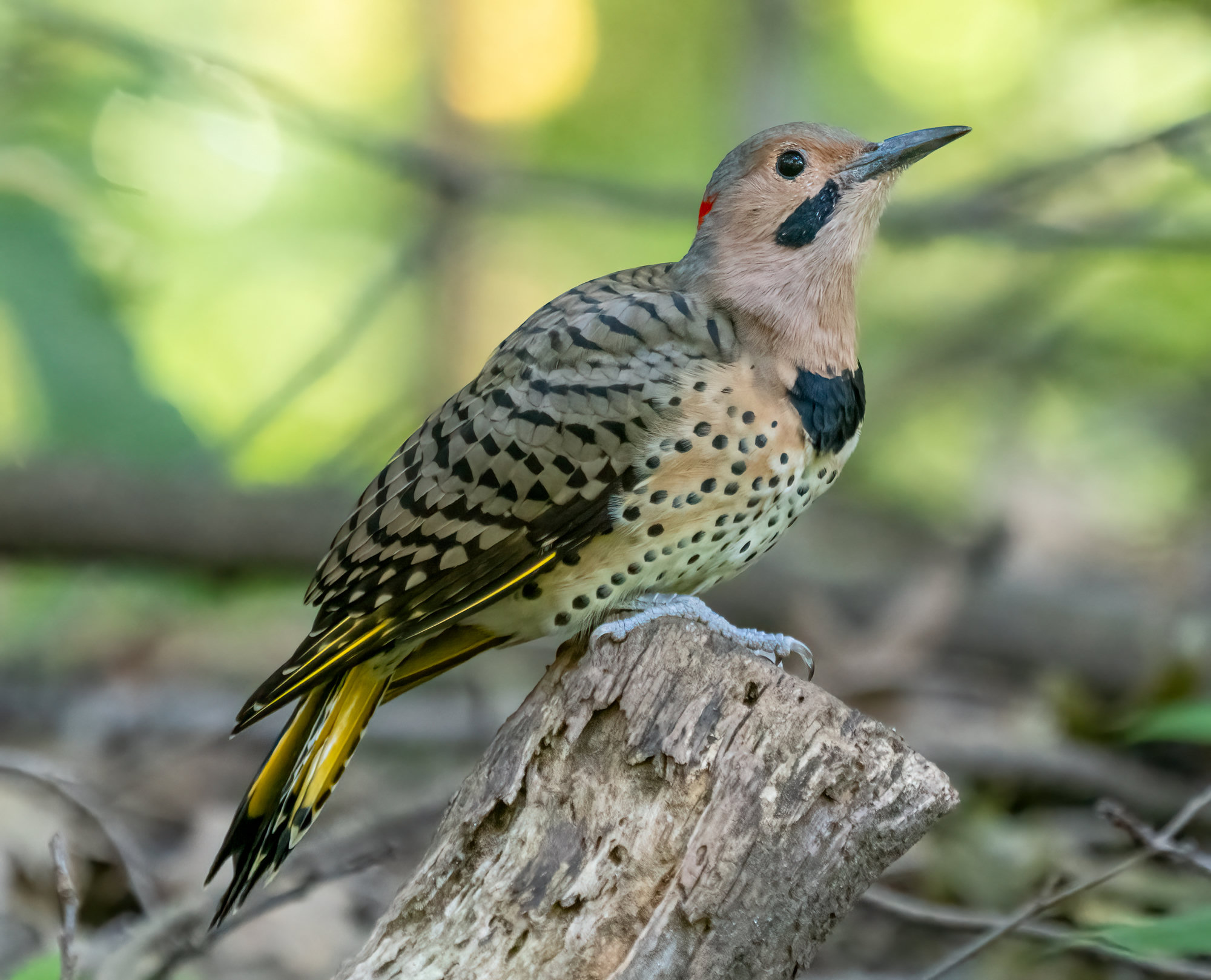
Photo Rhododendrites (opens in a new tab) / Wikimedia Commons, CC BY-SA 4.0 (opens in a new tab)
At a glance
- Size
- About 28 to 31 cm long
- Weight
- About 110 to 165 g
- Habitat
- Open woods, fields, suburbs and parks
- Diet
- Mostly ants and beetles taken on the ground; also fruit and seeds
- In Georgia
- Common resident; more in winter
- Voice
- A loud "wick-wick-wick" and a sharp "kleer"
- Rabies vector
- No
Identification
- Key marks
- Brown with black spots below; black crescent on the breast; bright white rump in flight; yellow under the wings and tail in eastern birds
- Told apart from
- Red-bellied woodpecker, which is grey with a barred back
- Where to look
- On lawns and bare ground, digging for ants
Behaviour
Flickers feed mostly on the ground, hammering and probing for ants with a long, barbed tongue. They are the state bird of Alabama, known there as the yellowhammer.
Why they matter
Flickers eat enormous numbers of ants. Their large cavities are used by many other animals, including owls, kestrels and bufflehead ducks in the north.
Reproduction and lifecycle
Nest — A cavity dug in a dead tree or post
Eggs — Usually five to eight
Incubation — About 11 to 13 days
Chicks — Fed by both parents
Flight — At about 24 to 27 days
Lifespan — Several years
Living around people
- Lawns treated with insecticides remove their food; ant-rich ground feeds them.
- Flickers drumming on metal gutters are signalling to rivals; a cover over the spot usually ends it.
Misconceptions
- Woodpeckers only feed on trees. Flickers feed mostly on the ground.
Related species
Seasonal activity
When this species is breeding, and when there are nests on the ground. Mowing during the shaded months is how most nests are found.
| Jan | Feb | Mar | Apr | May | Jun | Jul | Aug | Sep | Oct | Nov | Dec | |
|---|---|---|---|---|---|---|---|---|---|---|---|---|
| Breeding | Jan: no | Feb: no | Mar: no | Apr: no | May: no | Jun: no | Jul: no | Aug: no | Sep: no | Oct: no | Nov: no | Dec: no |
| Active nests | Jan: no | Feb: no | Mar: no | Apr: no | May: no | Jun: no | Jul: no | Aug: no | Sep: no | Oct: no | Nov: no | Dec: no |
| Notes | Wintering birds join residents | Present | Pairs forming | Nesting | Chicks | Young fledging | Present | Present | Migrants arriving | Migrants | Present | Present |
Where it lives
Recorded in 82 states and provinces. Each one links to the other animals there, and to the rehabilitators licensed for them.
United States
- Alabamain winter
- Alaska
- Arizona
- Arkansasin winter
- California
- Colorado
- Connecticut
- Delaware
- District of Columbia
- Florida
- Georgia
- Idaho
- Illinois
- Indiana
- Iowa
- Kansasin winter
- Kentucky
- Louisiana
- Mainebreeding
- Maryland
- Massachusetts
- Michigan
- Minnesota
- Mississippiin winter
- Missouriin winter
- Montana
- Nebraska
- Nevada
- New Hampshire
- New Jersey
- New Mexico
- New York
- North Carolina
- North Dakota
- Ohio
- Oklahomain winter
- Oregon
- Pennsylvania
- Rhode Island
- South Carolinain winter
- South Dakota
- Tennessee
- Texasin winter
- Utah
- Vermontbreeding
- Virginia
- Washington
- West Virginia
- Wisconsinbreeding
- Wyoming
Canada
If you found one
Answer a few questions and you will get a specific answer for what you are looking at.
I found an animal