
Species
Pileated woodpecker
Dryocopus pileatus
A crow-sized woodpecker with a flaming red crest, whose rectangular holes are used by many other animals.
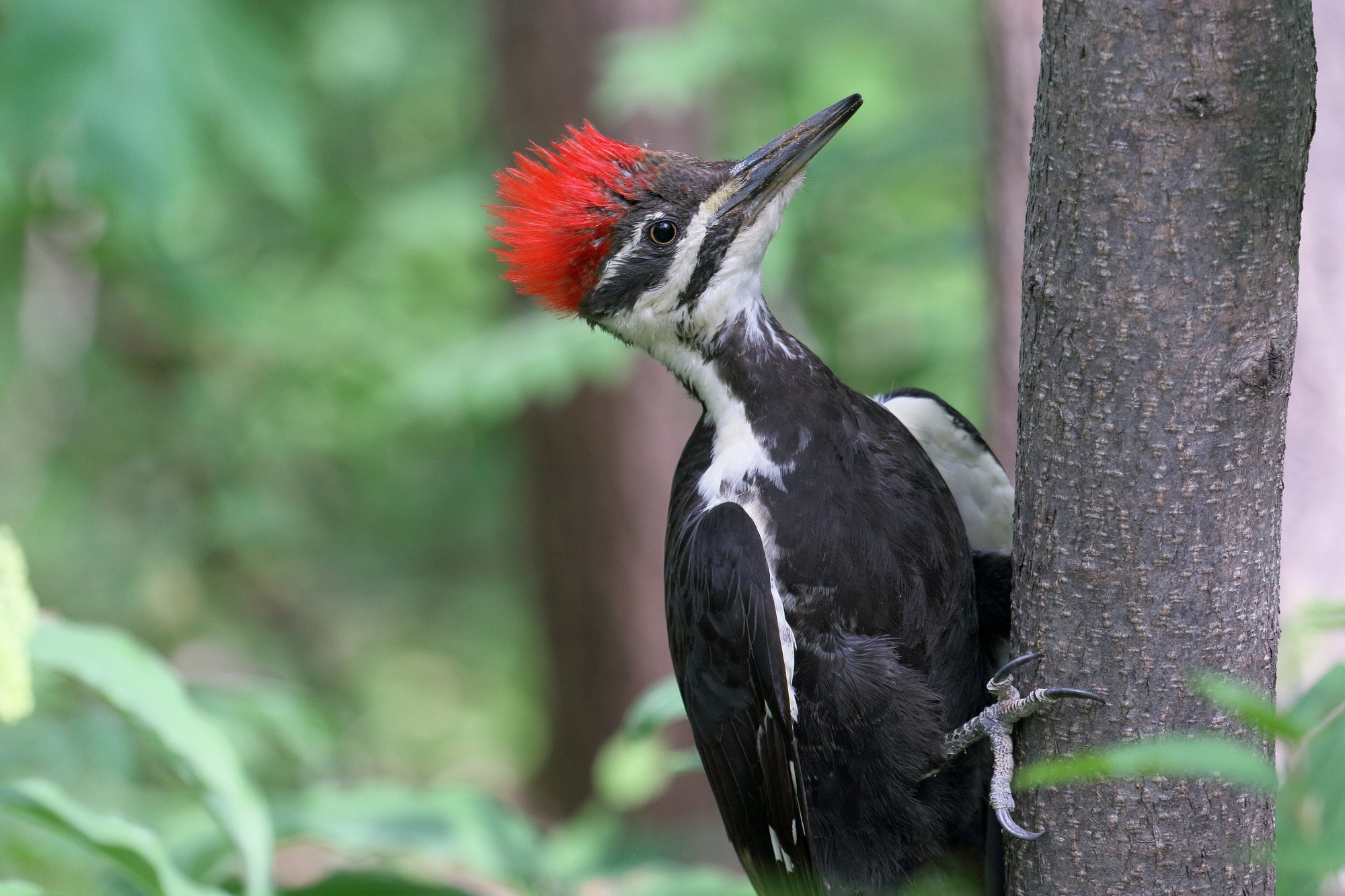
Photo Cephas (opens in a new tab) / Wikimedia Commons, CC BY-SA 4.0 (opens in a new tab)
At a glance
- Size
- About 40 to 49 cm long
- Weight
- About 250 to 350 g
- Habitat
- Mature woods and wooded suburbs with large trees
- Diet
- Carpenter ants and beetle larvae; fruit and nuts
- In Georgia
- Common resident statewide
- Voice
- A loud, wild "cuk-cuk-cuk" and slow, powerful drumming
- Rabies vector
- No
Identification
- Key marks
- Very large, black woodpecker; bright red crest; white stripes on the face and neck; white underwings in flight
- Told apart from
- Red-headed woodpecker, which is much smaller with an all-red head
- Where to look
- Large trees and fallen logs in woods; listen for loud calls
Behaviour
Pileated woodpeckers dig large rectangular holes in trees and logs to reach carpenter ants. Pairs hold territories year-round.
Why they matter
Pileated woodpeckers are key "ecosystem engineers": their large cavities are used for nesting and roosting by owls, ducks, bats, squirrels and many other animals, and their foraging speeds the decay of dead wood.
Reproduction and lifecycle
Nest — A new cavity dug each year in a large dead tree
Eggs — Usually three to five
Incubation — About 15 to 18 days
Chicks — Fed by both parents
Flight — At about 24 to 28 days
Lifespan — Wild birds over twelve years are recorded
Living around people
- Large dead trees left standing where safe support pileated woodpeckers and the animals that use their holes.
Misconceptions
- Pileated woodpeckers kill trees. They feed on trees already infested with ants or decay.
- It is an ivory-billed woodpecker. The ivory-bill has a white bill and white on the back of the wings; the pileated is the woodpecker actually seen.
Related species
Seasonal activity
When this species is breeding, and when there are nests on the ground. Mowing during the shaded months is how most nests are found.
| Jan | Feb | Mar | Apr | May | Jun | Jul | Aug | Sep | Oct | Nov | Dec | |
|---|---|---|---|---|---|---|---|---|---|---|---|---|
| Breeding | Jan: no | Feb: no | Mar: no | Apr: no | May: no | Jun: no | Jul: no | Aug: no | Sep: no | Oct: no | Nov: no | Dec: no |
| Active nests | Jan: no | Feb: no | Mar: no | Apr: no | May: no | Jun: no | Jul: no | Aug: no | Sep: no | Oct: no | Nov: no | Dec: no |
| Notes | Pairs drumming | Pairs calling | Nest excavation | Nesting | Chicks | Young fledging | Young with parents | Young independent | Present | Present | Present | Present |
Where it lives
Recorded in 53 states and provinces. Each one links to the other animals there, and to the rehabilitators licensed for them.
United States
- Alabama
- Arkansas
- California
- Connecticut
- Delaware
- District of Columbia
- Florida
- Georgia
- Idaho
- Illinois
- Indiana
- Iowa
- Kansas
- Kentucky
- Louisiana
- Maine
- Maryland
- Massachusetts
- Michigan
- Minnesota
- Mississippi
- Missouri
- Montana
- Nebraska
- New Hampshire
- New Jersey
- New York
- North Carolina
- North Dakota
- Ohio
- Oklahoma
- Oregon
- Pennsylvania
- Rhode Island
- South Carolina
- Tennessee
- Texas
- Vermont
- Virginia
- Washington
- West Virginia
- Wisconsin
If you found one
Answer a few questions and you will get a specific answer for what you are looking at.
I found an animal