
Species
Nutria
Myocastor coypus
A large, orange-toothed South American rodent, brought here for fur and now living wild in southern wetlands.
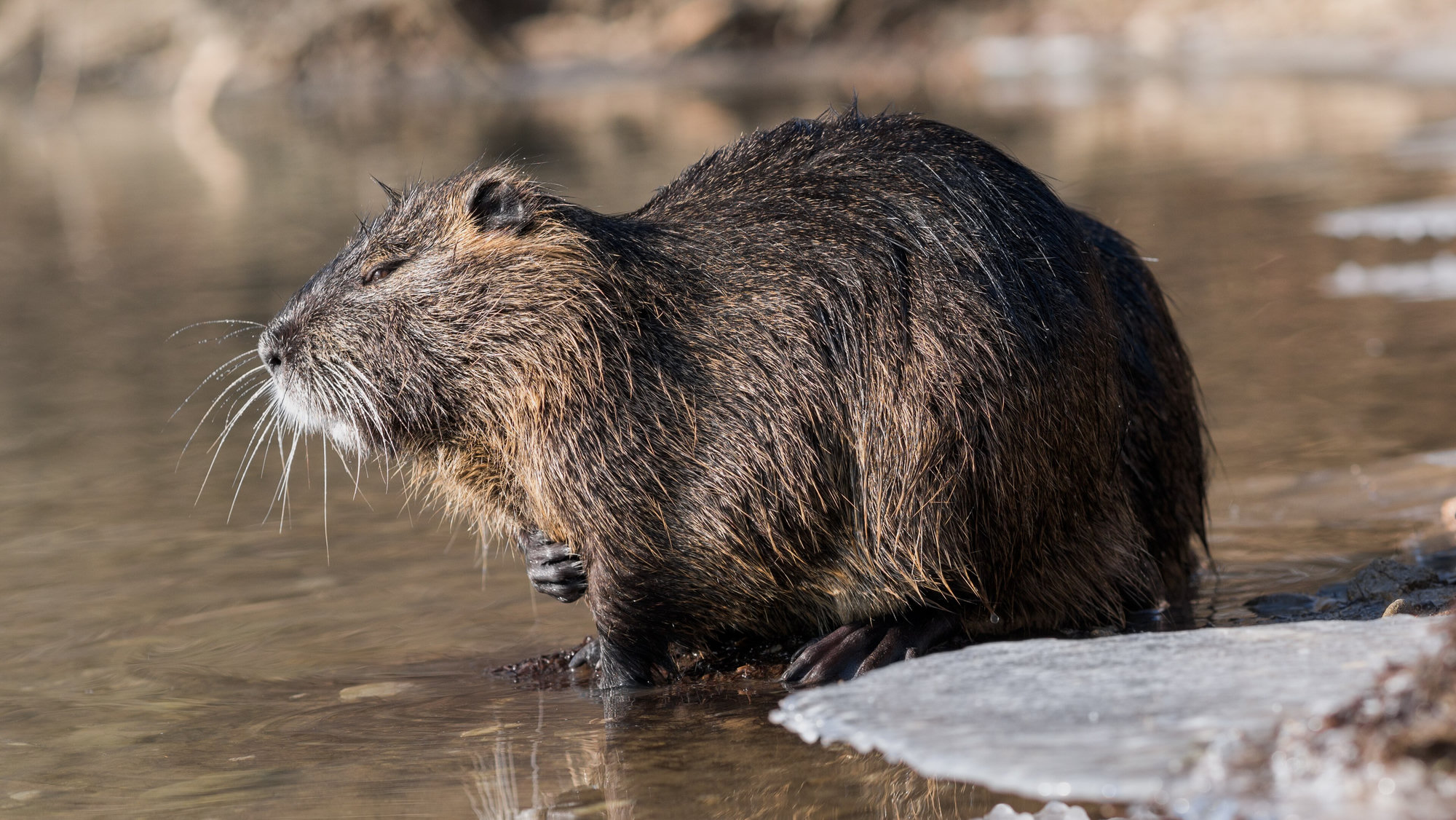
Photo Petar Milošević (opens in a new tab) / Wikimedia Commons, CC BY-SA 4.0 (opens in a new tab)
At a glance
- Size
- Body about 45 to 60 cm; tail about 30 to 45 cm
- Weight
- About 5 to 9 kg
- Habitat
- Marshes, swamps, ponds, rivers and canals
- Diet
- Roots, stems, rhizomes and leaves of marsh and water plants
- Active
- Mostly dusk and night
- Shelter
- Burrows in banks, and platforms of plants in marshes
- Origin
- Native to South America; brought to North America for fur farming
- Rabies vector
- No
Identification
- Key marks
- Large; coarse brown fur; round, scaly, nearly naked tail; large orange front teeth; long white whiskers; webbed hind feet
- Told apart from
- American beaver, which has a broad, flat, paddle-shaped tail
- Told apart from
- Muskrat, which is much smaller with a flattened tail
- Where to look
- In Georgia, recorded mainly in the southwest; along canals, ponds and marshes at dusk
Behaviour
Nutria live in and beside water, digging burrows into banks and feeding on water plants. They eat the roots and underground stems of marsh plants, digging and grazing them away.
Their teats are set high on the sides of the body, so the young can nurse while their mother floats in the water.
Why they matter
Nutria are an introduced animal whose feeding can strip marsh vegetation and turn marsh into open water, especially along the Gulf Coast, where they have been part of serious wetland losses.
None of that is the animal's fault. Nutria were brought from South America by people for their fur and released or escaped when the fur market collapsed. The animal itself is a well-adapted wetland rodent, living where people put it.
Reproduction and lifecycle
Breeding — all year
Gestation — about four months
Litter — usually four to six young, born fully furred with eyes open
Swimming — within hours of birth
Weaning — at about seven to eight weeks old
Maturity — at about four to six months old
Lifespan — a few years in the wild
Living around people
- Nutria burrowing into pond dams and levees can be discouraged with wire mesh or stone facing.
- Feeding nutria concentrates them and increases damage to plants.
- Lethal traps for nutria can catch otters, beavers and other native animals.
Misconceptions
- Nutria are giant muskrats or beavers. They are a separate South American rodent.
- Nutria are native. They were brought to North America by people for fur farming.
- Introduced animals are villains. The damage they do follows from where people released them.
Related species
Seasonal activity
When this species is breeding, and when there are nests on the ground. Mowing during the shaded months is how most nests are found.
| Jan | Feb | Mar | Apr | May | Jun | Jul | Aug | Sep | Oct | Nov | Dec | |
|---|---|---|---|---|---|---|---|---|---|---|---|---|
| Breeding | Jan: no | Feb: no | Mar: no | Apr: no | May: no | Jun: no | Jul: no | Aug: no | Sep: no | Oct: no | Nov: no | Dec: no |
| Active nests | Jan: no | Feb: no | Mar: no | Apr: no | May: no | Jun: no | Jul: no | Aug: no | Sep: no | Oct: no | Nov: no | Dec: no |
| Notes | Breeding can occur year-round | Breeding | Litters born | Breeding | Young swim within hours of birth | Breeding | Breeding | Breeding | Breeding | Active at dusk | Breeding continues | Cold snaps can kill nutria at the northern edge of their range |
Where it lives
Recorded in 14 states and provinces. Each one links to the other animals there, and to the rehabilitators licensed for them.
If you found one
Answer a few questions and you will get a specific answer for what you are looking at.
I found an animal