
Species
Muskrat
Ondatra zibethicus
A large, water-loving vole with a flattened tail, the builder of lodges in marshes and ponds.
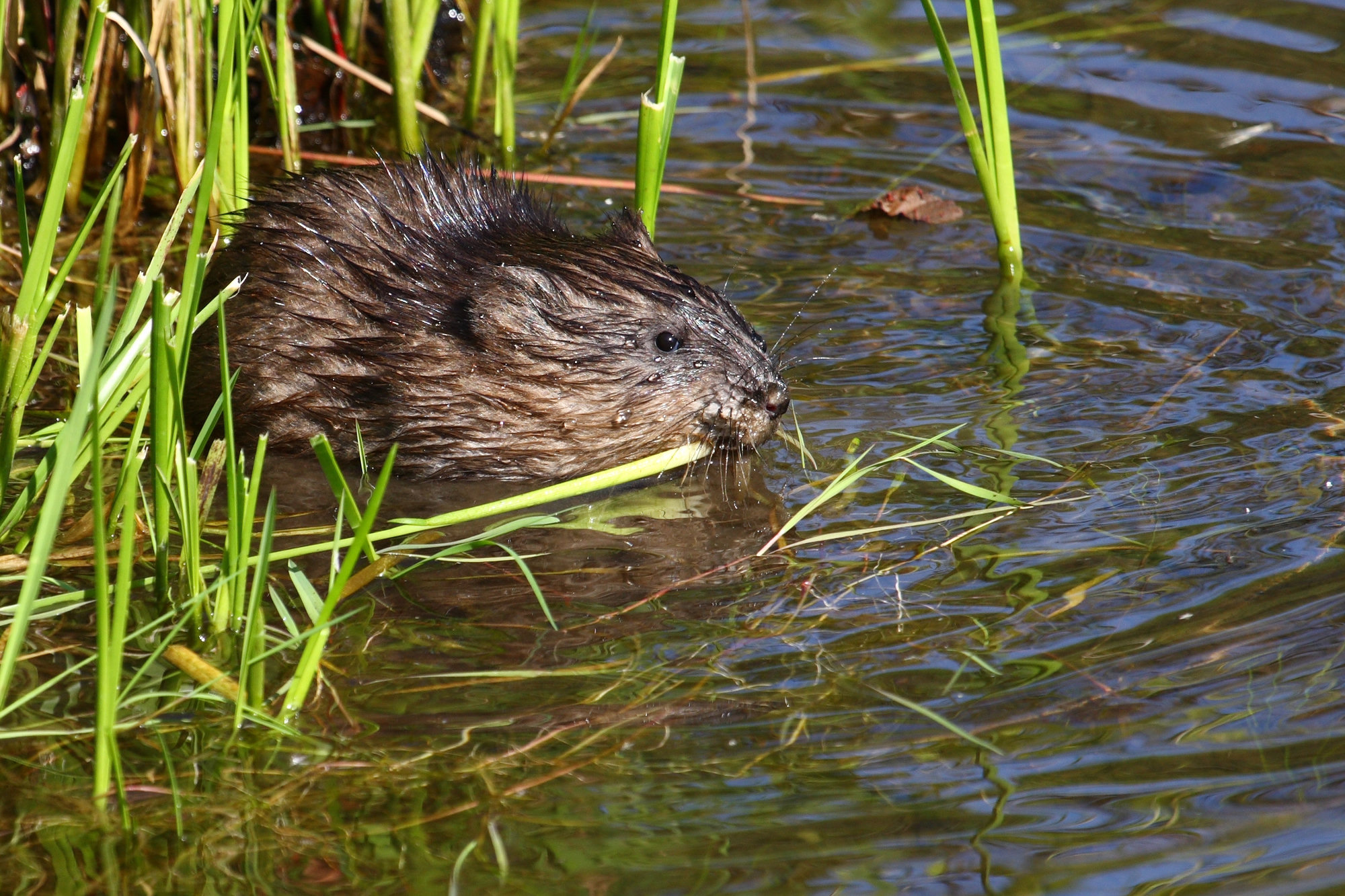
Photo Cephas (opens in a new tab) / Wikimedia Commons, CC BY-SA 3.0 (opens in a new tab)
At a glance
- Size
- Body about 25 to 35 cm; tail about 20 to 28 cm
- Weight
- About 0.7 to 1.8 kg
- Habitat
- Marshes, ponds, lakes, slow rivers, ditches and farm ponds
- Diet
- Cattails, sedges, water lilies and other aquatic plants, plus some mussels, crayfish and fish
- Active
- Mostly dusk and night
- Shelter
- Dome-shaped lodges of cattails and mud, or burrows in banks with underwater entrances
- Lifespan
- A few years
- Rabies vector
- No
Identification
- Key marks
- Dense, glossy brown fur; tail long, scaly, nearly naked and flattened from side to side; partly webbed hind feet; small ears
- Swimming
- Only the head and part of the back show, with the tail sculling from side to side behind
- Told apart from
- American beaver, which is much larger with a broad, flat, paddle-shaped tail
- Told apart from
- Nutria, which is larger with a round tail, white whiskers and orange front teeth
- Where to look
- Ponds, marshes and ditches at dusk; lodges and feeding platforms of cut plants
Behaviour
Muskrats are at home in the water. They swim with their hind feet and flattened tail, can stay under water for up to about 15 minutes, and build lodges of cattails, reeds and mud in marshes, or dig burrows into banks with entrances below the water line.
They feed mainly on aquatic plants, often on small platforms of cut vegetation, and sometimes eat mussels and crayfish. They are not rats at all but large voles, adapted for life in water.
Why they matter
Muskrats shape marshes. By cutting cattails and other plants for food and lodges, they open up patches of water in dense marsh, creating the mix of open water and vegetation that ducks, herons, frogs and fish need. Their lodges are used as resting and nesting sites by birds, turtles and snakes.
They are also a food for mink, otters, foxes, hawks, owls and alligators.
Reproduction and lifecycle
Breeding — spring and summer, and much of the year in the South
Gestation — about 25 to 30 days
Litter — usually four to eight young, several litters a year
Eyes open — at about two weeks old
Weaning — at about three to four weeks old
Lifespan — a few years
Living around people
- Muskrats burrowing into pond dams and banks can be discouraged by lining banks with wire mesh or stone.
- Lethal traps set for muskrats can catch otters, mink and other animals.
- A young muskrat alone on land may be dispersing; it is best watched from a distance before anyone intervenes.
Misconceptions
- Muskrats are rats. They are large, water-living voles.
- Muskrats are the same as beavers. Beavers are far larger and have broad, flat tails.
- Muskrats are the same as nutria. Nutria are an introduced South American rodent with round tails and orange teeth.
Related species
Seasonal activity
When this species is breeding, and when there are nests on the ground. Mowing during the shaded months is how most nests are found.
| Jan | Feb | Mar | Apr | May | Jun | Jul | Aug | Sep | Oct | Nov | Dec | |
|---|---|---|---|---|---|---|---|---|---|---|---|---|
| Breeding | Jan: no | Feb: no | Mar: no | Apr: no | May: no | Jun: no | Jul: no | Aug: no | Sep: no | Oct: no | Nov: no | Dec: no |
| Active nests | Jan: no | Feb: no | Mar: no | Apr: no | May: no | Jun: no | Jul: no | Aug: no | Sep: no | Oct: no | Nov: no | Dec: no |
| Notes | Active under ice in the north; feeding in lodges and burrows | Breeding begins in the South | Breeding | First litters born in lodges and burrows | Young swim and dive within a few weeks | Second litters | Young disperse along waterways | Breeding continues in the South | Building and repairing lodges | Lodges enlarged for winter | Active in lodges and bank burrows | Active under ice in the north |
Where it lives
Recorded in 64 states and provinces. Each one links to the other animals there, and to the rehabilitators licensed for them.
United States
- Alabama
- Alaska
- Arizona
- Arkansas
- California
- Colorado
- Connecticut
- Delaware
- District of Columbia
- Georgia
- Idaho
- Illinois
- Indiana
- Iowa
- Kansas
- Kentucky
- Louisiana
- Maine
- Maryland
- Massachusetts
- Michigan
- Minnesota
- Mississippi
- Missouri
- Montana
- Nebraska
- Nevada
- New Hampshire
- New Jersey
- New Mexico
- New York
- North Carolina
- North Dakota
- Ohio
- Oklahoma
- Oregon
- Pennsylvania
- Rhode Island
- South Carolina
- South Dakota
- Tennessee
- Texas
- Utah
- Vermont
- Virginia
- Washington
- West Virginia
- Wisconsin
- Wyoming
Canada
If you found one
Answer a few questions and you will get a specific answer for what you are looking at.
I found an animal