
Species
North American racer
Coluber constrictor
A fast, glossy black snake that holds its head high and races off at the slightest disturbance.
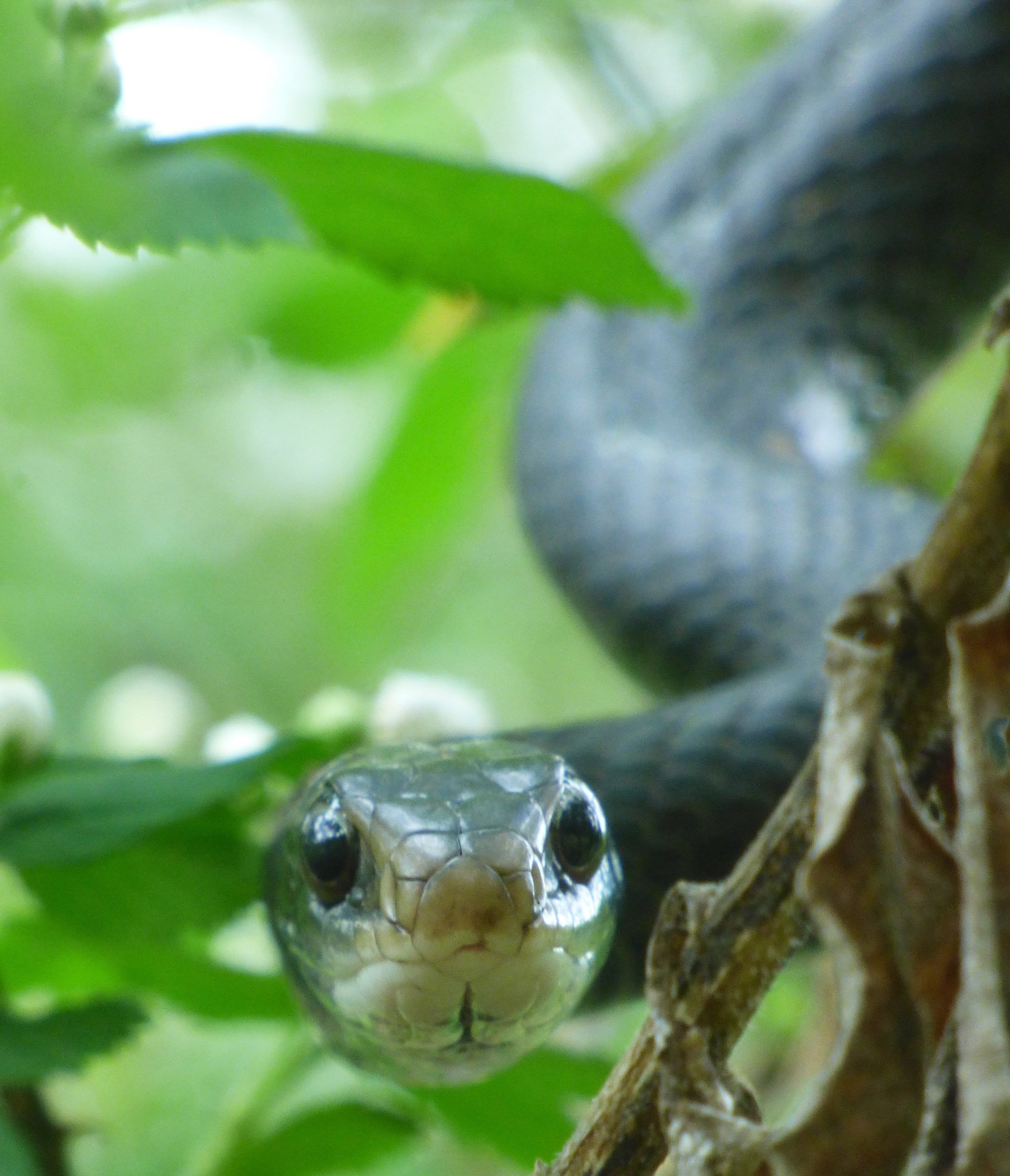
Photo Unknown photographer (opens in a new tab) / iNaturalist, CC0 1.0 (opens in a new tab)
At a glance
- Size
- Usually 90 to 150 cm long
- Habitat
- Fields, woodland edges, suburbs and roadsides
- Diet
- Insects, frogs, lizards, snakes, rodents and birds
- In Georgia
- Common statewide
- Venomous
- No
- Rabies vector
- No
Identification
- Key marks
- Slim and glossy black with a white chin and throat; young are grey with brown blotches
- Told apart from
- Central ratsnake, which is duller, less glossy and slower
- Told apart from
- Eastern kingsnake, which has white chain-like bands
- Where to look
- Crossing roads and fields by day
Behaviour
Racers hunt by sight with their heads raised, and they are fast. They do not constrict; they overpower prey. When cornered they vibrate the tail in dry leaves and may bite, but they would much rather flee.
Why they matter
Racers eat many rodents, insects and other snakes, and are food for hawks. They are among the most often seen snakes in the Southeast.
Reproduction and lifecycle
Eggs — Usually 8 to 20, leathery
Nest — In rotting logs or loose soil
Incubation — About 50 to 65 days
Hatchlings — Grey, blotched with brown
Maturity — In two to three years
Lifespan — About 10 years
Living around people
- A racer is harmless and fast; it will leave if given the chance.
Misconceptions
- Black racers chase people. A racer moving toward you is usually heading for cover behind you.
Related species
Seasonal activity
When this species is breeding, and when there are nests on the ground. Mowing during the shaded months is how most nests are found.
| Jan | Feb | Mar | Apr | May | Jun | Jul | Aug | Sep | Oct | Nov | Dec | |
|---|---|---|---|---|---|---|---|---|---|---|---|---|
| Breeding | Jan: no | Feb: no | Mar: no | Apr: no | May: no | Jun: no | Jul: no | Aug: no | Sep: no | Oct: no | Nov: no | Dec: no |
| Active nests | Jan: no | Feb: no | Mar: no | Apr: no | May: no | Jun: no | Jul: no | Aug: no | Sep: no | Oct: no | Nov: no | Dec: no |
| Notes | Sheltering | Out on warm days | Active | Active | Mating | Laying | Active | Hatching | Young active | Active | Sheltering | Sheltering |
Where it lives
Recorded in 50 states and provinces. Each one links to the other animals there, and to the rehabilitators licensed for them.
United States
- Alabama
- Arkansas
- California
- Colorado
- Connecticut
- Delaware
- District of Columbia
- Florida
- Georgia
- Idaho
- Illinois
- Indiana
- Iowa
- Kansas
- Kentucky
- Louisiana
- Maryland
- Massachusetts
- Michigan
- Minnesota
- Mississippi
- Missouri
- Montana
- Nebraska
- Nevada
- New Hampshire
- New Jersey
- New Mexico
- New York
- North Carolina
- North Dakota
- Ohio
- Oklahoma
- Oregon
- Pennsylvania
- Rhode Island
- South Carolina
- South Dakota
- Tennessee
- Texas
- Utah
- Virginia
- Washington
- West Virginia
- Wisconsin
- Wyoming
Mexico
If you found one
Answer a few questions and you will get a specific answer for what you are looking at.
I found an animal