
Species
Mudsnake
Farancia abacura
A glossy black-and-red snake of southern swamps that feeds almost only on amphiumas and sirens.
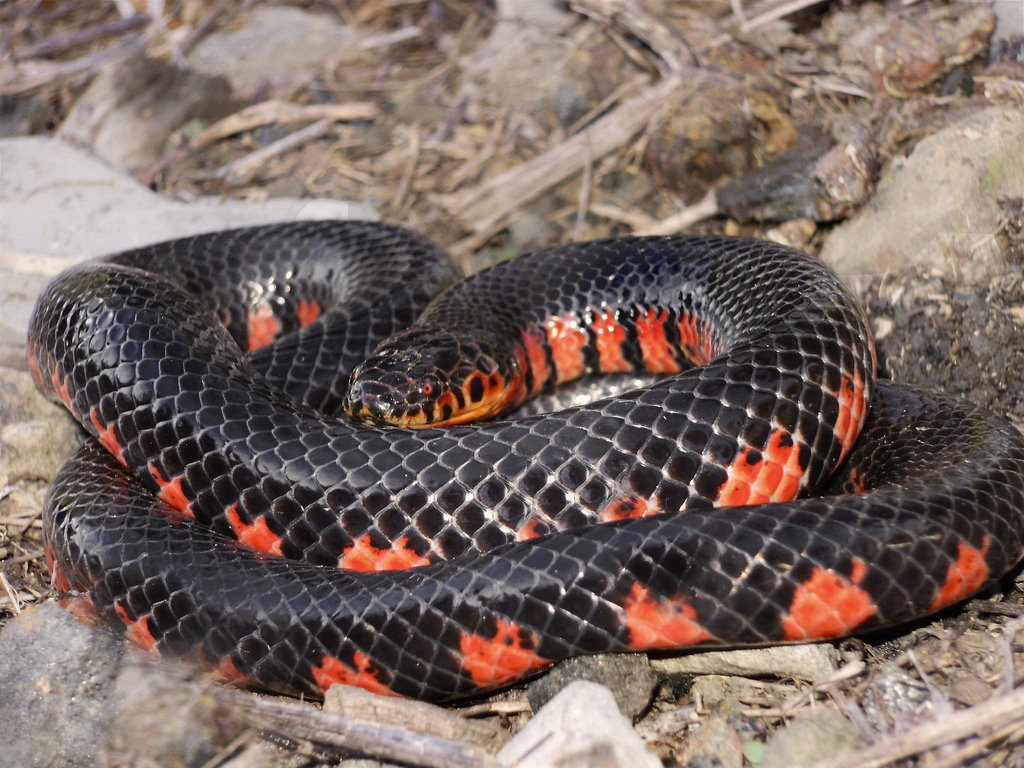
Photo John Sullivan (opens in a new tab) / Wikimedia Commons, CC BY-SA 3.0 (opens in a new tab)
At a glance
- Size
- Usually 100 to 140 cm long
- Habitat
- Swamps, marshes, slow streams and ponds
- Diet
- Amphiumas, sirens and other aquatic salamanders; frogs and fish
- In Georgia
- The Coastal Plain and lower Piedmont
- Venomous
- No
- Rabies vector
- No
Identification
- Key marks
- Glossy black above; red or pink belly with bars extending up the sides; tail ends in a sharp spine
- Told apart from
- Rainbow snake, which has red and yellow stripes along the back
- Where to look
- Rarely seen; sometimes crossing roads on rainy nights
Behaviour
Mudsnakes hunt amphiumas and sirens, large salamanders of the mud, gripping them with long teeth. The pointed tail tip is harmless; the snake presses it against a hand when grabbed.
Why they matter
They are the main predator of amphiumas and sirens, and part of the balance of southern swamps. Females coil around their eggs until they hatch.
Reproduction and lifecycle
Eggs — Often 20 to 50, sometimes more
Nest — In cavities in soil or logs, guarded by the female
Incubation — About 8 to 12 weeks
Hatchlings — About 20 cm long
Maturity — In a few years
Lifespan — Over 15 years
Living around people
- It is harmless and almost never bites.
Misconceptions
- Hoop snakes roll like wheels and sting with their tails. No snake rolls, and the tail spine is harmless.
Related species
Seasonal activity
When this species is breeding, and when there are nests on the ground. Mowing during the shaded months is how most nests are found.
| Jan | Feb | Mar | Apr | May | Jun | Jul | Aug | Sep | Oct | Nov | Dec | |
|---|---|---|---|---|---|---|---|---|---|---|---|---|
| Breeding | Jan: no | Feb: no | Mar: no | Apr: no | May: no | Jun: no | Jul: no | Aug: no | Sep: no | Oct: no | Nov: no | Dec: no |
| Active nests | Jan: no | Feb: no | Mar: no | Apr: no | May: no | Jun: no | Jul: no | Aug: no | Sep: no | Oct: no | Nov: no | Dec: no |
| Notes | Sheltering | Sheltering | Active on warm days | Active | Mating | Laying | Guarding eggs | Hatching | Young active | Active | Sheltering | Sheltering |
Where it lives
Recorded in 14 states and provinces. Each one links to the other animals there, and to the rehabilitators licensed for them.
If you found one
Answer a few questions and you will get a specific answer for what you are looking at.
I found an animal