
Species
Mourning dove
Zenaida macroura
The slender, soft-voiced dove of every Georgia yard, whose mournful coo is often mistaken for an owl.
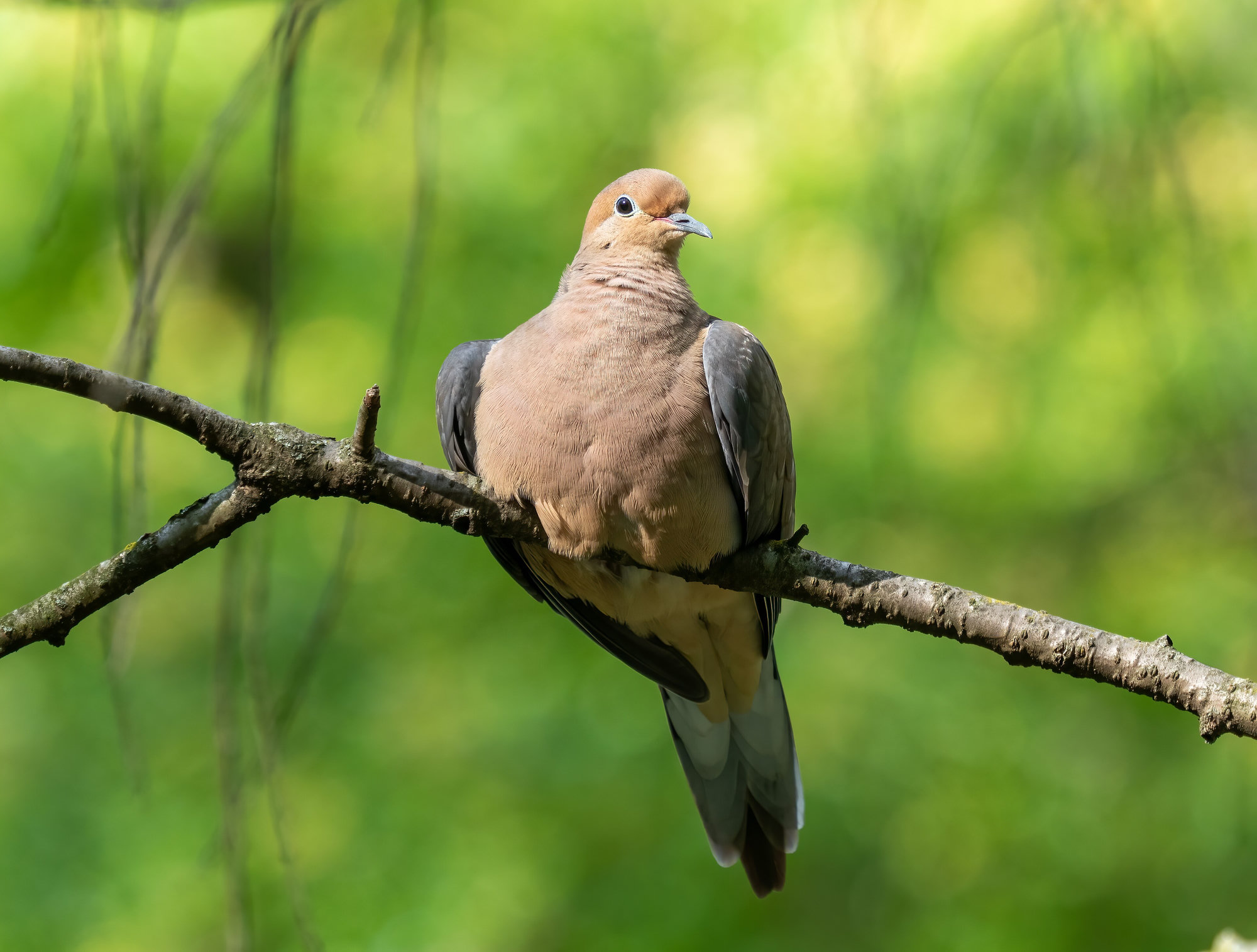
Photo Rhododendrites (opens in a new tab) / Wikimedia Commons, CC BY-SA 4.0 (opens in a new tab)
At a glance
- Size
- About 23 to 34 cm long
- Weight
- About 100 to 170 g
- Habitat
- Yards, farms, fields, open woods and towns
- Diet
- Seeds, almost exclusively
- In Georgia
- Abundant resident statewide
- Voice
- A mournful "coo-OO-oo, oo, oo"; wings whistle on take-off
- Rabies vector
- No
Identification
- Key marks
- Slim, tan-brown body; small head; long pointed tail edged in white; black spots on the wings
- Told apart from
- Eurasian collared-dove, which is paler with a black collar and square tail
- Told apart from
- Common ground-dove, which is much smaller with rusty wings
- Where to look
- Wires, yards, fields and roadsides everywhere
Behaviour
Mourning doves feed on the ground on seeds and store them in the crop, a pouch in the throat, before flying off to digest them. They can drink by sucking water up without lifting their heads, unlike most birds.
Pairs nest repeatedly from spring through autumn, and both parents feed their young on crop milk.
Why they matter
The mourning dove is one of the most abundant birds in North America, and it eats huge quantities of weed seeds. It is prey for hawks, falcons and many other animals, and its many broods a year let it sustain those losses.
Reproduction and lifecycle
Nest — A flimsy platform of twigs, sometimes so thin the eggs show through
Eggs — Usually two
Incubation — About 14 days, shared by both parents
Nestlings — Fed crop milk; leave the nest at about 12 to 15 days
After leaving — Fed by the parents for another week or two on the ground
Broods — Up to five or six in a year in the South
Lifespan — Most live about a year; a few much longer
Living around people
- Mourning doves nest in hanging planters, gutters and porch lights; the whole cycle takes about a month, and leaving it be is the kindest thing.
- Young doves out of the nest look fully feathered but have short tails; they are fledglings being fed by their parents on the ground.
- Keeping cats indoors saves many ground-feeding doves.
Misconceptions
- A fully feathered young dove on the ground has fallen and needs help. Fledgling doves leave the nest before they fly well and are fed by their parents nearby.
- The coo at dawn is an owl. It is the mourning dove, often heard before sunrise.
- Doves mate for life and grieve. Pairs often stay together for a season or longer, but the story of lifelong grief is sentiment.
Related species
Seasonal activity
When this species is breeding, and when there are nests on the ground. Mowing during the shaded months is how most nests are found.
| Jan | Feb | Mar | Apr | May | Jun | Jul | Aug | Sep | Oct | Nov | Dec | |
|---|---|---|---|---|---|---|---|---|---|---|---|---|
| Breeding | Jan: no | Feb: no | Mar: no | Apr: no | May: no | Jun: no | Jul: no | Aug: no | Sep: no | Oct: no | Nov: no | Dec: no |
| Active nests | Jan: no | Feb: no | Mar: no | Apr: no | May: no | Jun: no | Jul: no | Aug: no | Sep: no | Oct: no | Nov: no | Dec: no |
| Notes | Flocks; some pairs courting | Pairs forming | Nesting begins | Nesting | Nesting | Nesting | Nesting | Nesting | Last nests | Flocks | Flocks | Flocks |
Where it lives
Recorded in 87 states and provinces. Each one links to the other animals there, and to the rehabilitators licensed for them.
United States
- Alabama
- Arizona
- Arkansas
- California
- Coloradobreeding
- Connecticut
- Delaware
- District of Columbia
- Florida
- Georgia
- Hawaiiintroduced
- Idaho
- Illinois
- Indiana
- Iowa
- Kansas
- Kentucky
- Louisiana
- Maine
- Maryland
- Massachusetts
- Michigan
- Minnesota
- Mississippi
- Missouri
- Montanabreeding
- Nebraskabreeding
- Nevada
- New Hampshire
- New Jersey
- New Mexico
- New York
- North Carolina
- North Dakotabreeding
- Ohio
- Oklahoma
- Oregon
- Pennsylvania
- Rhode Island
- South Carolina
- South Dakotabreeding
- Tennessee
- Texas
- Utah
- Vermont
- Virginia
- Washington
- West Virginia
- Wisconsin
- Wyomingbreeding
Canada
If you found one
Answer a few questions and you will get a specific answer for what you are looking at.
I found an animal