
Species
Common ground dove
Columbina passerina
A sparrow-sized dove of sandy southern ground, which flashes rusty wings when it flies.
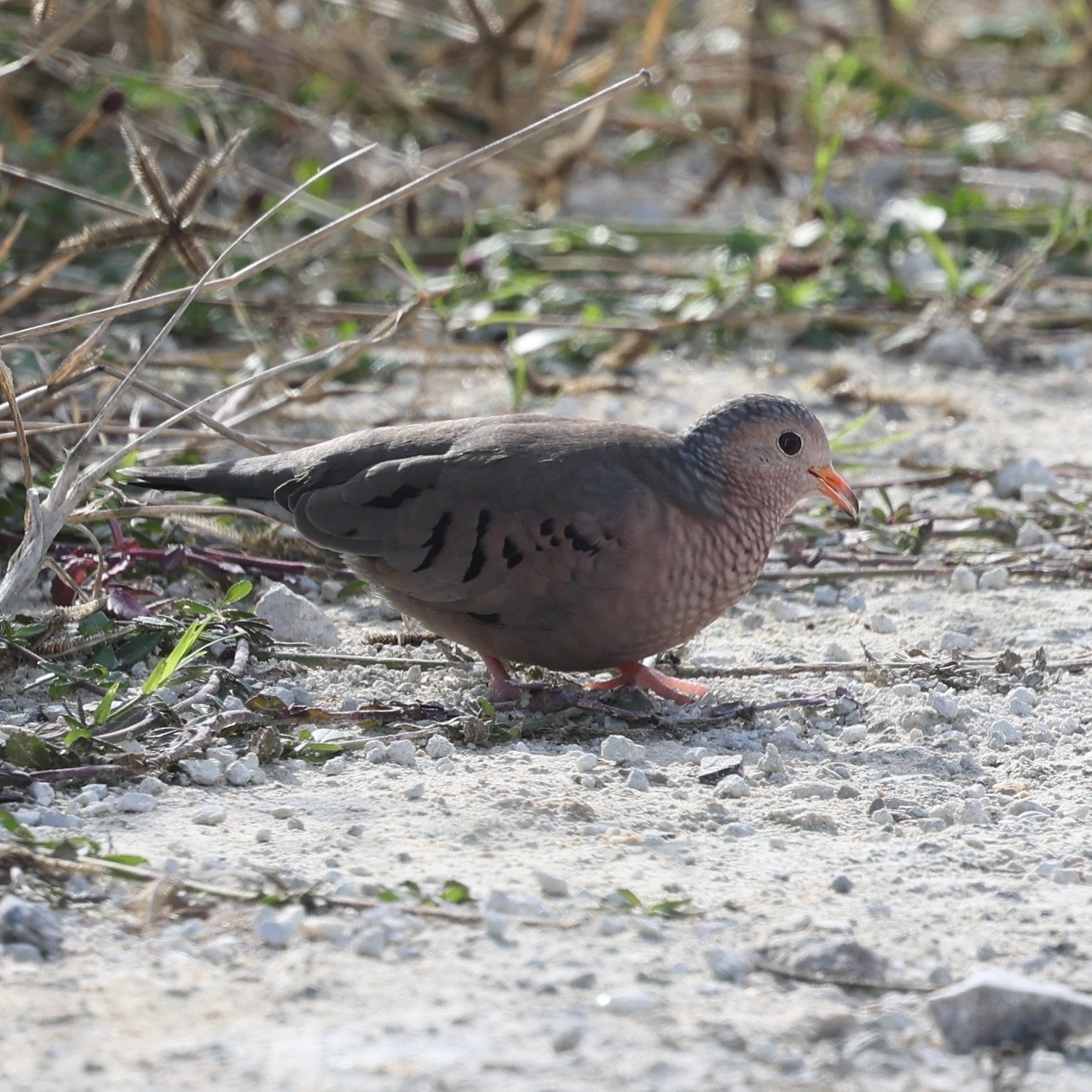
Photo Wes Gapp (opens in a new tab) / iNaturalist, CC BY 4.0 (opens in a new tab)
At a glance
- Size
- About 15 to 18 cm long
- Weight
- About 25 to 40 g
- Habitat
- Sandy open ground, pine woods, field edges, coastal dunes and yards
- Diet
- Small seeds, berries and insects
- In Georgia
- Resident in the south and on the coast; scarcer farther north
- Voice
- A soft, repeated, rising "woo-up"
- Rabies vector
- No
Identification
- Key marks
- Tiny, plump, grey-brown dove; scaly-looking head and breast; short tail; bright rufous wing patches in flight
- Told apart from
- A young mourning dove, which is larger with a long pointed tail and no rufous in the wing
- Told apart from
- Sparrows, which have thick seed-cracking bills
- Where to look
- On the ground in sandy yards, pine woods and dunes
Behaviour
Common ground-doves walk quietly on the ground, bobbing their heads as they pick up tiny seeds. Pairs stay together much of the year and nest repeatedly through the warm months.
Why they matter
The smallest dove in Georgia, the ground-dove depends on open, sandy ground with seeds and scattered cover — habitats kept open by fire and grazing. It has declined in parts of the Southeast as open pine woods and old fields have been lost.
Reproduction and lifecycle
Nest — A flimsy platform on the ground, a stump or a low branch
Eggs — Usually two
Incubation — About 12 to 14 days
Nestlings — Fed crop milk; leave the nest at about 11 days
Broods — Several a year
Lifespan — A few years
Living around people
- Free-roaming cats take many ground-doves; keeping cats indoors helps them.
- Sandy, lightly mowed yards with seed-bearing plants suit them.
Misconceptions
- A tiny dove is a baby. Common ground-doves are fully grown at sparrow size.
Related species
Seasonal activity
When this species is breeding, and when there are nests on the ground. Mowing during the shaded months is how most nests are found.
| Jan | Feb | Mar | Apr | May | Jun | Jul | Aug | Sep | Oct | Nov | Dec | |
|---|---|---|---|---|---|---|---|---|---|---|---|---|
| Breeding | Jan: no | Feb: no | Mar: no | Apr: no | May: no | Jun: no | Jul: no | Aug: no | Sep: no | Oct: no | Nov: no | Dec: no |
| Active nests | Jan: no | Feb: no | Mar: no | Apr: no | May: no | Jun: no | Jul: no | Aug: no | Sep: no | Oct: no | Nov: no | Dec: no |
| Notes | Pairs on sandy ground | Pairs | Nesting begins | Nesting | Nesting | Nesting | Nesting | Nesting | Last nests | Small groups | Small groups | Pairs |
Where it lives
Recorded in 39 states and provinces. Each one links to the other animals there, and to the rehabilitators licensed for them.
United States
Mexico
- Aguascalientespassing through
- Baja California
- Baja California Sur
- Campeche
- Chiapas
- Chihuahuain winter
- Coahuilabreeding
- Colima
- Durangobreeding
- Guanajuatobreeding
- Guerrero
- Hidalgo
- Jalisco
- Michoacan
- Morelos
- Nayarit
- Nuevo Leon
- Oaxaca
- Puebla
- Queretaro
- Quintana Roo
- San Luis Potosibreeding
- Sinaloa
- Sonora
- State of Mexico
- Tamaulipas
- Veracruz
- Yucatan
- Zacatecasin winter
If you found one
Answer a few questions and you will get a specific answer for what you are looking at.
I found an animal