
Species
White-winged dove
Zenaida asiatica
A dove of the Southwest with bold white wing stripes, turning up more and more often in Georgia.
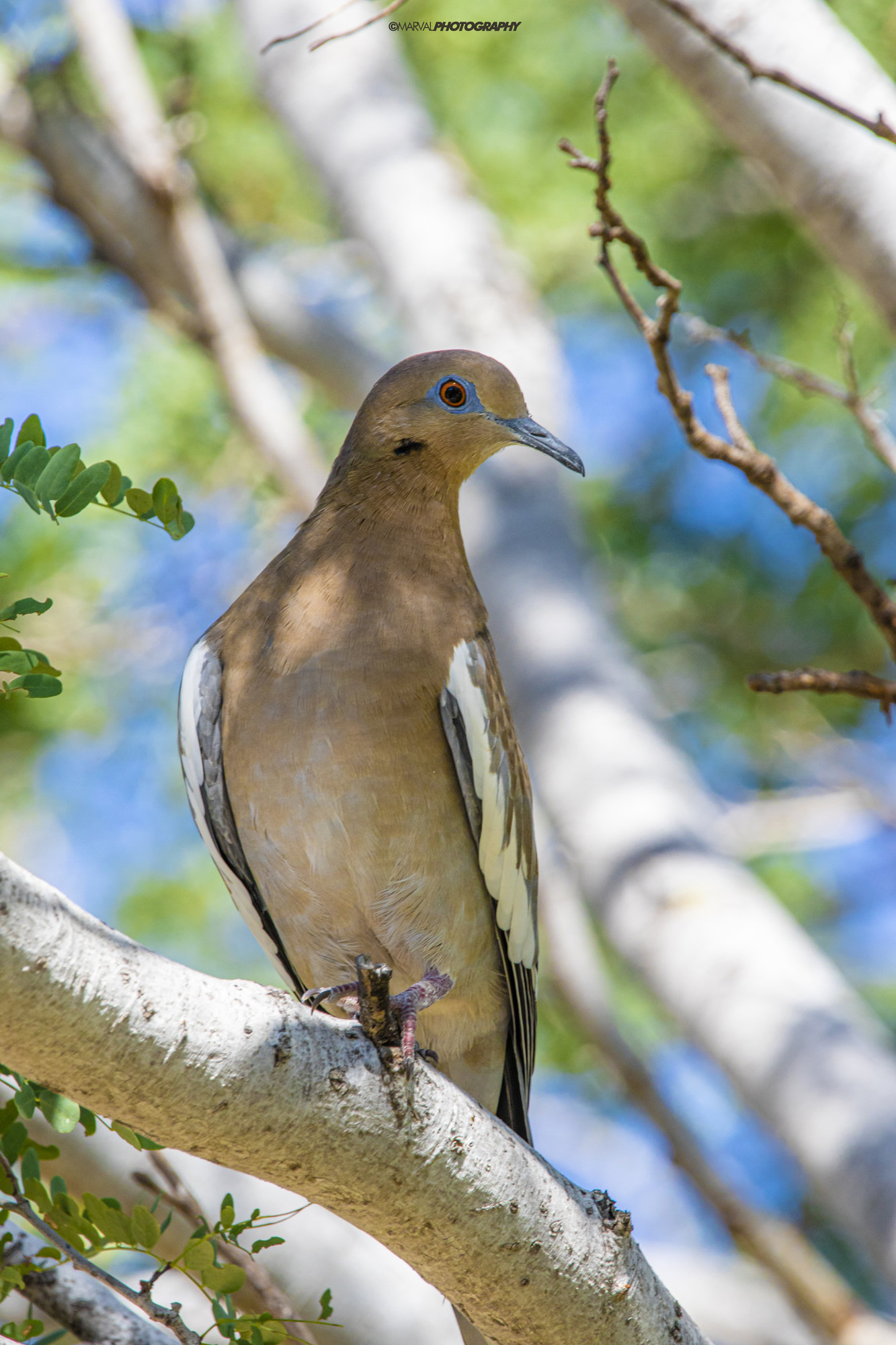
Photo MarvalPhotography19 (opens in a new tab) / iNaturalist, CC BY 4.0 (opens in a new tab)
At a glance
- Size
- About 29 cm long
- Weight
- About 125 to 190 g
- Habitat
- Towns, farms and brushland
- Diet
- Seeds, grain and fruit
- In Georgia
- An uncommon visitor, most often on the coast and in the south, increasing
- Voice
- A hooting "who-cooks-for-you"
- Rabies vector
- No
Identification
- Key marks
- Grey-brown dove with a broad white stripe along the folded wing, bold in flight; square tail with white corners; blue skin around a red eye
- Told apart from
- Mourning dove, which has no white in the wing and a long pointed tail
- Told apart from
- Eurasian collared-dove, which is paler with a black collar
- Where to look
- Feeders and farmyards, especially near the coast
Behaviour
White-winged doves feed on seeds and fruit. In the desert Southwest they feed heavily on saguaro cactus fruit and nectar and pollinate the flowers.
Why they matter
Once limited to the Southwest and Mexico, white-winged doves have spread north and east over recent decades, into towns across the Gulf states and beyond. In the desert they help pollinate saguaro cactus, one of the few birds to do so.
Reproduction and lifecycle
Nest — A flimsy platform of twigs in a tree or shrub
Eggs — Usually two
Incubation — About 14 days
Nestlings — Fed crop milk; fledge at about 13 to 16 days
Lifespan — Several years
Living around people
- White-winged doves visit farmyards and feeders and do no harm.
Misconceptions
- Any dove with white in the wing is a pigeon breed. The white-winged dove is a wild native of the Southwest.
Related species
Seasonal activity
When this species is breeding, and when there are nests on the ground. Mowing during the shaded months is how most nests are found.
| Jan | Feb | Mar | Apr | May | Jun | Jul | Aug | Sep | Oct | Nov | Dec | |
|---|---|---|---|---|---|---|---|---|---|---|---|---|
| Breeding | Jan: no | Feb: no | Mar: no | Apr: no | May: no | Jun: no | Jul: no | Aug: no | Sep: no | Oct: no | Nov: no | Dec: no |
| Active nests | Jan: no | Feb: no | Mar: no | Apr: no | May: no | Jun: no | Jul: no | Aug: no | Sep: no | Oct: no | Nov: no | Dec: no |
| Notes | A few present in the south | Present | Present | Some breeding in the Southeast | Breeding | Breeding | Breeding | Breeding | Present | Present | Present | Present |
Where it lives
Recorded in 49 states and provinces. Each one links to the other animals there, and to the rehabilitators licensed for them.
United States
Mexico
- Aguascalientes
- Baja California
- Baja California Sur
- Campeche
- Chiapas
- Chihuahua
- Coahuila
- Colima
- Durango
- Guanajuato
- Guerrero
- Hidalgo
- Jalisco
- Mexico City
- Michoacan
- Morelos
- Nayarit
- Nuevo Leon
- Oaxaca
- Puebla
- Queretaro
- Quintana Roo
- San Luis Potosi
- Sinaloa
- Sonora
- State of Mexico
- Tabasco
- Tamaulipas
- Tlaxcalabreeding
- Veracruz
- Yucatan
- Zacatecas
If you found one
Answer a few questions and you will get a specific answer for what you are looking at.
I found an animal