
Species
Long-tailed weasel
Neogale frenata
A slim, fierce, long-bodied hunter with a black-tipped tail, able to take prey larger than itself.
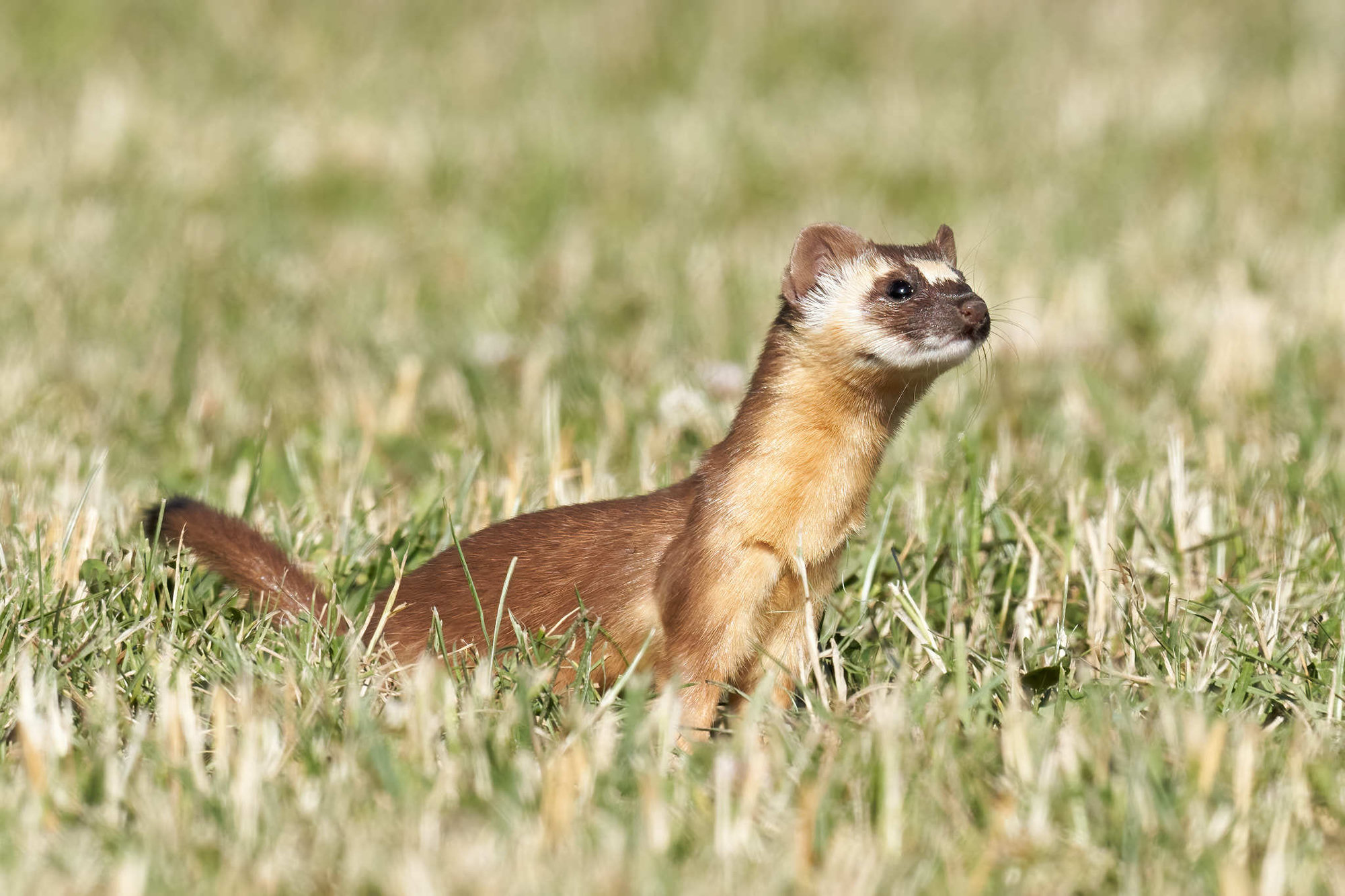
Photo benjchristensen (opens in a new tab) / iNaturalist, CC BY 4.0 (opens in a new tab)
At a glance
- Size
- Body about 20 to 30 cm; tail about 10 to 15 cm
- Weight
- About 85 to 350 g; males are much larger than females
- Habitat
- Forests, fields, farmland, marshes and brushy edges, usually near water
- Diet
- Mice, voles, rats, rabbits, squirrels, chipmunks, birds and eggs
- Active
- Day and night
- Shelter
- Dens in the burrows of prey, rock piles, hollow logs and brush
- Lifespan
- A few years
- Rabies vector
- No
Identification
- Key marks
- Long, slender body; short legs; brown back, cream to orange-yellow belly; tail about half the length of the body with a black tip
- Winter coat
- In the north, turns white in winter except for the black tail tip; in Georgia it stays brown
- Told apart from
- American mink, which is dark chocolate-brown all over and lives by water
- Told apart from
- Squirrels and chipmunks, which have bushy tails and move differently
- Where to look
- Stone walls, brush piles and field edges, often bounding across a road or path
Behaviour
Long-tailed weasels are active, curious hunters that search every hole, crevice and burrow for prey. They kill with a bite to the back of the head, and can take animals larger than themselves, including rabbits.
They are restless and fast, bounding with their backs arched, and will stand up on their hind legs to look around. They often take over the burrows of animals they have eaten.
Why they matter
Weasels are among the most effective natural controls of mice, voles and rats. A single weasel eats a large number of rodents in a year, following them into their own tunnels where few other predators can reach.
They are also a sign of healthy, varied farmland and woodland with enough cover and prey.
Reproduction and lifecycle
Mating — midsummer
Delayed implantation — the embryos rest for most of the year before implanting in late winter
Pregnancy — about 27 days after implantation
Birth — April and May, usually four to eight young
Eyes open — at about five weeks old
Weaning — at about five to six weeks old
Independence — by late summer
Lifespan — a few years
Living around people
- Weasels sometimes raid chicken coops; secure coops with fine mesh and a solid floor.
- Rodent poisons kill weasels that eat poisoned mice and rats.
- Stone walls, brush piles and field edges give them cover and prey.
- A weasel is unlikely to harm a person and will usually avoid people.
Misconceptions
- Weasels are sneaky and cruel. They are hunters doing what their bodies are built for, and they remove many rodents.
- A weasel near the house is dangerous. It is there for the mice.
Related species
Seasonal activity
When this species is breeding, and when there are nests on the ground. Mowing during the shaded months is how most nests are found.
| Jan | Feb | Mar | Apr | May | Jun | Jul | Aug | Sep | Oct | Nov | Dec | |
|---|---|---|---|---|---|---|---|---|---|---|---|---|
| Breeding | Jan: no | Feb: no | Mar: no | Apr: no | May: no | Jun: no | Jul: no | Aug: no | Sep: no | Oct: no | Nov: no | Dec: no |
| Active nests | Jan: no | Feb: no | Mar: no | Apr: no | May: no | Jun: no | Jul: no | Aug: no | Sep: no | Oct: no | Nov: no | Dec: no |
| Notes | Active; hunting rodents under snow in the north | Active | Active | Young born in a den, after a long delayed pregnancy | Young open their eyes at about five weeks old | Young begin following their mother on hunts | Mating season; young disperse | Mating continues; implantation is delayed | Active | Northern weasels begin changing to white | Active | Active |
Where it lives
Recorded in 87 states and provinces. Each one links to the other animals there, and to the rehabilitators licensed for them.
United States
- Alabama
- Arizona
- Arkansas
- California
- Colorado
- Connecticut
- Delaware
- District of Columbia
- Florida
- Georgia
- Idaho
- Illinois
- Indiana
- Iowa
- Kansas
- Kentucky
- Louisiana
- Maine
- Maryland
- Massachusetts
- Michigan
- Minnesota
- Mississippi
- Missouri
- Montana
- Nebraska
- Nevada
- New Hampshire
- New Jersey
- New Mexico
- New York
- North Carolina
- North Dakota
- Ohio
- Oklahoma
- Oregon
- Pennsylvania
- Rhode Island
- South Carolina
- South Dakota
- Tennessee
- Texas
- Utah
- Vermont
- Virginia
- Washington
- West Virginia
- Wisconsin
- Wyoming
If you found one
Answer a few questions and you will get a specific answer for what you are looking at.
I found an animal