
Species
Eastern spotted skunk
Spilogale putorius
A small, climbing skunk with wavy white stripes that does a handstand before it sprays.
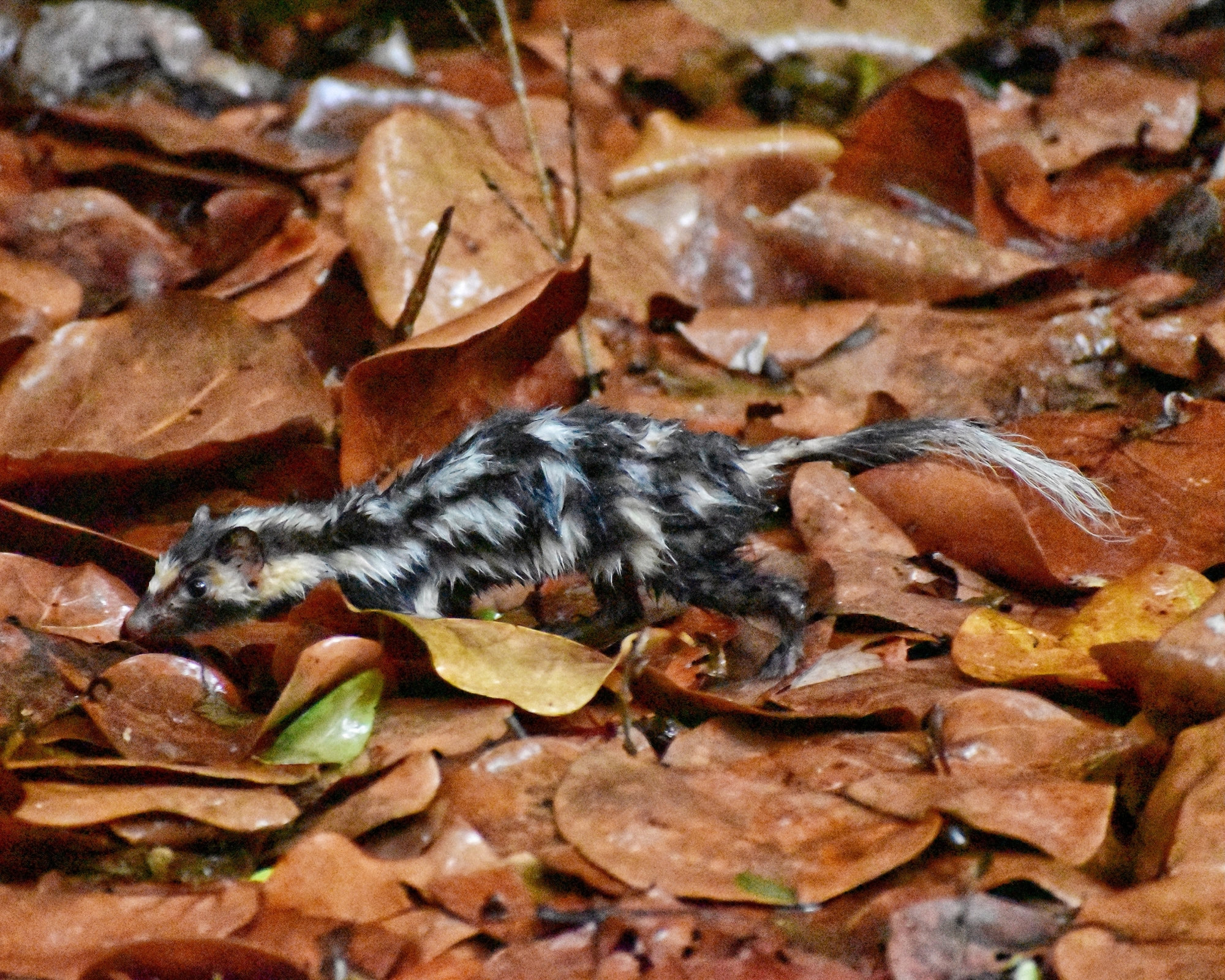
Photo kitkatka (opens in a new tab) / iNaturalist, CC BY-NC 4.0 (opens in a new tab)
At a glance
- Size
- Body about 23 to 35 cm; tail about 10 to 20 cm
- Weight
- About 0.4 to 1 kg
- Habitat
- Forests, brushy fields, rocky areas and farmland, especially with dense cover
- Diet
- Insects, mice and other small mammals, eggs, fruit, and amphibians and reptiles
- Active
- Night
- Shelter
- Dens in rock piles, hollow logs, brush, burrows and under buildings
- Status
- Declined across much of its range and now rare in many places
- Rabies vector
- Yes
Identification
- Key marks
- Small; glossy black fur with four to six broken, wavy white stripes and spots; white spot on the forehead; bushy tail with a white tip
- Warning display
- Stands on its front legs with its tail raised before spraying
- Told apart from
- Striped skunk, which is much larger with two broad white stripes
- Told apart from
- Cats, which move and look quite different up close
- Where to look
- Rarely seen; brushy woods and rocky areas at night, including in north and south Georgia
Behaviour
Eastern spotted skunks are the acrobats of the skunk world. They climb trees well, move quickly, and when threatened they stamp their feet and perform a handstand, lifting their hind end high to show their warning colours before they spray.
They hunt at night for insects, mice, eggs and fruit, and den in rock piles, logs and brush. They are far more secretive than striped skunks.
Why they matter
Spotted skunks eat many insects and small rodents, and their decline across much of their range, especially in the Midwest, has made them a species of conservation concern.
Their handstand warning shows how much an animal will do to avoid using its defence: spraying is costly, and a spotted skunk would much rather warn than fight.
Reproduction and lifecycle
Mating — March and April
Gestation — about 50 to 65 days
Birth — May and June, usually two to six young
Eyes open — at about a month old
Weaning — at about two months old
Independence — by late summer
Lifespan — a few years in the wild
Living around people
- Rock piles, brush and dense cover give spotted skunks places to den.
- Chicken coops should be secured with fine mesh and solid floors.
- A skunk doing a handstand is giving a clear warning; back away slowly and it will not spray.
- Never handle a skunk; skunks are rabies vector species.
Misconceptions
- A small skunk is a baby striped skunk. It may be an adult spotted skunk.
- Skunks spray without warning. Spotted skunks go through a whole display, including a handstand, first.
- Skunks are common everywhere. This species has become rare across much of its range.
Related species
Seasonal activity
When this species is breeding, and when there are nests on the ground. Mowing during the shaded months is how most nests are found.
| Jan | Feb | Mar | Apr | May | Jun | Jul | Aug | Sep | Oct | Nov | Dec | |
|---|---|---|---|---|---|---|---|---|---|---|---|---|
| Breeding | Jan: no | Feb: no | Mar: no | Apr: no | May: no | Jun: no | Jul: no | Aug: no | Sep: no | Oct: no | Nov: no | Dec: no |
| Active nests | Jan: no | Feb: no | Mar: no | Apr: no | May: no | Jun: no | Jul: no | Aug: no | Sep: no | Oct: no | Nov: no | Dec: no |
| Notes | Active; may share dens in cold weather | Active | Mating | Mating continues | Young born in a den | Young open their eyes at about a month old | Young begin to forage with their mother | Young become independent | Young disperse | Active | Active | Active; less so in cold spells |
Where it lives
Recorded in 12 states and provinces. Each one links to the other animals there, and to the rehabilitators licensed for them.
Treated as a rabies-vector species in Alabama, Florida, Georgia, Kentucky, Maryland, Mississippi, North Carolina, Pennsylvania, South Carolina, Tennessee, Virginia and West Virginia. There, only a certified rehabilitator may take one.
If you found one
Answer a few questions and you will get a specific answer for what you are looking at.
I found an animal