
Species
Least flycatcher
Empidonax minimus
The smallest eastern flycatcher, a grey-green bird that calls 'che-bek!' and passes through Georgia on migration.
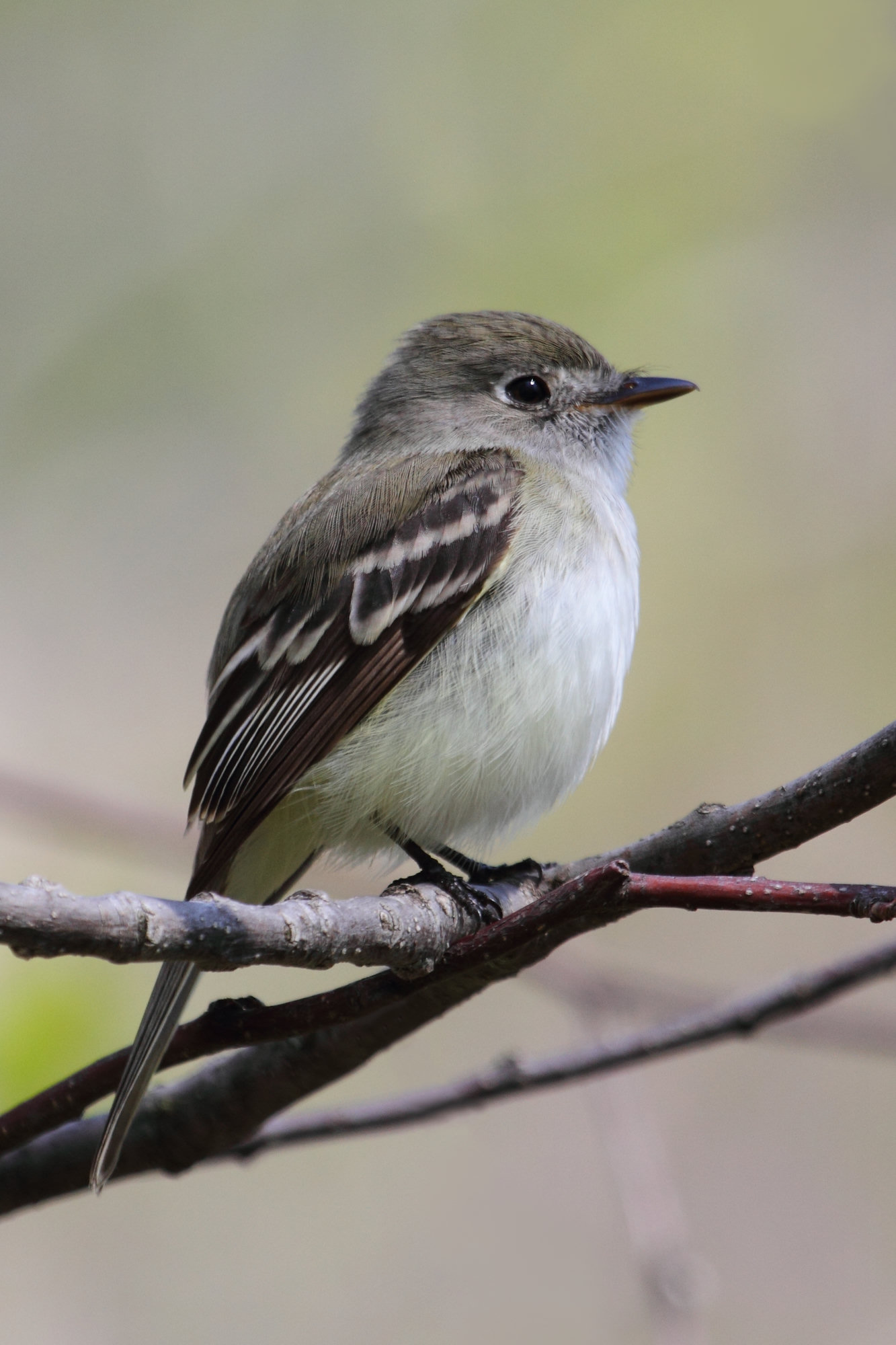
Photo Cephas (opens in a new tab) / Wikimedia Commons, CC BY-SA 3.0 (opens in a new tab)
At a glance
- Size
- About 12 to 14 cm long
- Weight
- About 8 to 13 g
- Habitat
- Open woods and edges; any woods on migration
- Diet
- Insects
- In Georgia
- An uncommon migrant; a few nest in the mountains
- Voice
- A sharp "che-BEK"
- Rabies vector
- No
Identification
- Key marks
- Small; grey-olive; bold white eye-ring; white wing bars; short bill
- Told apart from
- Acadian flycatcher, which is larger and greener
- Where to look
- Woodland edges during migration
Behaviour
Least flycatchers catch insects in short flights and flick their tails and wings. They defend small territories fiercely.
Why they matter
Least flycatchers nest in tight clusters, and a single woodland may hold many territories. They are one of the most frequently seen small flycatchers on migration.
Reproduction and lifecycle
Nest — A small cup in a branch fork
Eggs — Usually four
Incubation — About 13 to 15 days
Chicks — Fed by both parents
Flight — At about 13 to 16 days
Lifespan — Several years
Living around people
- Migrating flycatchers often strike windows.
Misconceptions
- Flycatchers only eat flies. They take many kinds of insects.
Related species
Seasonal activity
When this species is breeding, and when there are nests on the ground. Mowing during the shaded months is how most nests are found.
| Jan | Feb | Mar | Apr | May | Jun | Jul | Aug | Sep | Oct | Nov | Dec | |
|---|---|---|---|---|---|---|---|---|---|---|---|---|
| Breeding | Jan: no | Feb: no | Mar: no | Apr: no | May: no | Jun: no | Jul: no | Aug: no | Sep: no | Oct: no | Nov: no | Dec: no |
| Active nests | Jan: no | Feb: no | Mar: no | Apr: no | May: no | Jun: no | Jul: no | Aug: no | Sep: no | Oct: no | Nov: no | Dec: no |
| Notes | In Central America | In Central America | In Central America | Migrating north | Migrants; a few nesting in the mountains | Nesting | Nesting | Migrants | Migrants | Last migrants | In Central America | In Central America |
Where it lives
Recorded in 83 states and provinces. Each one links to the other animals there, and to the rehabilitators licensed for them.
United States
- Alabamapassing through
- Arkansaspassing through
- Coloradobreeding
- Connecticutbreeding
- Delawarepassing through
- District of Columbiapassing through
- Floridain winter
- Georgiabreeding
- Idahobreeding
- Illinoispassing through
- Indianapassing through
- Iowapassing through
- Kansaspassing through
- Kentuckypassing through
- Louisianain winter
- Mainebreeding
- Marylandbreeding
- Massachusettsbreeding
- Michiganbreeding
- Minnesotabreeding
- Mississippiin winter
- Missouripassing through
- Montanabreeding
- Nebraskapassing through
- New Hampshirebreeding
- New Jerseybreeding
- New Yorkbreeding
- North Carolinabreeding
- North Dakotabreeding
- Ohiopassing through
- Oklahomapassing through
- Oregonbreeding
- Pennsylvaniabreeding
- Rhode Islandbreeding
- South Dakotabreeding
- Tennesseebreeding
- Texaspassing through
- Utahbreeding
- Vermontbreeding
- Virginiabreeding
- Washingtonbreeding
- West Virginiabreeding
- Wisconsinbreeding
- Wyomingbreeding
Canada
Mexico
- Aguascalientespassing through
- Campechein winter
- Chiapasin winter
- Coahuilain winter
- Colimain winter
- Durangoin winter
- Guanajuatoin winter
- Guerreroin winter
- Hidalgoin winter
- Jaliscoin winter
- Mexico Cityin winter
- Michoacanin winter
- Morelosin winter
- Nayaritin winter
- Nuevo Leonin winter
- Oaxacain winter
- Pueblain winter
- Queretaroin winter
- Quintana Rooin winter
- San Luis Potosiin winter
- Sinaloain winter
- State of Mexicoin winter
- Tabascoin winter
- Tamaulipasin winter
- Veracruzin winter
- Yucatanin winter
- Zacatecasin winter
If you found one
Answer a few questions and you will get a specific answer for what you are looking at.
I found an animal