
Species
Laughing gull
Leucophaeus atricilla
The black-hooded summer gull of Georgia's beaches, named for its raucous, laughing call.
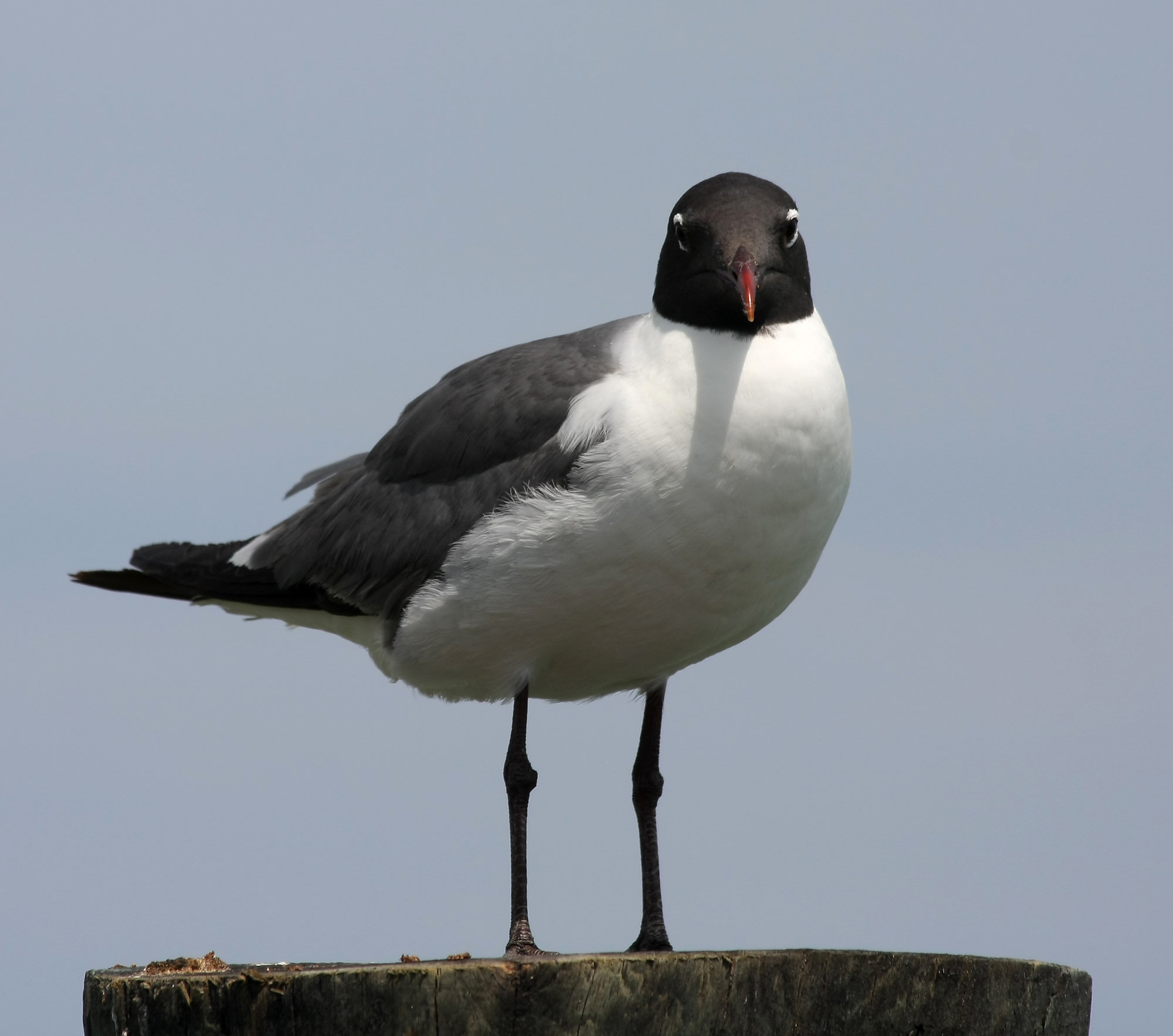
Photo Ianaré Sévi (opens in a new tab) / Wikimedia Commons, CC BY-SA 3.0 (opens in a new tab)
At a glance
- Size
- About 36 to 42 cm long
- Weight
- About 200 to 370 g
- Habitat
- Beaches, marshes, harbours, car parks and farm fields near the coast
- Diet
- Fish, crabs, insects, horseshoe crab eggs and food scraps
- In Georgia
- Abundant on the coast all year; nests in colonies on marsh islands
- Voice
- A loud, laughing "ha-ha-ha-ha-haah"
- Rabies vector
- No
Identification
- Key marks
- Dark grey back; black wingtips; in summer a black hood and dark red bill; in winter a smudgy grey head
- Told apart from
- Bonaparte's gull, which is smaller with a white wedge on the wing
- Told apart from
- Franklin's gull, a rare visitor, which has white spots on the wingtips
- Where to look
- Any Georgia beach, dock or causeway
Behaviour
Laughing gulls feed on almost anything, from fish and crabs to picnic scraps. They steal food from pelicans, sometimes landing on a pelican's head to take fish from its pouch.
They nest in large colonies on marsh islands and beaches.
Why they matter
Laughing gulls were nearly wiped out on the Atlantic coast in the late 1800s, when their feathers were used on hats. Protection brought them back, and today they are one of the most familiar birds of Georgia's beaches. They clean up dead fish and other waste along the shore.
Reproduction and lifecycle
Nest — A bowl of grass on marsh islands or beaches, in colonies
Eggs — Usually three
Incubation — About 22 to 27 days
Chicks — Downy; stay near the nest, fed by both parents
Flight — At about five weeks
Lifespan — Wild birds over twenty years are recorded
Living around people
- Gulls fed from boats and beaches become bold; not feeding them keeps them wild.
- Fishing line and hooks are a leading cause of injury in gulls.
- A young gull alone on the beach is often a fledgling still being fed by its parents.
Misconceptions
- Gulls are "sea gulls" that live only at sea. Most gulls, including this one, live on coasts and rarely go far from land.
Related species
Seasonal activity
When this species is breeding, and when there are nests on the ground. Mowing during the shaded months is how most nests are found.
| Jan | Feb | Mar | Apr | May | Jun | Jul | Aug | Sep | Oct | Nov | Dec | |
|---|---|---|---|---|---|---|---|---|---|---|---|---|
| Breeding | Jan: no | Feb: no | Mar: no | Apr: no | May: no | Jun: no | Jul: no | Aug: no | Sep: no | Oct: no | Nov: no | Dec: no |
| Active nests | Jan: no | Feb: no | Mar: no | Apr: no | May: no | Jun: no | Jul: no | Aug: no | Sep: no | Oct: no | Nov: no | Dec: no |
| Notes | Present in smaller numbers | Numbers increasing | Hoods appearing | Colonies forming | Nesting | Chicks | Chicks | Young flying | Flocks on beaches | Many move south | Fewer present | Wintering birds |
Where it lives
Recorded in 50 states and provinces. Each one links to the other animals there, and to the rehabilitators licensed for them.
United States
- Alabama
- California
- Connecticutbreeding
- Delawarebreeding
- District of Columbiapassing through
- Florida
- Georgia
- Louisiana
- Mainebreeding
- Marylandbreeding
- Massachusettsbreeding
- Mississippi
- New Hampshirebreeding
- New Jerseybreeding
- New Yorkbreeding
- North Carolinabreeding
- Pennsylvaniabreeding
- Rhode Islandbreeding
- South Carolina
- Texas
- Virginiabreeding
Mexico
- Baja California Sur
- Campeche
- Chiapasin winter
- Coahuilain winter
- Colima
- Durangoin winter
- Guanajuatoin winter
- Guerrero
- Hidalgoin winter
- Jalisco
- Mexico Cityin winter
- Michoacanin winter
- Nayarit
- Nuevo Leonbreeding
- Oaxacain winter
- Pueblain winter
- Queretaroin winter
- Quintana Roo
- Sinaloa
- Sonora
- State of Mexicoin winter
- Tabascoin winter
- Tamaulipas
- Tlaxcalain winter
- Veracruz
- Yucatan
If you found one
Answer a few questions and you will get a specific answer for what you are looking at.
I found an animal