
Species
Franklin's gull
Leucophaeus pipixcan
A prairie gull with a dark hood and white-spotted wingtips, a rare migrant in Georgia.
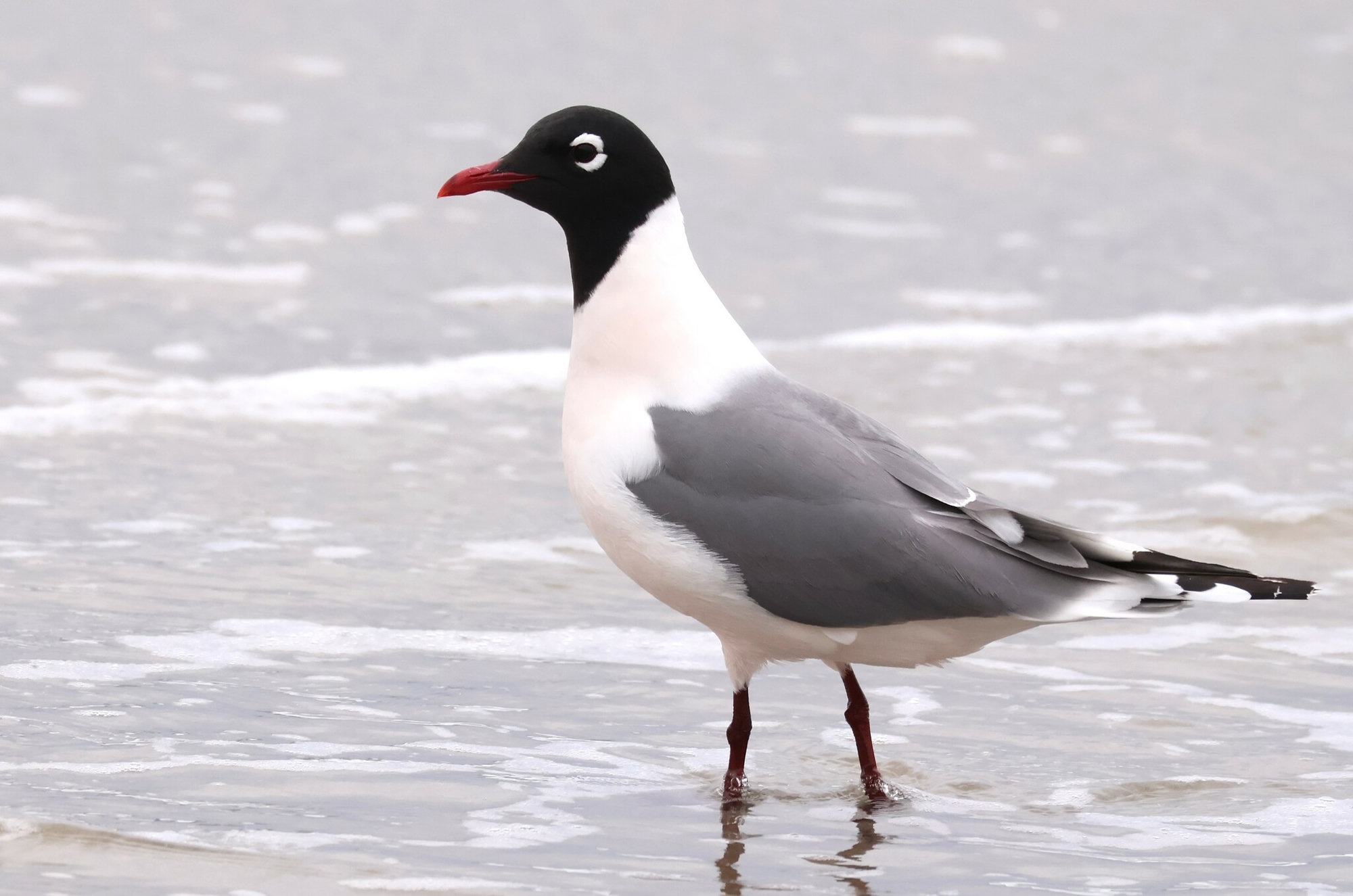
Photo Millie Basden (opens in a new tab) / iNaturalist, CC BY 4.0 (opens in a new tab)
At a glance
- Size
- About 32 to 38 cm long
- Weight
- About 220 to 335 g
- Habitat
- Prairie marshes and farm fields; lakes and coasts on migration
- Diet
- Insects, earthworms and small fish
- In Georgia
- A rare migrant, mostly in autumn
- Voice
- A soft "kuk"
- Rabies vector
- No
Identification
- Key marks
- Dark grey back; black wingtips separated by a white band; white crescents around the eye; a partial dark hood in winter
- Told apart from
- Laughing gull, which lacks the white band on the wingtips and has a smudgier winter head
- Where to look
- Reservoirs and fields with other gulls, October and November
Behaviour
Franklin's gulls follow ploughs to catch insects and worms, and they nest on floating mats in prairie marshes. Nearly the whole population winters on the Pacific coast of South America.
Why they matter
Franklin's gulls are called "prairie doves" by farmers on the northern plains because they eat so many insects in newly worked fields. Their long migration from the prairies to Peru and Chile links two very different landscapes.
Reproduction and lifecycle
Nest — A floating mat of plants in prairie marshes
Eggs — Usually three
Incubation — About 24 days
Chicks — Fed by both parents
Flight — At about five to six weeks
Lifespan — Several years
Living around people
- Franklin's gulls are rarely seen in Georgia and should be enjoyed from a distance.
Misconceptions
- All black-hooded gulls in Georgia are laughing gulls. Most are; a Franklin's gull is a rare exception.
Related species
Seasonal activity
When this species is breeding, and when there are nests on the ground. Mowing during the shaded months is how most nests are found.
| Jan | Feb | Mar | Apr | May | Jun | Jul | Aug | Sep | Oct | Nov | Dec | |
|---|---|---|---|---|---|---|---|---|---|---|---|---|
| Breeding | Jan: no | Feb: no | Mar: no | Apr: no | May: no | Jun: no | Jul: no | Aug: no | Sep: no | Oct: no | Nov: no | Dec: no |
| Active nests | Jan: no | Feb: no | Mar: no | Apr: no | May: no | Jun: no | Jul: no | Aug: no | Sep: no | Oct: no | Nov: no | Dec: no |
| Notes | In South America | In South America | Migrating north | Arriving on the prairies | Nesting | Nesting | Chicks | Flocks gathering | Migrating south | A few reach Georgia | Rare visitor | In South America |
Where it lives
Recorded in 35 states and provinces. Each one links to the other animals there, and to the rehabilitators licensed for them.
United States
- Californiain winter
- Coloradopassing through
- Georgiapassing through
- Idahopassing through
- Iowapassing through
- Kansaspassing through
- Louisianapassing through
- Minnesotabreeding
- Mississippiin winter
- Missouripassing through
- Montanabreeding
- Nebraskapassing through
- Nevadapassing through
- New Mexicopassing through
- North Dakotabreeding
- Oklahomapassing through
- Oregonpassing through
- South Dakotabreeding
- Tennesseepassing through
- Texaspassing through
- Utahpassing through
- Wyomingpassing through
If you found one
Answer a few questions and you will get a specific answer for what you are looking at.
I found an animal