
Species
Eastern gray squirrel
Sciurus carolinensis
A familiar tree squirrel whose forgotten acorn caches help regenerate eastern hardwood forests.
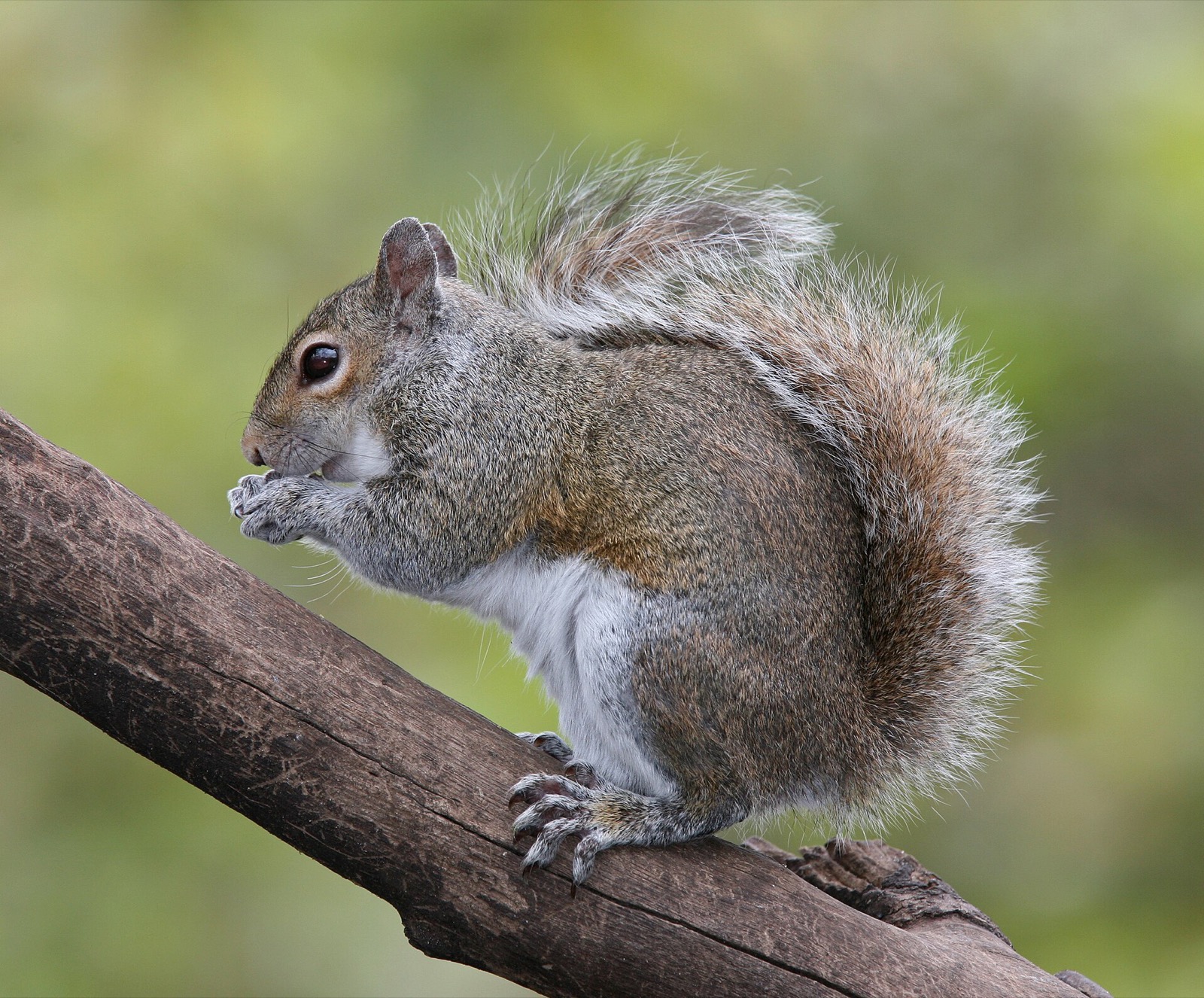
Photo Tom Friedel (opens in a new tab), CC BY 3.0 (opens in a new tab)
At a glance
- Occurrence
- Native to North America
- Habitat
- Hardwood and mixed forests, parks, campuses and wooded neighbourhoods
- Diet
- Acorns, hickory nuts, seeds, buds, fungi, fruit and occasional animal matter
- Activity
- Diurnal, with strongest activity in morning and late afternoon
- Shelter
- Tree cavities and leafy nests called dreys
- Social pattern
- Mostly independent, though several may share a cavity in cold weather
- Rabies vector
- No
Identification
- Key marks
- Grey upperparts, a white belly and a large bushy tail, sometimes with reddish tones
- Told apart from
- Eastern fox squirrel, which is larger and often has more variable colour with a longer, fuller tail
- Where to look
- Hardwood and mixed forests, parks, campuses and wooded neighbourhoods
Behaviour
It is diurnal, with strongest activity in morning and late afternoon. It uses habitats including hardwood and mixed forests, parks, campuses and wooded neighbourhoods. It feeds on acorns, hickory nuts, seeds, buds, fungi, fruit and occasional animal matter.
Tree squirrels travel through the canopy and on the ground, using memory and scent to recover buried food. They also maintain more caches than they can retrieve.
Scatter-hoarded nuts that are never recovered can germinate, making squirrels important seed dispersers.
Why they matter
By burying nuts and failing to recover some of them, tree squirrels disperse oaks, hickories and other large-seeded trees. They are also important prey for hawks, owls, foxes and snakes.
Scatter-hoarding spreads risk across hundreds of small caches and incidentally plants part of the next generation of forest.
Reproduction and lifecycle
Breeding — tree squirrels commonly have a winter breeding period and a second summer period.
Gestation — about 44–45 days.
Nestling — young are born naked and blind in a cavity or leaf nest and remain there for roughly 6–8 weeks.
Independence — juveniles begin foraging on their own after weaning but may remain near the natal range for weeks.
Living around people
- Inspect tree cavities and leaf nests before pruning or removing trees, especially during nesting seasons.
- Use baffles rather than poisons when squirrels reach bird feeders.
- Cap chimneys and repair roof openings after confirming no squirrels or young remain inside.
- Keep cats indoors or supervised; young squirrels spend time on trunks and the ground while learning routes.
Misconceptions
- A squirrel that approaches people is tame. Animals fed by people can lose normal distance without becoming domesticated.
- Every leaf nest is empty in winter. Dreys can be used for resting and may hold young at other times of year.
- Squirrels remember every nut they bury. They recover many caches, but unrecovered seeds are part of how they disperse trees.
Related species
- eastern-fox-squirrel
- Groundhog
- Southern flying squirrel
Seasonal activity
When this species is breeding, and when there are nests on the ground. Mowing during the shaded months is how most nests are found.
| Jan | Feb | Mar | Apr | May | Jun | Jul | Aug | Sep | Oct | Nov | Dec | |
|---|---|---|---|---|---|---|---|---|---|---|---|---|
| Breeding | Jan: no | Feb: no | Mar: no | Apr: no | May: no | Jun: no | Jul: no | Aug: no | Sep: no | Oct: no | Nov: no | Dec: no |
| Active nests | Jan: no | Feb: no | Mar: no | Apr: no | May: no | Jun: no | Jul: no | Aug: no | Sep: no | Oct: no | Nov: no | Dec: no |
| Notes | Winter breeding is active; courtship chases may be conspicuous. | Females are pregnant or nursing first litters; cavity and leaf nests are heavily used. | First litters grow in nests and adults feed on buds, stored nuts and early spring foods. | Juveniles begin emerging and learning canopy routes. | Spring young become increasingly independent; adults feed on fresh plant growth. | The second major breeding period begins. | Summer courtship, pregnancy and nesting continue. | Second litters develop and early summer young disperse. | Nuts and seeds become major foods and scatter-hoarding increases. | Peak autumn caching of acorns and hickory nuts. | Activity remains high as animals use and create food caches. | Winter courtship begins again in many populations late in the month. |
If you found one
Answer a few questions and you will get a specific answer for what you are looking at.
I found an animal