
Species
Eastern fence lizard
Sceloporus undulatus
A grey, rough-scaled lizard of sunny fences, logs and woodpiles, whose males flash blue bellies.
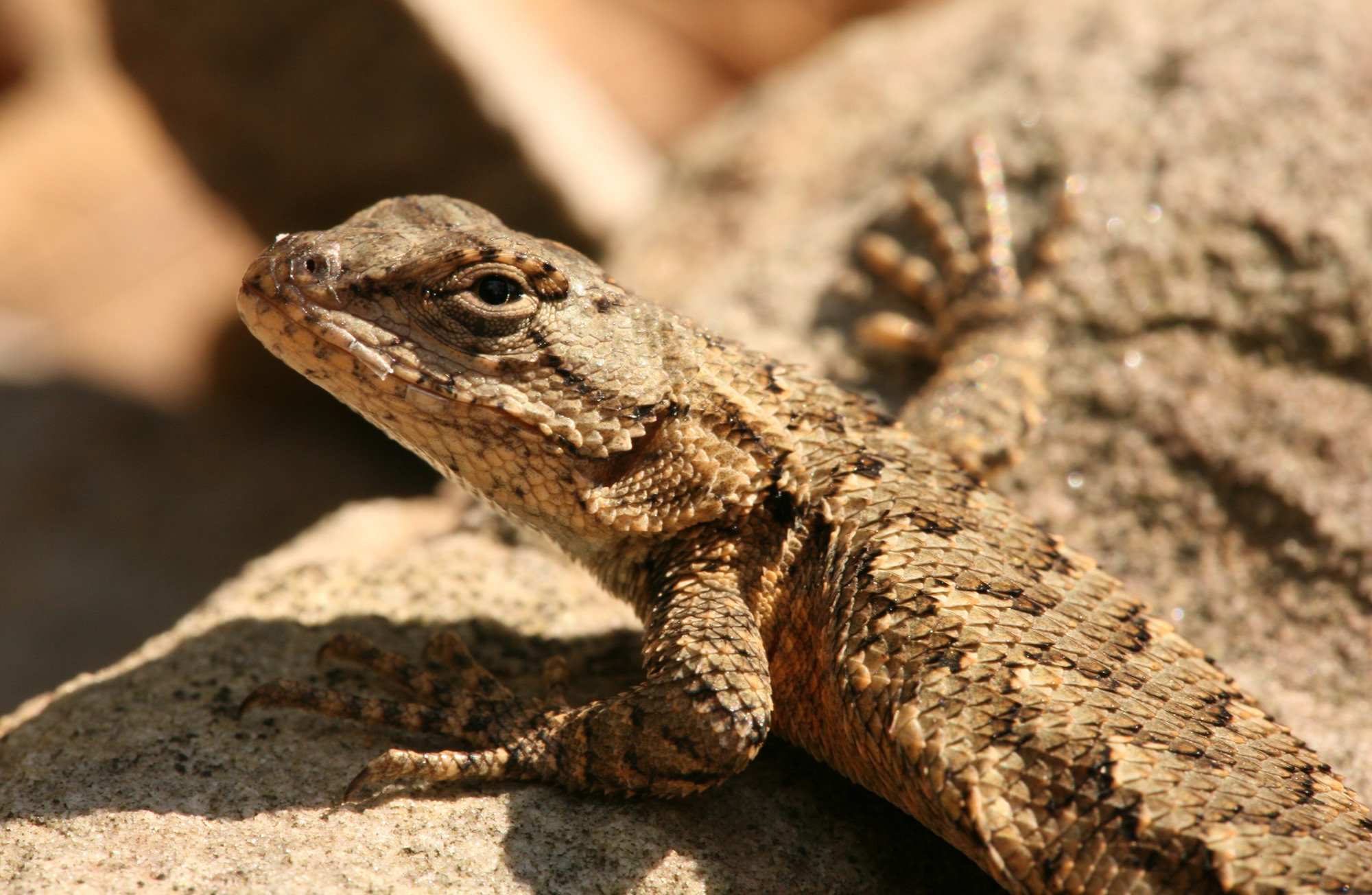
Photo Daniel Schwen (opens in a new tab) / Wikimedia Commons, CC BY-SA 4.0 (opens in a new tab)
At a glance
- Size
- About 10 to 19 cm long including the tail
- Habitat
- Dry, open woods, pine forests, woodpiles, fences and rocky places
- Diet
- Insects, spiders and other small invertebrates
- In Georgia
- Common statewide
- Rabies vector
- No
Identification
- Key marks
- Rough, spiny grey or brown scales with dark wavy bars; males have bright blue patches on the belly and throat
- Told apart from
- Skinks, which have smooth, shiny scales
- Where to look
- Basking on fence posts, logs, stumps and tree trunks, dodging round to the far side when approached
Behaviour
Fence lizards bask in the sun and dash up trees, keeping the trunk between themselves and a watcher. Males display by bobbing and doing push-ups to show their blue bellies. Where fire ants have invaded, fence lizards have evolved longer legs and new behaviour to shake the ants off.
Why they matter
Fence lizards eat many insects and are prey for snakes, birds and mammals. Their blood carries a protein that kills the bacteria causing Lyme disease in ticks that feed on them, which may lower the risk of the disease where the lizards are common.
Reproduction and lifecycle
Eggs — Usually 3 to 16, one to several clutches a year
Nest — Dug in loose, sunny soil
Incubation — About 6 to 10 weeks
Hatchlings — About 5 cm long
Maturity — In their first or second year
Lifespan — Usually a few years
Living around people
- Woodpiles and stone walls give fence lizards shelter.
- A fence lizard indoors can be herded out of a door; it is harmless.
Misconceptions
- Lizards spread disease to people. Fence lizards may even help reduce Lyme disease in ticks.
Related species
Seasonal activity
When this species is breeding, and when there are nests on the ground. Mowing during the shaded months is how most nests are found.
| Jan | Feb | Mar | Apr | May | Jun | Jul | Aug | Sep | Oct | Nov | Dec | |
|---|---|---|---|---|---|---|---|---|---|---|---|---|
| Breeding | Jan: no | Feb: no | Mar: no | Apr: no | May: no | Jun: no | Jul: no | Aug: no | Sep: no | Oct: no | Nov: no | Dec: no |
| Active nests | Jan: no | Feb: no | Mar: no | Apr: no | May: no | Jun: no | Jul: no | Aug: no | Sep: no | Oct: no | Nov: no | Dec: no |
| Notes | Sheltering; out on warm days | Out on warm days | Active | Males displaying | Breeding; laying | Laying | Laying | Hatchlings | Hatchlings | Active | Sheltering | Sheltering |
Where it lives
Recorded in 19 states and provinces. Each one links to the other animals there, and to the rehabilitators licensed for them.
If you found one
Answer a few questions and you will get a specific answer for what you are looking at.
I found an animal