
Species
Common five-lined skink
Plestiodon fasciatus
A shiny, striped lizard of woodpiles and old logs; the young have bright blue tails.
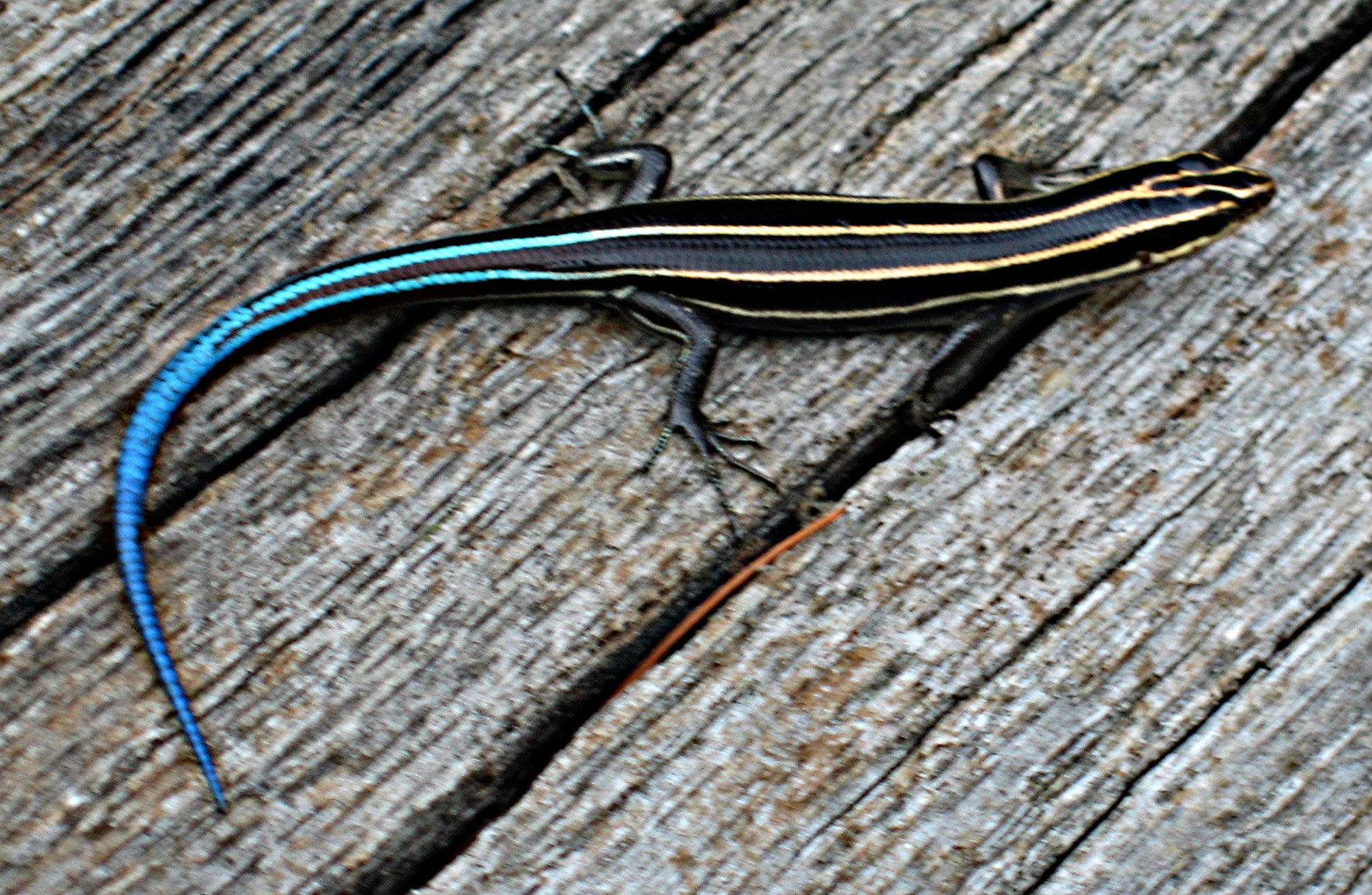
Photo Michael Holroyd (opens in a new tab) / Wikimedia Commons, Public domain (opens in a new tab)
At a glance
- Size
- About 12 to 21 cm long including the tail
- Habitat
- Damp woodland with logs, stumps, woodpiles and rock piles
- Diet
- Insects, spiders, worms and snails
- In Georgia
- Common statewide
- Rabies vector
- No
Identification
- Key marks
- Smooth, shiny scales; young are black with five cream stripes and a bright blue tail; old males turn brown with an orange-red head
- Told apart from
- Southeastern five-lined skink, which has narrower scales under the tail
- Told apart from
- Broad-headed skink, which grows larger with a much broader head
- Where to look
- On logs, stumps, decks and woodpiles on sunny days
Behaviour
Five-lined skinks forage on the ground and in rotting logs. If grabbed, a young skink can drop its bright blue tail, which keeps wriggling to hold a predator's attention while the skink escapes. Females guard their eggs, curling round them in a nest under a log.
Why they matter
Skinks eat many insects and are prey for snakes, birds and mammals. The mother's care of her eggs, rare among lizards, is one of the more surprising things about them.
Reproduction and lifecycle
Eggs — Usually 6 to 12
Nest — Under logs or in rotting wood, guarded by the female
Incubation — About 4 to 8 weeks
Hatchlings — About 5 to 6 cm long, with blue tails
Maturity — In about two years
Lifespan — Around 6 years
Living around people
- Leaving logs and woodpiles gives skinks shelter.
- Skinks are harmless; they may bite if held, without harm.
- Cats kill many skinks.
Misconceptions
- Blue-tailed skinks are venomous or "scorpions". They are harmless to people and pets.
- A cat that eats a skink will be poisoned. Skinks are not venomous; any upset is not from venom.
Related species
Seasonal activity
When this species is breeding, and when there are nests on the ground. Mowing during the shaded months is how most nests are found.
| Jan | Feb | Mar | Apr | May | Jun | Jul | Aug | Sep | Oct | Nov | Dec | |
|---|---|---|---|---|---|---|---|---|---|---|---|---|
| Breeding | Jan: no | Feb: no | Mar: no | Apr: no | May: no | Jun: no | Jul: no | Aug: no | Sep: no | Oct: no | Nov: no | Dec: no |
| Active nests | Jan: no | Feb: no | Mar: no | Apr: no | May: no | Jun: no | Jul: no | Aug: no | Sep: no | Oct: no | Nov: no | Dec: no |
| Notes | Sheltering underground | Sheltering | Emerging | Active; courtship | Breeding | Females guarding eggs | Hatching | Young with blue tails | Active | Active on warm days | Sheltering | Sheltering |
Where it lives
Recorded in 32 states and provinces. Each one links to the other animals there, and to the rehabilitators licensed for them.
United States
Canada
If you found one
Answer a few questions and you will get a specific answer for what you are looking at.
I found an animal