
Species
Green anole
Anolis carolinensis
Georgia's native anole: a small lizard that turns from green to brown and flashes a pink throat fan.
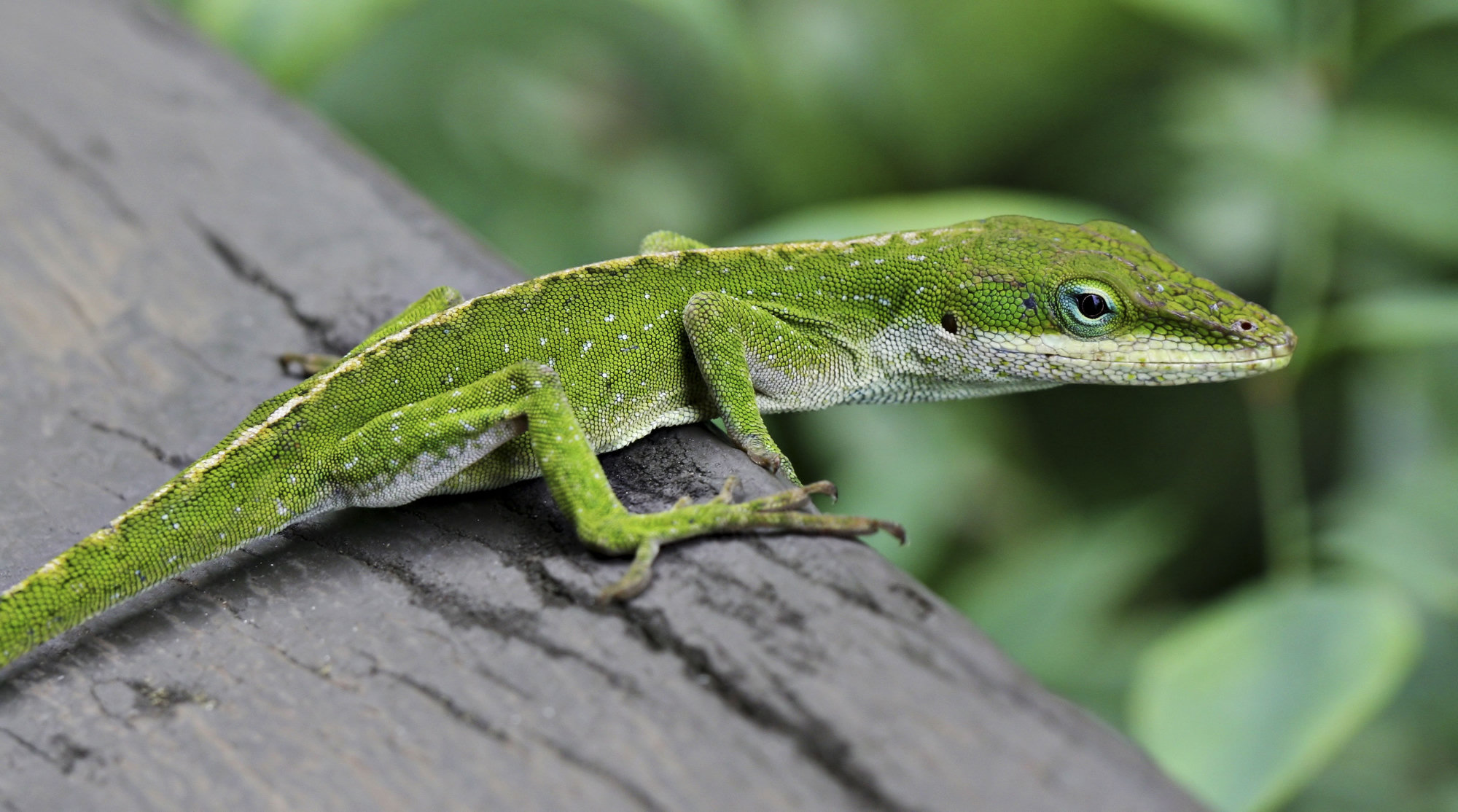
Photo Paul Hirst ( Phirst ) (opens in a new tab) / Wikimedia Commons, CC BY-SA 2.5 (opens in a new tab)
At a glance
- Size
- About 12 to 20 cm long including the tail
- Habitat
- Shrubs, vines, trees, fences and house walls
- Diet
- Insects and spiders
- In Georgia
- Common statewide, especially in the south
- Voice
- Silent
- Rabies vector
- No
Identification
- Key marks
- Slender, long-snouted lizard, bright green or brown; males extend a pink throat fan
- Told apart from
- Brown anole, which is never green, has a pattern down its back and an orange-red throat fan
- Where to look
- On shrubs, fences and walls in sun, bobbing their heads at each other
Behaviour
Green anoles change colour from bright green to brown with temperature, light and mood, not to match their background. Males defend territories by bobbing their heads and flaring their throat fans. Sticky pads on their toes let them climb smooth walls and glass. In cold weather they shelter in crevices and under bark.
Why they matter
Anoles eat huge numbers of insects, including garden pests, and are food for snakes, birds and larger lizards. Where the introduced brown anole has spread, green anoles have moved higher into the trees, a change biologists have watched happen within a few decades.
Reproduction and lifecycle
Eggs — One egg at a time, every week or two through the summer
Nest — Laid singly in moist soil, leaf litter or rotting wood
Incubation — About 5 to 7 weeks
Hatchlings — About 6 cm long and independent at once
Maturity — In their first year
Lifespan — Usually 2 to 4 years in the wild
Living around people
- Anoles on walls and windows are hunting insects and are harmless.
- Cats kill many anoles; keeping cats indoors protects them.
- An anole that has dropped its tail will grow a new one.
Misconceptions
- Anoles are chameleons. They are a different family; they change colour, but not to match their background.
- A lizard that loses its tail is badly hurt. Dropping the tail is a defence, and it grows back.
Related species
Seasonal activity
When this species is breeding, and when there are nests on the ground. Mowing during the shaded months is how most nests are found.
| Jan | Feb | Mar | Apr | May | Jun | Jul | Aug | Sep | Oct | Nov | Dec | |
|---|---|---|---|---|---|---|---|---|---|---|---|---|
| Breeding | Jan: no | Feb: no | Mar: no | Apr: no | May: no | Jun: no | Jul: no | Aug: no | Sep: no | Oct: no | Nov: no | Dec: no |
| Active nests | Jan: no | Feb: no | Mar: no | Apr: no | May: no | Jun: no | Jul: no | Aug: no | Sep: no | Oct: no | Nov: no | Dec: no |
| Notes | Sheltering; out on warm days | Out on warm days | Active | Males displaying | Breeding | Females laying | Laying | Laying ends | Hatchlings | Active | Sheltering in cold spells | Sheltering |
Where it lives
Recorded in 14 states and provinces. Each one links to the other animals there, and to the rehabilitators licensed for them.
If you found one
Answer a few questions and you will get a specific answer for what you are looking at.
I found an animal