
Species
Eastern copperhead
Agkistrodon contortrix
A beautifully patterned, well-camouflaged pit viper that would rather lie still than bite.
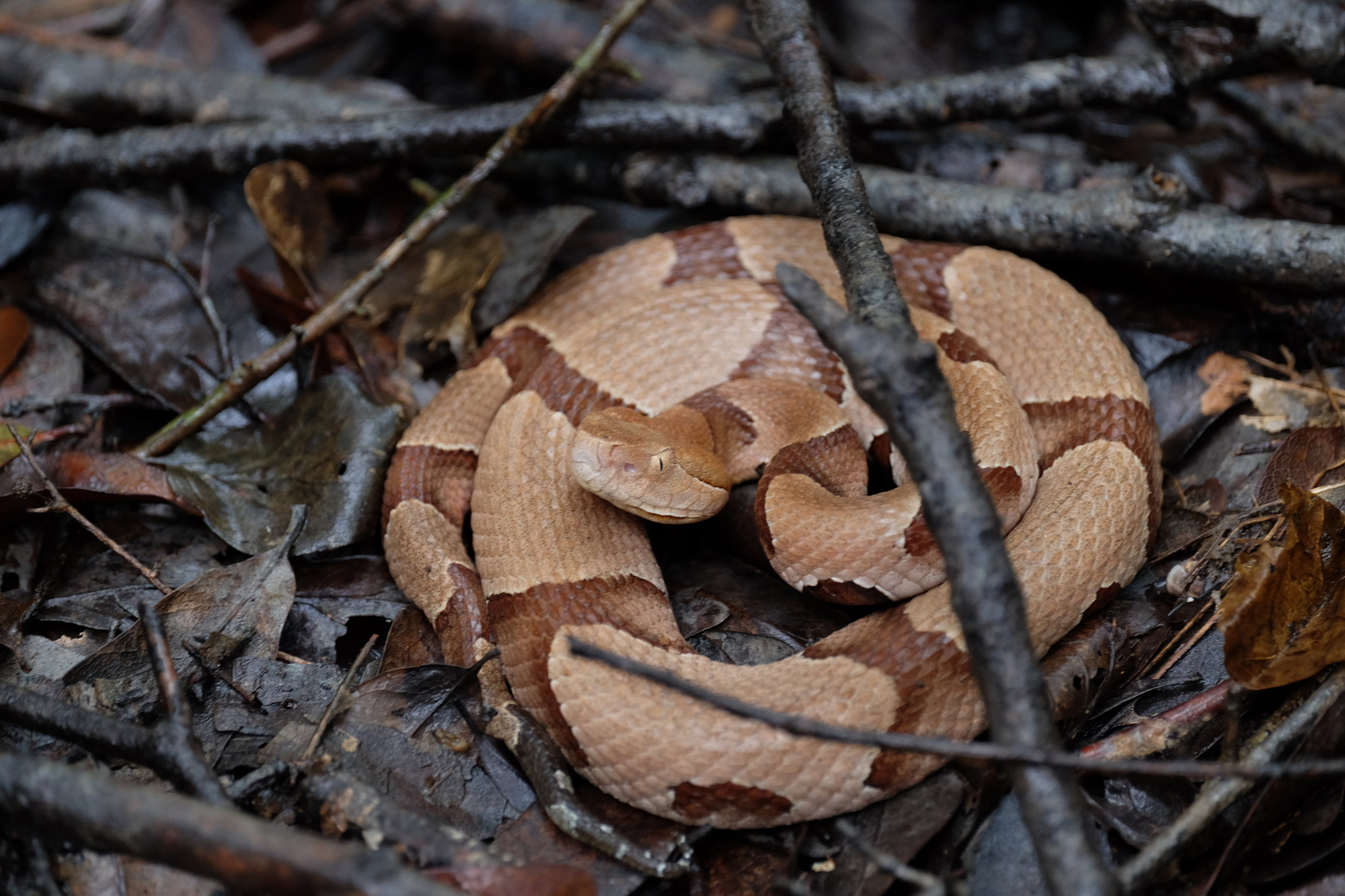
Photo Unknown photographer (opens in a new tab) / iNaturalist, CC0 1.0 (opens in a new tab)
At a glance
- Size
- Usually 60 to 90 cm long
- Habitat
- Woodland, rocky hillsides, stream edges, and wooded yards and gardens
- Diet
- Mice, voles, frogs, lizards and cicadas
- In Georgia
- Common statewide
- Venomous
- Yes
- Rabies vector
- No
Identification
- Key marks
- Coppery-tan head; pale tan body crossed by dark, hourglass-shaped bands, narrow on the back and wide on the sides; young have a yellow tail tip
- Told apart from
- Northern watersnake and corn snakes, whose bands do not pinch to an hourglass and whose heads are not coppery
- Where to look
- Coiled on leaf litter, where its pattern makes it almost invisible
Behaviour
Copperheads rely on camouflage: when a person approaches, most stay motionless rather than flee or strike, which is why people step near them without noticing. They are ambush hunters, waiting for prey to pass, and young ones wiggle their yellow tail tips to lure frogs and lizards. Most bites happen when someone steps on or picks up a snake they did not see.
Why they matter
Copperheads eat many mice and voles and are prey for kingsnakes, hawks and owls. Their venom is being studied for compounds that affect blood clotting and cancer cells. Copperhead bites are rarely fatal to people, and the snake's first choice is always to stay hidden.
Reproduction and lifecycle
Young — Born live, usually 3 to 10, in late summer
Size at birth — About 20 to 25 cm, with yellow-tipped tails
Venom — Present from birth
Maturity — At about three years
Breeding — Females usually give birth every other year
Lifespan — Often 10 years or more
Living around people
- Give a copperhead space and it will move on. Keep children and pets away while it does.
- Wear shoes outdoors at night in summer, and look before reaching into leaf litter, woodpiles or under boards.
- If someone is bitten, call 911 and get to a hospital. Keep the person calm and still; do not cut, suck, ice or tie off the bite.
- A pet that has been bitten needs a vet at once.
- If a copperhead must be moved from somewhere it cannot stay, keep everyone back and ask a licensed wildlife rehabilitator for advice rather than trying to handle it.
Misconceptions
- Copperheads are aggressive. They freeze rather than strike, and bite when stepped on or grabbed.
- Killing snakes makes a yard safe. Most bites happen to people trying to kill or handle snakes.
- Baby copperheads are more dangerous than adults. They are no more dangerous; they simply have less venom and are easier to overlook.
Related species
Seasonal activity
When this species is breeding, and when there are nests on the ground. Mowing during the shaded months is how most nests are found.
| Jan | Feb | Mar | Apr | May | Jun | Jul | Aug | Sep | Oct | Nov | Dec | |
|---|---|---|---|---|---|---|---|---|---|---|---|---|
| Breeding | Jan: no | Feb: no | Mar: no | Apr: no | May: no | Jun: no | Jul: no | Aug: no | Sep: no | Oct: no | Nov: no | Dec: no |
| Active nests | Jan: no | Feb: no | Mar: no | Apr: no | May: no | Jun: no | Jul: no | Aug: no | Sep: no | Oct: no | Nov: no | Dec: no |
| Notes | Sheltering in dens | Sheltering | Emerging on warm days | Active; basking | Active by day | Active at night in hot weather | Hunting cicadas at night | Young born | Young and adults active | Returning to dens | Sheltering | Sheltering |
Where it lives
Recorded in 28 states and provinces. Each one links to the other animals there, and to the rehabilitators licensed for them.
If you found one
Answer a few questions and you will get a specific answer for what you are looking at.
I found an animal