
Species
Common watersnake
Nerodia sipedon
A thick-bodied, harmless water snake of north Georgia's streams and ponds, often mistaken for a cottonmouth.
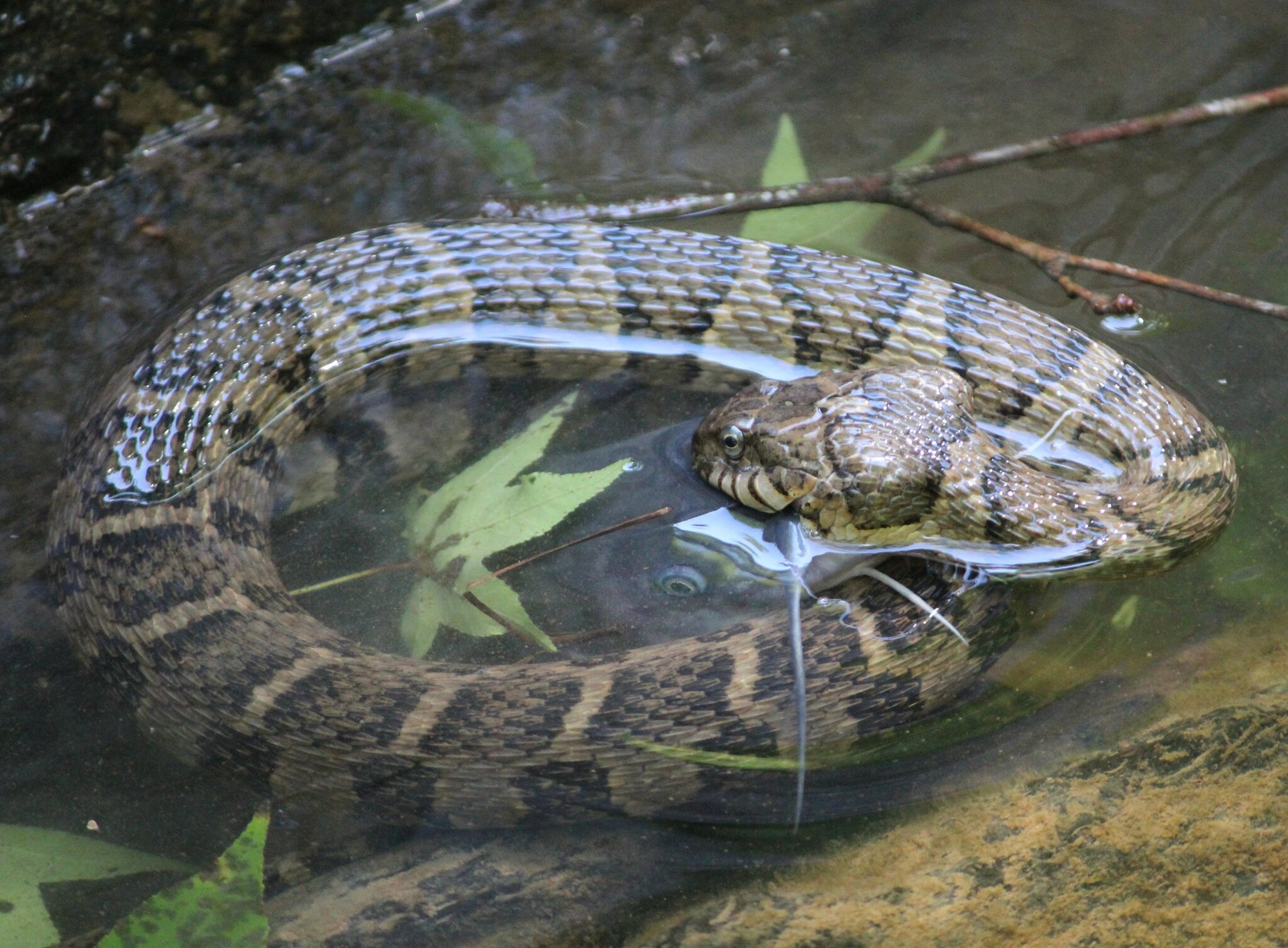
Photo Ashwin Srinivasan (opens in a new tab) / iNaturalist, CC BY 4.0 (opens in a new tab)
At a glance
- Size
- Usually 60 to 110 cm long
- Habitat
- Streams, rivers, ponds, lakes and marshes
- Diet
- Fish, frogs, salamanders and crayfish
- In Georgia
- The mountains and Piedmont
- Venomous
- No
- Rabies vector
- No
Identification
- Key marks
- Brown to grey with dark crossbands near the head breaking into blotches along the body; belly with half-moon marks; round pupils; darkens with age
- Told apart from
- Northern cottonmouth, which is heavier, has a broad head with a dark eye stripe, vertical pupils and floats high in the water
- Where to look
- Basking on rocks, logs and branches over water
Behaviour
Watersnakes hunt fish and frogs in the water and bask on branches above it, dropping in when disturbed. Cornered, they flatten their bodies, bite readily and smear musk, but they are not venomous.
Why they matter
They are important predators in streams and ponds and are prey for herons, hawks and larger snakes. Watersnakes are killed in great numbers by people who mistake them for cottonmouths.
Reproduction and lifecycle
Young — Born live, often 10 to 40
Size at birth — About 16 to 27 cm
Maturity — In about three years
Breeding — Every year
Lifespan — About 10 years
Diet shift — Young eat small fish and tadpoles
Living around people
- Watersnakes are harmless if left alone; they bite only when grabbed.
- A snake basking over a pond is almost certainly a watersnake; it will drop into the water if you step back.
Misconceptions
- Every thick snake in water is a cottonmouth. In north Georgia, most are watersnakes.
Related species
Seasonal activity
When this species is breeding, and when there are nests on the ground. Mowing during the shaded months is how most nests are found.
| Jan | Feb | Mar | Apr | May | Jun | Jul | Aug | Sep | Oct | Nov | Dec | |
|---|---|---|---|---|---|---|---|---|---|---|---|---|
| Breeding | Jan: no | Feb: no | Mar: no | Apr: no | May: no | Jun: no | Jul: no | Aug: no | Sep: no | Oct: no | Nov: no | Dec: no |
| Active nests | Jan: no | Feb: no | Mar: no | Apr: no | May: no | Jun: no | Jul: no | Aug: no | Sep: no | Oct: no | Nov: no | Dec: no |
| Notes | Sheltering | Sheltering | Emerging | Mating | Active | Active | Active | Young born | Young born | Active | Sheltering | Sheltering |
Where it lives
Recorded in 36 states and provinces. Each one links to the other animals there, and to the rehabilitators licensed for them.
United States
- Alabama
- Arkansas
- Colorado
- Connecticut
- Delaware
- District of Columbia
- Georgia
- Illinois
- Indiana
- Iowa
- Kansas
- Kentucky
- Maine
- Maryland
- Massachusetts
- Michigan
- Minnesota
- Mississippi
- Missouri
- Nebraska
- New Hampshire
- New Jersey
- New York
- North Carolina
- Ohio
- Oklahoma
- Pennsylvania
- Rhode Island
- South Carolina
- Tennessee
- Vermont
- Virginia
- West Virginia
- Wisconsin
If you found one
Answer a few questions and you will get a specific answer for what you are looking at.
I found an animal