
Species
Eastern box turtle
Terrapene carolina
A land turtle that shuts itself inside its own shell and can live more than half a century in the same patch of woods.
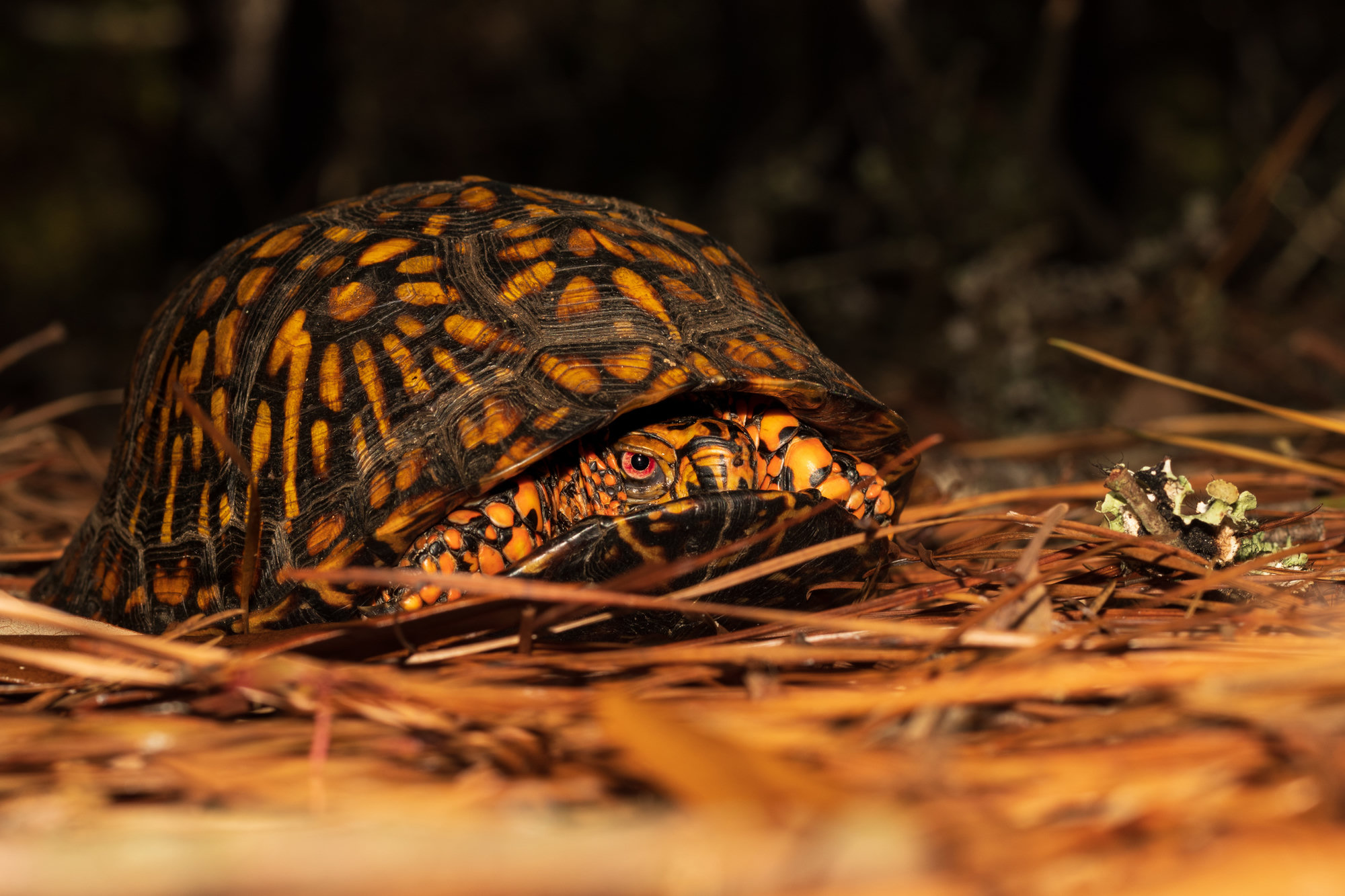
Photo Joshua Liverman (opens in a new tab) / iNaturalist, CC BY 4.0 (opens in a new tab)
At a glance
- Size
- Shell usually 11 to 17 cm long, high and domed
- Habitat
- Forests, woodland edges, old fields and gardens
- Diet
- Worms, slugs, insects, berries, mushrooms and fallen fruit
- In Georgia
- Statewide; in the far northwest it meets and interbreeds with the three-toed box turtle
- Rabies vector
- No
Identification
- Key marks
- High, domed shell with yellow or orange markings; hinged underside that closes completely; males usually have red eyes, females brown
- Told apart from
- Three-toed box turtle, which usually has three hind toes and a plainer shell
- Told apart from
- Water turtles, which have flatter shells and cannot close up completely
- Where to look
- On the forest floor and at woodland edges after rain, in gardens and crossing roads
Behaviour
A box turtle spends its life in a home range of only a few hectares, and knows it well. It is most active in the morning and after rain, and soaks in puddles in dry weather. When threatened it pulls in its head and legs and closes the hinged underside like a box. In winter it burrows into soft soil and leaf litter.
Why they matter
Box turtles eat mushrooms and fruit and spread the seeds and spores, and they eat slugs and snails in gardens. Because they breed slowly and live long, losing even a few adults each year makes a population decline, which is why road deaths and collecting have made them scarcer across the East.
Reproduction and lifecycle
Nest — Dug by the female in open soil
Eggs — Usually 3 to 6
Incubation — About 70 to 90 days
Hatchlings — About 3 cm long, secretive and rarely seen
Maturity — At 7 to 10 years
Lifespan — Often over 50 years; some pass 100
Living around people
- A box turtle crossing a road can be carried across in the direction it was heading. Never move one to a new area: turtles taken from their home range wander until they die.
- Never put a box turtle in a pond. It is a land turtle and can drown in deep water.
- Mowing high and checking long grass first saves many box turtles in summer.
Misconceptions
- A box turtle in the garden is lost. It is almost certainly inside its home range and knows its way.
- Turtles can leave their shells. The shell is part of the skeleton, joined to the spine and ribs.
Related species
Seasonal activity
When this species is breeding, and when there are nests on the ground. Mowing during the shaded months is how most nests are found.
| Jan | Feb | Mar | Apr | May | Jun | Jul | Aug | Sep | Oct | Nov | Dec | |
|---|---|---|---|---|---|---|---|---|---|---|---|---|
| Breeding | Jan: no | Feb: no | Mar: no | Apr: no | May: no | Jun: no | Jul: no | Aug: no | Sep: no | Oct: no | Nov: no | Dec: no |
| Active nests | Jan: no | Feb: no | Mar: no | Apr: no | May: no | Jun: no | Jul: no | Aug: no | Sep: no | Oct: no | Nov: no | Dec: no |
| Notes | Buried in soil and leaf litter | Buried | Emerging on warm days | Active; courtship | Nesting | Nesting; most road crossings | Active after rain | Hatching begins | Hatchlings emerge or stay in the nest | Feeding before winter | Burrowing in | Buried |
Where it lives
Recorded in 24 states and provinces. Each one links to the other animals there, and to the rehabilitators licensed for them.
If you found one
Answer a few questions and you will get a specific answer for what you are looking at.
I found an animal