
Species
Common nighthawk
Chordeiles minor
A long-winged twilight flier that catches insects over towns and nests on flat gravel roofs.
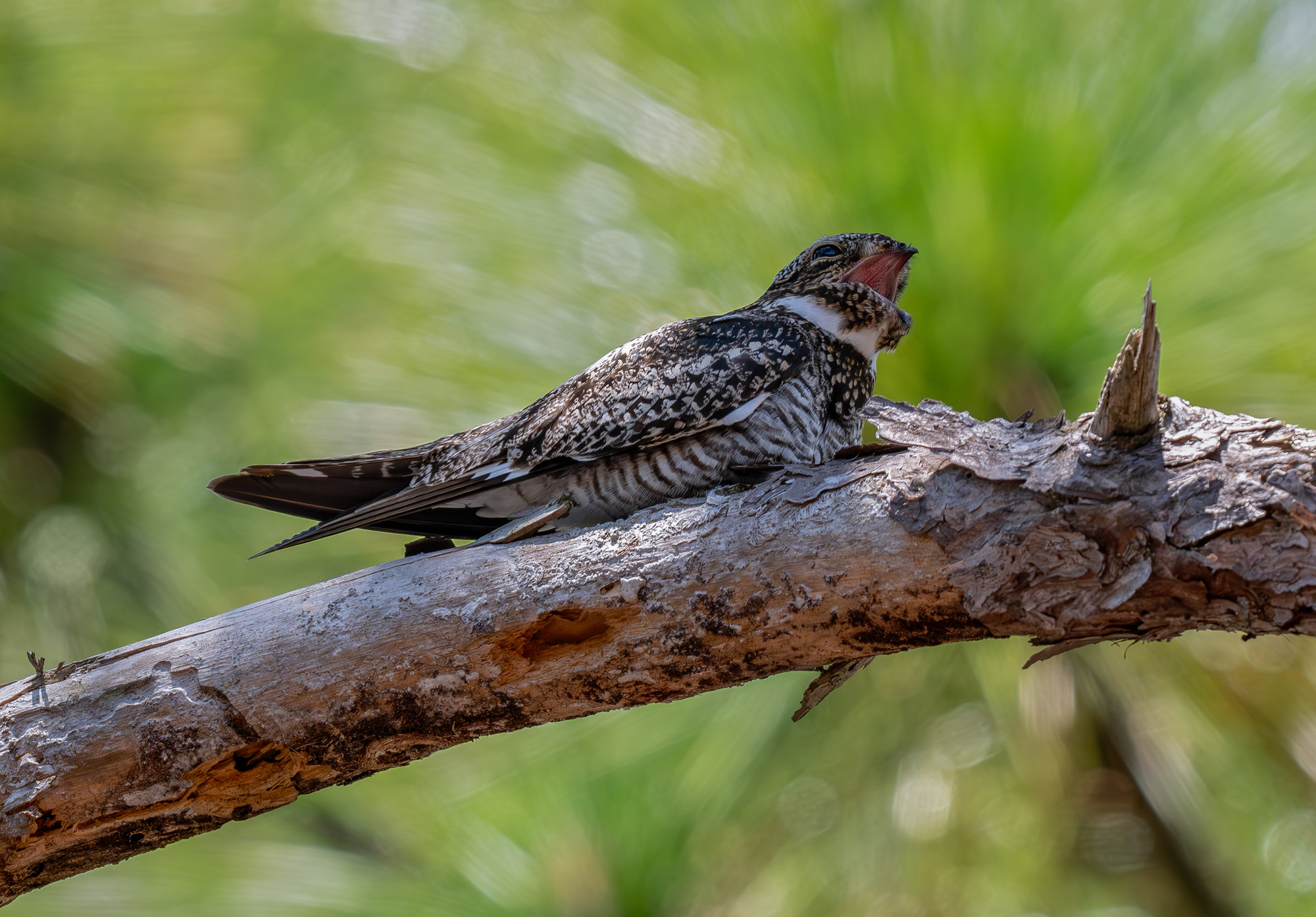
Photo Karen Szafrajda (opens in a new tab) / iNaturalist, CC BY 4.0 (opens in a new tab)
At a glance
- Size
- About 22 to 25 cm long; wingspan about 55 cm
- Weight
- About 55 to 100 g
- Habitat
- Open country, towns, fields and burned pine woods
- Diet
- Flying insects, especially beetles, moths and flying ants
- In Georgia
- A summer resident and common migrant, April to October
- Voice
- A nasal "peent" in flight; males dive with a booming wing-sound
- Rabies vector
- No
Identification
- Key marks
- Long, pointed wings with a bold white bar near the tips; grey-brown mottled body; notched tail; flies with erratic, bounding wingbeats
- Told apart from
- Chuck-will's-widow and whip-poor-will, which have rounded wings with no white bar and fly low at night
- Told apart from
- Chimney swift, which is much smaller with shorter, curved wings
- Where to look
- Over towns and fields at dusk; large migrating flocks in late August and September
Behaviour
Nighthawks hunt at dawn and dusk, catching insects in flight with their wide mouths. Males court by diving towards the ground and pulling up sharply, the air through their wings making a loud "boom".
They nest on bare ground or on flat gravel rooftops, laying eggs directly on the surface.
Why they matter
Common nighthawks eat vast numbers of flying insects, and one migrating flock can include hundreds of birds. They have declined sharply across North America, partly because gravel roofs are being replaced by smooth membranes that do not suit nesting, and partly because insect numbers have fallen.
Reproduction and lifecycle
Nest — No nest; eggs laid on bare gravel, sand or rock, or a flat gravel roof
Eggs — Usually two
Incubation — About 16 to 20 days
Chicks — Covered in down, able to move short distances soon after hatching
Flight — At about three weeks
Lifespan — Wild birds over nine years are recorded
Living around people
- A nighthawk on a flat roof or gravel car park in summer may be sitting on eggs; leaving it be for a few weeks is enough.
- A nighthawk sitting still on the ground is not necessarily injured; they rest on the ground and on branches, lying along them rather than across.
- Grounded nighthawks cannot easily take off from flat surfaces if hurt or cold; a rehabilitator can help.
Misconceptions
- Nighthawks are hawks. They are nightjars, related to whip-poor-wills, and eat only insects.
- A bird lying flat on gravel is dead or dying. Nighthawks rest flat and rely on camouflage.
Related species
Seasonal activity
When this species is breeding, and when there are nests on the ground. Mowing during the shaded months is how most nests are found.
| Jan | Feb | Mar | Apr | May | Jun | Jul | Aug | Sep | Oct | Nov | Dec | |
|---|---|---|---|---|---|---|---|---|---|---|---|---|
| Breeding | Jan: no | Feb: no | Mar: no | Apr: no | May: no | Jun: no | Jul: no | Aug: no | Sep: no | Oct: no | Nov: no | Dec: no |
| Active nests | Jan: no | Feb: no | Mar: no | Apr: no | May: no | Jun: no | Jul: no | Aug: no | Sep: no | Oct: no | Nov: no | Dec: no |
| Notes | In South America | In South America | In South America | Arriving late in the month | Males diving and booming | Nesting on the ground and rooftops | Young fledging | Migrating flocks begin | Peak migration | Last birds leaving | In South America | In South America |
Where it lives
Recorded in 71 states and provinces. Each one links to the other animals there, and to the rehabilitators licensed for them.
United States
- Alabamabreeding
- Alaskabreeding
- Arizonabreeding
- Arkansasbreeding
- Californiabreeding
- Coloradobreeding
- Connecticutpassing through
- Delawarebreeding
- District of Columbiapassing through
- Floridabreeding
- Georgiabreeding
- Idahobreeding
- Illinoisbreeding
- Indianabreeding
- Iowabreeding
- Kansasbreeding
- Kentuckybreeding
- Louisianabreeding
- Mainebreeding
- Marylandbreeding
- Massachusettsbreeding
- Michiganbreeding
- Minnesotabreeding
- Mississippibreeding
- Missouribreeding
- Montanabreeding
- Nebraskabreeding
- Nevadabreeding
- New Hampshirebreeding
- New Jerseybreeding
- New Mexicobreeding
- New Yorkbreeding
- North Carolinabreeding
- North Dakotabreeding
- Ohiobreeding
- Oklahomabreeding
- Oregonbreeding
- Pennsylvaniabreeding
- Rhode Islandpassing through
- South Carolinabreeding
- South Dakotabreeding
- Tennesseebreeding
- Texasbreeding
- Utahbreeding
- Vermontpassing through
- Virginiabreeding
- Washingtonbreeding
- West Virginiabreeding
- Wisconsinbreeding
- Wyomingbreeding
Canada
If you found one
Answer a few questions and you will get a specific answer for what you are looking at.
I found an animal