
Species
Chuck-will's-widow
Antrostomus carolinensis
The largest nightjar in North America, whose name is its call, repeated through southern summer nights.
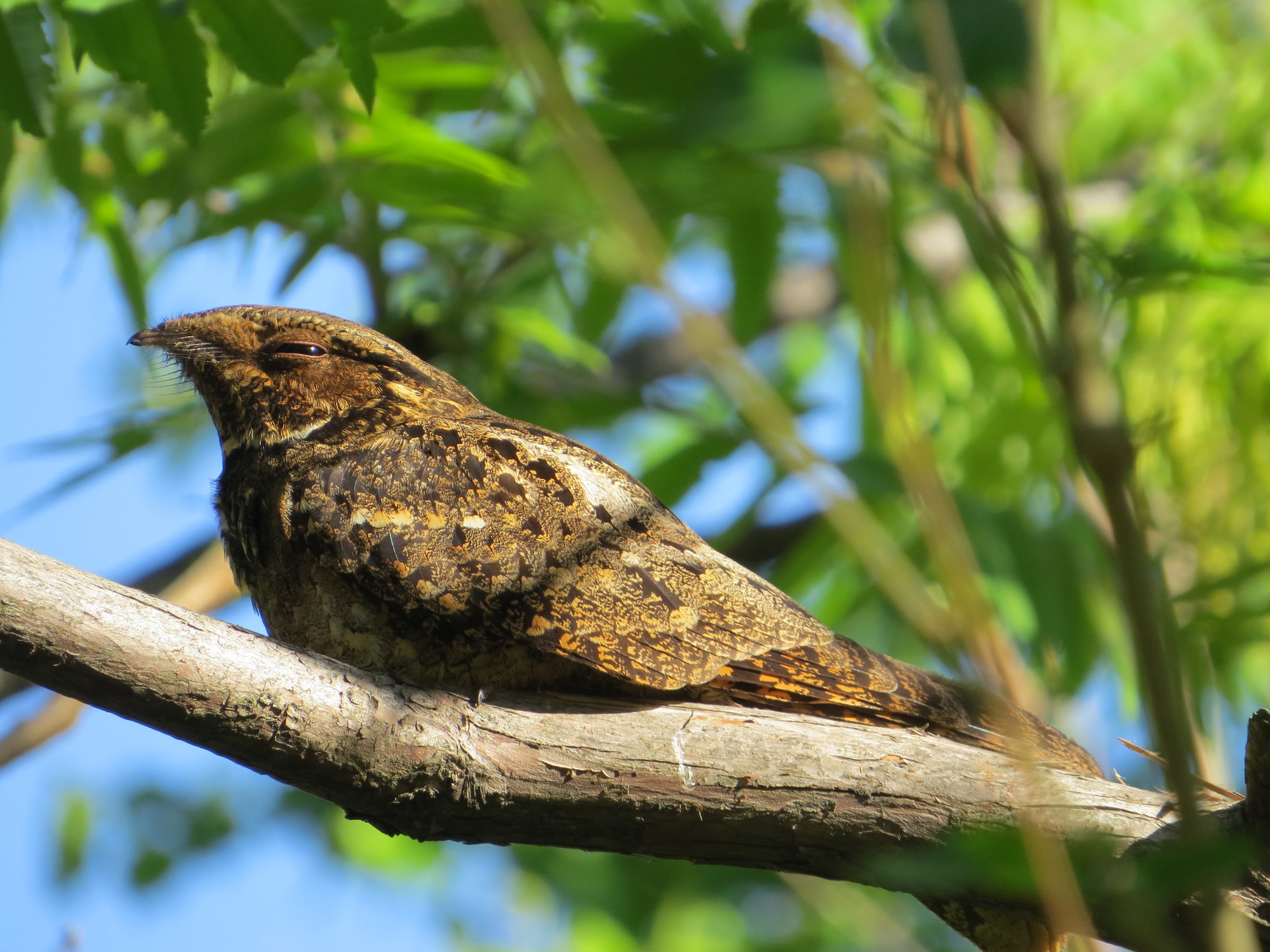
Photo Unknown photographer (opens in a new tab) / iNaturalist, CC0 1.0 (opens in a new tab)
At a glance
- Size
- About 28 to 32 cm long
- Weight
- About 95 to 190 g
- Habitat
- Pine and oak woods, woodland edges and forested neighbourhoods
- Diet
- Large flying insects such as moths and beetles; occasionally small birds
- In Georgia
- A common summer resident, April to September
- Voice
- A loud, repeated "chuck-WILL'S-WID-ow", mostly at dusk and dawn
- Rabies vector
- No
Identification
- Key marks
- Large, cryptic brown and buff bird; huge mouth; rounded wings; males show white on the inner tail feathers
- Told apart from
- Eastern whip-poor-will, which is smaller and greyer with a faster call
- Told apart from
- Common nighthawk, which has pointed wings with a white bar
- Where to look
- Heard at dusk from woods; sometimes seen on roads at night, eyes shining red in headlights
Behaviour
Chuck-will's-widows hunt from perches and by flying low through open woods, taking moths and beetles in their wide mouths. By day they rest on the ground or along a branch, hidden by their bark-like colours.
Why they matter
These nightjars eat large moths and beetles at night, and their call is one of the defining sounds of a southern summer. They have declined in many areas, possibly because of fewer large insects and the loss of open woods.
Reproduction and lifecycle
Nest — No nest; eggs laid on leaf litter on the forest floor
Eggs — Usually two
Incubation — About 20 days
Chicks — Downy and able to shuffle short distances soon after hatching
Flight — At about two to three weeks
Lifespan — Several years
Living around people
- Nightjars rest on quiet roads at night and are often hit by cars; driving slowly on wooded roads after dark helps.
- A nightjar on the ground in the day is usually resting on its nest or roost and relying on camouflage.
Misconceptions
- Every nightjar call is a whip-poor-will. In most of Georgia the calling bird is the chuck-will's-widow.
- Goatsuckers drink milk from goats. The old name comes from a myth; they eat insects.
Related species
Seasonal activity
When this species is breeding, and when there are nests on the ground. Mowing during the shaded months is how most nests are found.
| Jan | Feb | Mar | Apr | May | Jun | Jul | Aug | Sep | Oct | Nov | Dec | |
|---|---|---|---|---|---|---|---|---|---|---|---|---|
| Breeding | Jan: no | Feb: no | Mar: no | Apr: no | May: no | Jun: no | Jul: no | Aug: no | Sep: no | Oct: no | Nov: no | Dec: no |
| Active nests | Jan: no | Feb: no | Mar: no | Apr: no | May: no | Jun: no | Jul: no | Aug: no | Sep: no | Oct: no | Nov: no | Dec: no |
| Notes | In Central America and the Caribbean | In the tropics | First arrivals in south Georgia | Arriving; calling begins | Nesting | Nesting; calling at its peak | Young fledging | Calling fades | Migrating south | Last birds leaving | In the tropics | In the tropics |
Where it lives
Recorded in 35 states and provinces. Each one links to the other animals there, and to the rehabilitators licensed for them.
United States
- Alabamabreeding
- Arkansasbreeding
- Delawarebreeding
- Floridabreeding
- Georgiabreeding
- Illinoisbreeding
- Indianabreeding
- Iowabreeding
- Kansasbreeding
- Kentuckybreeding
- Louisiana
- Mainebreeding
- Marylandbreeding
- Massachusettsbreeding
- Michiganbreeding
- Mississippibreeding
- Missouribreeding
- Nebraskabreeding
- New Jerseybreeding
- New Yorkbreeding
- North Carolinabreeding
- Ohiobreeding
- Oklahomabreeding
- Pennsylvaniabreeding
- Rhode Islandbreeding
- South Carolinabreeding
- Tennesseebreeding
- Texasbreeding
- Virginiabreeding
- West Virginiabreeding
- Wisconsinbreeding
If you found one
Answer a few questions and you will get a specific answer for what you are looking at.
I found an animal