
Species
Black skimmer
Rynchops niger
A black-and-white seabird whose lower bill is longer than the upper, used to slice the water for fish.
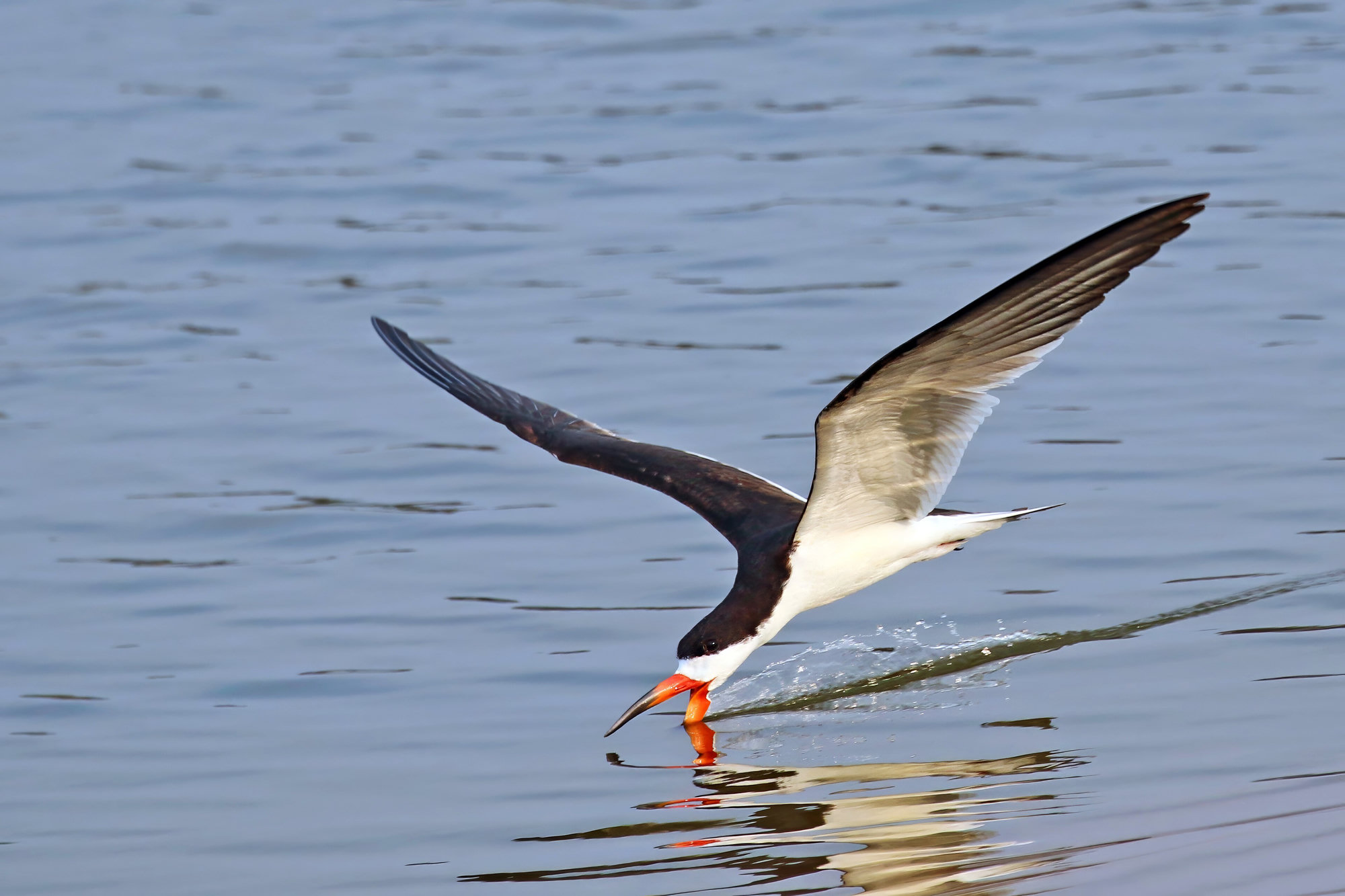
Photo Charles J. Sharp (opens in a new tab) / Wikimedia Commons, CC BY-SA 4.0 (opens in a new tab)
At a glance
- Size
- About 40 to 50 cm long; wingspan about 1.1 to 1.3 m
- Weight
- About 250 to 400 g
- Habitat
- Beaches, sandbars, inlets and calm coastal waters
- Diet
- Small fish
- In Georgia
- Common on the coast all year; nests in colonies on beaches
- Voice
- A soft, dog-like barking
- Rabies vector
- No
Identification
- Key marks
- Black above, white below; red-and-black bill with the lower half longer than the upper; short red legs
- Told apart from
- American oystercatcher, which has a thick orange bill and brown back
- Where to look
- Sandbars and calm water at dawn and dusk
Behaviour
Skimmers fly low with the lower bill slicing the water; when it touches a fish, the bill snaps shut. They feed mostly at dawn, dusk and night, and their pupils close to vertical slits in bright light, like a cat's.
Why they matter
The black skimmer is the only bird in the Americas that feeds by skimming. It nests on open beaches and sandbars, and its colonies are easily disturbed, making it a measure of how well beaches are shared with nesting birds.
Reproduction and lifecycle
Nest — A scrape in sand in colonies, often with terns
Eggs — Usually three to five
Incubation — About 21 to 25 days
Chicks — Fed by both parents; bills start equal and the lower grows longer as they age
Flight — At about four weeks
Lifespan — Wild birds over twenty years are recorded
Living around people
- Skimmer colonies on beaches are easily disturbed; posted areas protect them.
- Driving on beaches destroys eggs and chicks.
Misconceptions
- The unequal bill is a deformity. It is the skimmer's feeding tool.
Related species
Seasonal activity
When this species is breeding, and when there are nests on the ground. Mowing during the shaded months is how most nests are found.
| Jan | Feb | Mar | Apr | May | Jun | Jul | Aug | Sep | Oct | Nov | Dec | |
|---|---|---|---|---|---|---|---|---|---|---|---|---|
| Breeding | Jan: no | Feb: no | Mar: no | Apr: no | May: no | Jun: no | Jul: no | Aug: no | Sep: no | Oct: no | Nov: no | Dec: no |
| Active nests | Jan: no | Feb: no | Mar: no | Apr: no | May: no | Jun: no | Jul: no | Aug: no | Sep: no | Oct: no | Nov: no | Dec: no |
| Notes | Wintering flocks | Flocks | Flocks | Pairs forming | Nesting | Nesting | Chicks | Young flying | Flocks | Flocks | Flocks | Flocks |
Where it lives
Recorded in 35 states and provinces. Each one links to the other animals there, and to the rehabilitators licensed for them.
United States
Canada
If you found one
Answer a few questions and you will get a specific answer for what you are looking at.
I found an animal